- Once on the brink of extinction, Kashmir’s aromatic Mushq Budji rice is witnessing a revival through scientific intervention.
- Scientists have developed disease-resistant Mushq Budji using marker-assisted selection. The new variety retains the rice’s exclusivity.
- Farmers are returning to cultivating Mushq Budji, but face challenges with marketing and milling.
For years, many farmers across Kashmir had gradually stopped growing Mushq Budji, the region’s prized aromatic rice, after frequent outbreaks of blast disease made the crop too risky and expensive to maintain. But in the fields today, the tide is slowly beginning to turn.
Mushq Budji is a premium traditional rice variety native to the Kashmir Himalayas. It grows at an altitude of 1,600-1,800 metres above sea level and has a short, bold, translucent, and highly aromatic grain. It is especially prized as the preferred rice for Wazwan, the valley’s famed traditional feast. In 2023, the rice variety also received a Geographical Indication (GI) tag, protecting its authenticity and regional heritage.
However, Mushq Budji faced a major challenge. It was highly susceptible to blast disease, a fungal infection that can infect all above-ground parts of the plant, causing lesions on leaves, stems, and panicles and leading to total crop failure. Moreover, changing weather patterns worsened disease outbreaks. This disease had become so serious that the variety was almost on the verge of extinction.
The rice blast disease outbreak in Mushq Budji rice began in the early 1960s. Its cultivation began to decline from 1980 onwards, reaching its lowest level in 2000. “We worked specifically on addressing this issue. The SKUAST-Kashmir launched a revival programme in 2007. It is considered a rare case where a traditional farmers’ variety was genetically improved and saved from extinction,” Asif Bashir Shikari, Professor, Genetics and Plant Breeding at SKAUST-Kashmir, says.
Developing disease-resistant rice
The researchers used marker-assisted selection to develop the improved, disease-resistant Mushq Budji variety. In this procedure, it is possible to select useful traits, such as disease resistance or improved nutrition, within the same crop species and combine them through conventional breeding without altering the original genetic background. This way, the crop maintains its identity and taste while becoming healthier and more resilient.
In India, marker-assisted selection for disease resistance began in the early 2000s, with the first improved crop variety released in 2007. It was done in crops like rice, wheat, and maize. The results included the release of rice varieties resistant to diseases like bacterial blight (e.g., Improved PB-1 and Improved Pusa Basmati-1), a maize hybrid (Vivek QPM9) with improved nutritional content, and a pearl millet hybrid (HHB-67-2) resistant to downy mildew. These efforts aimed to develop climate-resilient and higher-quality crops more quickly than traditional methods.
According to Shikari, the researchers at SKUAST-Kashmir took 10 years to develop two versions of Mushq Budji: SKUA-485, which has three genes that protect the plant against blast disease, and SKUA-528, which has two such genes.
Although these new rice varieties were not explicitly designed for weather-related tolerance, they still retain essential traits of the traditional Mushq Budji, such as cold tolerance. “They are also shorter and stronger, which means they do not fall over easily during strong winds or heavy late-season rains. The presence of genes responsible for cold tolerance, early maturity, and other adaptive traits was confirmed through genome sequencing,” Zahoor Ahmad Dar, Professor of Genetics and Plant Breeding at SKUAST-Kashmir, says. Genome sequencing involves reading a plant’s complete DNA code to identify the genes responsible for specific traits.
To evaluate the success rate of the improved Mushq Budji variety, it has been tested in farmers’ fields across many districts, including Anantnag, Shumnag, Kupwara, and Beerwah (Budgam). “During unusually warm and humid periods — the conditions that make blast disease worse in the old variety — the improved version performed much better because of its disease resistance. We visited farmers in several districts, and they gave very positive feedback. The research team is hopeful that the area under the new variety will continue to grow,” Dar says.

That said, there are several challenges towards developing this variety as it is a highly technical and demanding job. “At one time, our team had to manage lakhs of cross-bred plants, conduct many field trials, perform DNA-based laboratory tests, and check cooking quality. In the beginning, we struggled with poor laboratory facilities, but later we improved our labs using funding from the Department of Biotechnology, Government of India, and through the Holistic Agriculture Development Program (HADP), Government of J&K,” Shikari say.
When asked whether the improved seeds of this variety are readily available and what is needed to increase their use among small farmers, the research team explained that this season they have produced two quintals of breeder seed of the improved Mushq Budji. “We have further multiplied the foundation seed at Mountain Research Centre for Field Crops, Khudwani, a research and development centre under the SKUAST-K.
Breeder seed is the first and most genetically pure seed produced by scientists who develop a variety. It is used to produce foundation seed, which is then multiplied further to generate certified seed for farmers.
Meanwhile, in a study published in 2024, scientists at SKUAST-Kashmir have also shown that Mushq Budji’s prized aroma is closely linked to altitude and temperature. In a study analysing rice samples from eight locations across the valley, ranging from about 1,500 to 2,000 metres, researchers identified nearly 35 aromatic compounds that together shape its distinctive fragrance. “We found that rice grown at higher altitudes had a richer and more complex aroma profile, with key fragrance compounds more abundant in cooler locations. Notably, 2-acetyl-1-pyrroline (2-AP), a compound commonly associated with aromatic rice, was detected mainly in samples from higher-altitude areas such as Budgam and Kupwara, suggesting that Mushq Budji’s aroma is shaped as much by its environment as by its genetics,” Syed Zameer Hussain, Professor at Division of Food Science and Technology, SKUAST, Kashmir and corresponding author of the study, said.
Farmers reclaim a lost grain
Zafar Ahmad Bhat, a farmer from Sagam village in Anantnag district, owns 19 kanals (0.96 ha) of land under rice cultivation. Of this, he grows the improved variety of Mushq Budji on 11 kanals (0.56 ha), while the rest of the land is used for other rice varieties such as SR-4 (Shalimar Rice-4) and K39.
“My family has been growing rice for many generations. We last cultivated the traditional Mushq Budji in 1980, but frequent disease outbreaks reduced the yield, so we stopped growing it,” he says.

In 2012, Bhat first heard about the improved variety of Mushq Budji. Scientists from SKUAST-Kashmir visited his village and held an awareness programme, during which they explained the importance of the crop and new cultivation methods. Farmers were given one kg of improved Mushq Budji seeds for field trials. “That is how my journey with Mushq Budji started again,” Bhat recalls.
The results were encouraging. The crop matured on time, and no fungicides were used. From one kanal (0.05 ha) of land, Bhat harvested 2.5 quintals of Mushq Budji, while common rice varieties yield about five quintals per kanal. However, Mushq Budji sells at a much higher price — ₹10,000 to 15,000 per quintal compared to ₹3,200 for regular rice.
A similar story comes from Kulgam district, where Ghulam Rasool, a farmer, grows the improved Mushq Budji on one kanal (0.05 ha) of land. He now plans to expand the area under the crop. “At first, I was worried that rice blast disease would damage the new variety too. But after attending awareness programmes and learning the new farming techniques, I felt confident,” he says.
He explains that traditional rice varieties are planted with a gap of only three to four centimetres between seedlings, which reduces sunlight as the plants shade each other. For the improved Mushq Budji, farmers leave a gap of about one square foot between seedlings. This allows more sunlight to reach the plants and helps the soil retain heat, improving crop health and preventing rice blast.
Pleased with the results, Ghulam Rasool now plans to grow Mushq Budji on five kanals (0.25 ha) of land. “This new variety has given me confidence to expand cultivation and grow it for commercial sale,” he says.

According to official documents accessed by Mongabay-India, seed production has expanded steadily over the past three years. The area under cultivation increased from about 250 ha in 2022–23 to an estimated 1,000 ha by 2025, while production is projected to rise from around 600 tonnes to about 2,500 tonnes over the same period.
Despite these successes, farmers face challenges. Marketing remains weak, with demand mostly limited to local consumers. National and international demand is still low. “Last year, the Department of Agriculture distributed Mushq Budji seeds in almost every district under the HADP programme, which increased production manifold. But due to fewer consumers, around 20% of farmers still have unsold stock,” Bhat claims.
Another significant issue is rice milling. “Local mills often produce broken grains, with nearly 20% of the rice breaking during processing. In contrast, basmati rice brought from outside the region is usually full grain. These are some of the challenges that we are facing,” he says.
To address these problems, SKAUST-K and the Jammu & Kashmir Department of Agriculture, in collaboration with the Agricultural and Processed Food Products Export Development Authority (APEDA), have started exploring export opportunities for Mushq Budji rice to Japan and Southeast Asian countries.
“The rice was showcased at the International Trade Fair 2025 in New Delhi, where international chefs praised its quality and suitability for global cuisines. The initiative aims to create new markets beyond Kashmir and ensure better and more stable incomes for farmers,” Asif Shikari says.
Read more: Indoor saffron farming offers hope amidst declining saffron production
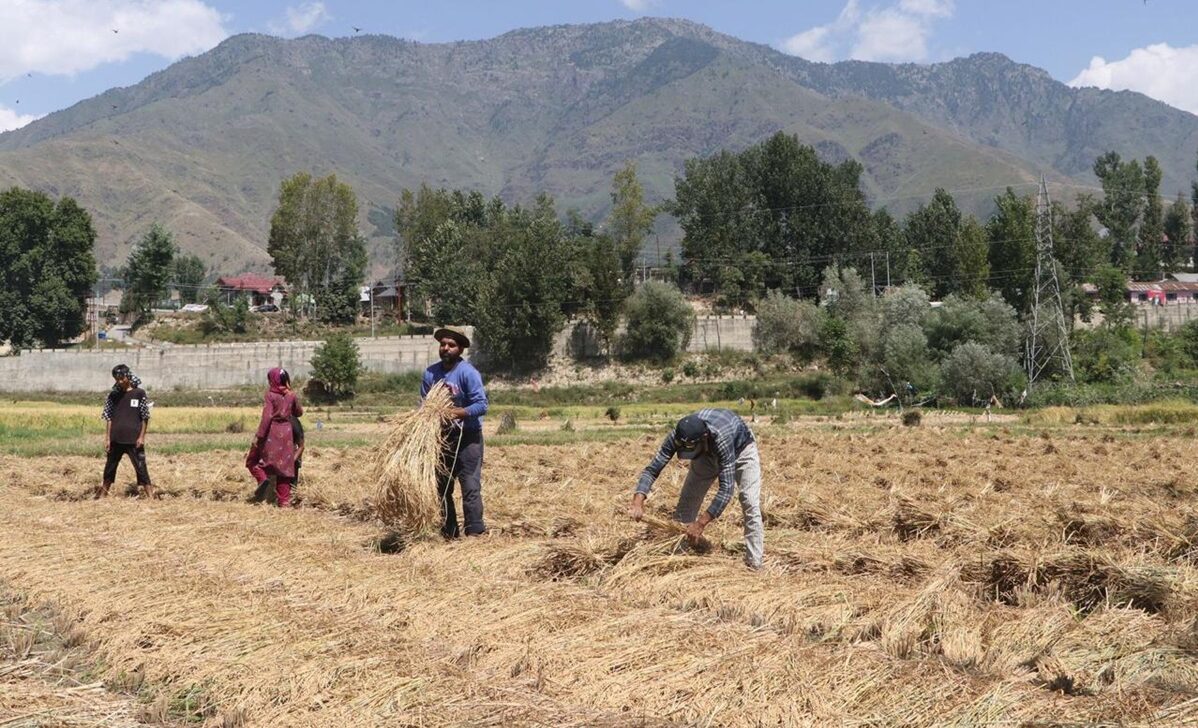
Banner image: Farmers gather freshly harvested Mushk Budji, a rice variety that nearly disappeared due to blast disease before recent revival efforts by SKUAST-Kashmir. Image by Hirra Azmat.