- Researchers have scientifically described a new species of fishing spider from a stream in Kerala.
- The fishing spider requires stringent conditions for survival that include pristine, slow-moving waters, making the spiders important bioindicators that reflect the health of an ecosystem.
- The new record highlights the yet unknown diversity of spiders in the Western Ghats, and the need for improving funding and involving citizen scientists in identifying undiscovered species.
Arjun Cherukutty, a research intern, learned about fishing spiders — large, semi-aquatic arachnids — during a discussion with an expert. Cherukutty, who worked with entomologist Jithu Unni Krishnan at the Kerala Forest Research Institute (KFRI), saw these spiders, soon after, on a field trip to the evergreen rainforests of the Western Ghats near Wayanad, Kerala. At that time, the team did not have the permissions to collect specimens from the wild for research. But six months later the spiders were seen again in an ecotourism resort in Wayanad. At the resort, the owner David Raju, a citizen scientist, naturalist, and author helped the team collect specimens of the fishing spiders to study.
While the spiders are solitary organisms, they were found in dozens near the stream. This could be because the fragmented habitat provided a microniche for all the spiders found in the region. It also indicates the effectiveness in conserving the ecotourism spot.
Cherukutty collected the spiders from both sexes, and along with Krishnan, conducted a detailed study of the new species, which is now named Dolomedes indicus sp. nov. The spider had been observed in some parts of India previously; the present study marks the first formal taxonomic description from India.
Adapted to fish and swim
Fishing or raft spiders have stringent survival conditions. They are mostly found along pristine, slow-moving water streams, within a temperature range of 18-24℃. Unlike other spiders that weave a web, fishing spiders spin a single silk thread with which they keep themselves anchored to small rocks, leaves, or twigs near the stream.
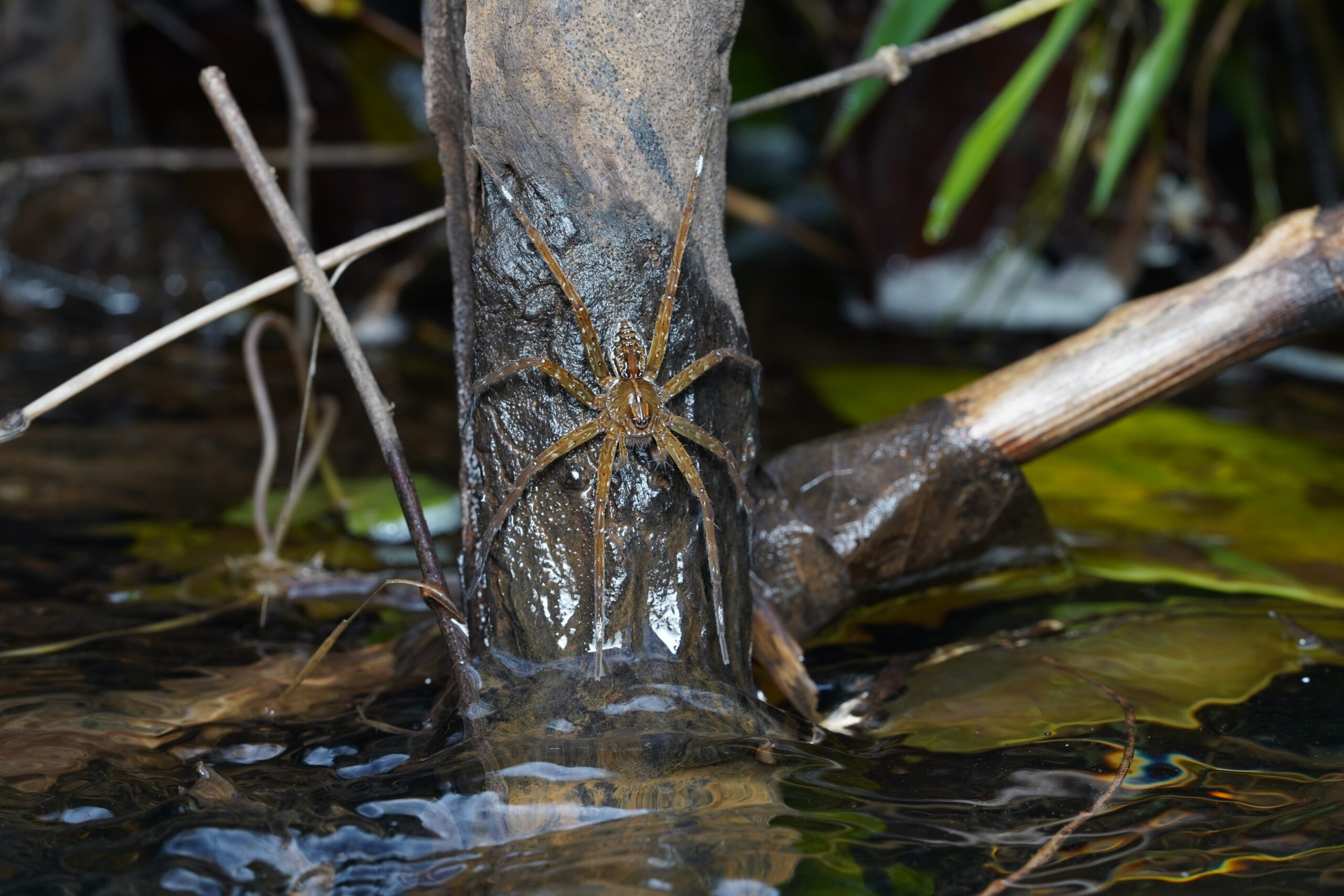
On a rock, the spider with its greenish-brown colours blends perfectly with the background. Fully grown adult males measure up to 13 cm, while females measure slightly longer, with a length of around 16 cm. In males, the dorsal front half of the body appears snow white, while in females, white spots are present along the carapace, which is the hard covering on top of the head, and a part of the face. The eyes and the hairy body of the fishing spiders help them adapt to the semi-aquatic habitat, enabling the spider to walk, catch prey, and breathe when underwater.
The fishing spiders are ambush predators and contain an additional pair of appendages called pedipalps that look like boxing gloves. In females, pedipalps assist in moving, capturing prey, and feeding, while in males, the pedipalps are sexual organs in which the males store and release sperm while mating.
With pedipalps in the water, the fishing spider senses the presence of prey through subtle movements such as ripples in the slow-moving water. “It then plunges into the water, grabs a fish, and then carries the prey back to its original position,” Krishnan said. He refers to the silk thread as a ‘lifeline’ which not only helps the spider take the prey to its original location but also helps it escape predators.
Evolutionary lineage
In further genetic investigation, researchers found that Dolomedes indicus sp. nov appeared as a separate lineage and closely resembled Dolomedes mizhoanus (also found in China, Laos, Taiwan, Malaysia, and India). “The results show that Dolomedes indicus is genetically distinct and clusters according to its geographic origin, highlighting how regional isolation has shaped the evolution of the fishing spider in India. This supports the idea that Indian lineages represent unique evolutionary histories that have remained largely unexplored,” Krishnan said.
Researchers note that the present study marks a beginning and warrants a multi-gene marker approach to study the spider’s evolution. “When you include multiple mitochondrial and nuclear genes, then a proper phylogenetic approach is required to assess their evolutionary relationship with other closely related species,” said Ashwin Warudkar, Research Associate, National Centre for Biological Sciences, Bengaluru, who is an independent expert in bird and insect ecology.

Challenges in the study
Experts say the process of taxonomic identification of spiders is challenging. In addition to studying the ecology and behaviour, “one has to catch the spider, carefully examine its body parts, conduct microscopic examination of its parts, including the hair and bristles on a spider’s body,” Warudkar said. This requires travel support and sophisticated equipment, which eventually depends on funding. If this isn’t enough, long procedures to obtain official permissions for the collection result in significant delays.
“During my Ph.D. in Rajasthan, I had to travel to Kerala to use proper microscopy facilities. This logistical challenge is compounded by the high costs of molecular studies, which are often constrained by limited funding,” said Rishikesh Tripathi, in an email. Tripathi is a postdoctoral researcher associate at the Ashoka Trust for Research in Ecology and the Environment (ATREE), Bengaluru, who is an expert in arachnology and helped the researchers in studying morpho-taxonomy.
Future directions
Since the fishing spider survives in a pristine microhabitat, researchers aim to explore the role of the spiders as an indicator species.
“One has to assess the occurrence and abundance of fishing spiders on a gradient of habitat suitability (in this case, waterbody health, prey availability and surrounding habitat type), and infer possible habitat thresholds of their survival in these ecosystems,” Warudkar suggested.
The study also highlights the potential for undergraduate research on the topic. Collaborations between researchers, ecologists, students, and citizen scientists can go a long way in identifying new species and amplifying conservation efforts. “It’s crucial to expand the geographic and ecological scope of research on fishing spiders. This includes conducting more comprehensive surveys across diverse habitats to understand their distribution and ecological roles better,” Tripathi said.
Read more: New species from the deep oceans and high mountains in 2025
Banner image: An adult female fishing spider. Image by Umesh Pavukandy.