
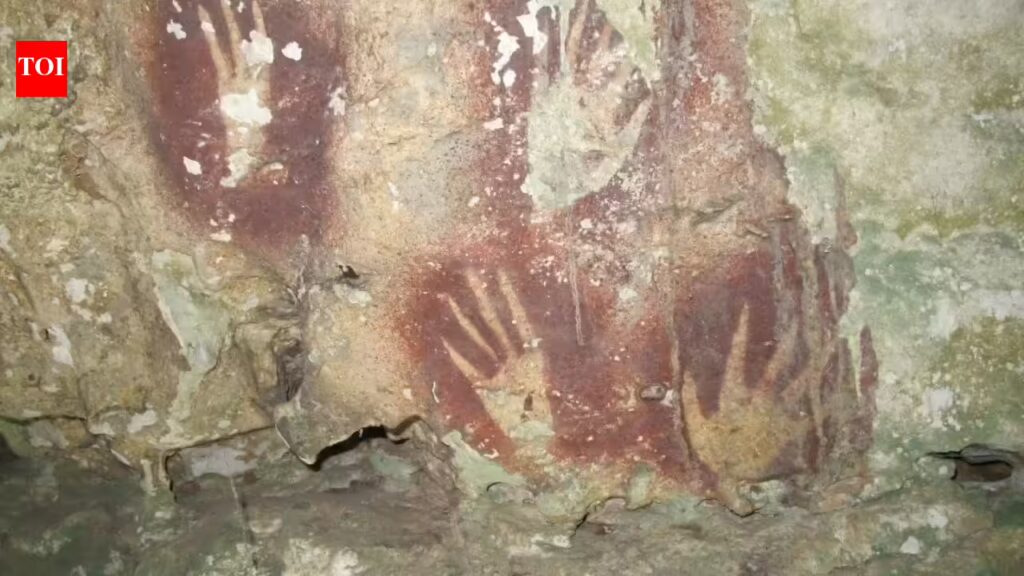
A faded outline of a human hand on a cave wall in Indonesia could now be the world’s oldest known rock art, according to archaeologists who say it was created at least 67,800 years ago. The handprint is part of a small cluster of similar stencils on the cave wall, but researchers believe this one is the oldest dated so far. If confirmed, the discovery would push back the timeline for ancient symbolic expression and strengthen evidence that early humans in Southeast Asia were producing meaningful art far earlier than previously assumed.The ancient handprint was identified inside a limestone cave on Muna Island in south-eastern Sulawesi. Although the cave is known and visited, the stencil-style image had gone unnoticed among more recent paintings of animals and other figures layered across the same surface.The work was led by archaeologists Prof Maxime Aubert and Prof Adam Brumm from Griffith University in Queensland, Australia, who have been documenting and dating ancient cave art in Sulawesi for years. Their findings were published in the journal Nature, giving the discovery major scientific weight and drawing global attention to the site.
Handprint hidden in plain sight
Hand stencils may look simple compared to dramatic prehistoric scenes, but they are among the most personal forms of early art. The cave handprint was likely created when a person pressed their hand against the wall and then sprayed a mixture of ochre pigment and water around it, leaving a negative outline once the hand was removed.Researchers say the find is important not only because of its striking age, but because rock art is notoriously difficult to date. Pigments often contain little material that can be directly measured, so archaeologists instead rely on natural mineral formations that develop on top of cave paintings over time.In this case, scientists dated tiny calcite deposits that had formed over the handprint, which allowed them to determine a minimum age for the artwork. That means the handprint must have been created before the mineral layer covered it.
Why the 67,800-year date matters
If the minimum age estimate holds up under further study, the Indonesian cave handprint would become one of the oldest known examples of rock art anywhere in the world.The discovery also adds weight to broader debates about how and when humans travelled across island Southeast Asia and eventually reached Sahul, the ancient landmass that once connected Australia, New Guinea and Tasmania.Sea levels were much lower tens of thousands of years ago, opening land bridges between some islands. But even then, early humans would still have needed to cross stretches of open water to move through the region, meaning migration likely required island-hopping journeys.
The strange detail: Narrow, pointy fingers
One of the most intriguing features of the handprint is its unusual shape. The fingers appear narrow and pointed, almost claw-like. Researchers believe this may have been intentional, suggesting the creator modified the hand shape to convey a deeper meaning.Why someone might alter the outline is still unclear. It could have been symbolic, ritualistic, or linked to storytelling and identity. But even the mystery itself hints that the people behind the cave art were not merely leaving random marks. They were communicating something that mattered within their culture.
Who made it: Modern humans or another ancient group?
The Griffith University researchers argue that the handprint’s altered appearance makes it more “complex”, pointing towards Homo sapiens as the likely creators. However, other experts have urged caution, saying it is not yet clear whether the pointy-finger effect was intentional or simply the result of the creator moving their hand during the process.The debate matters because cave-art discoveries in other parts of the world have challenged long-held assumptions. In Spain, for example, some ochre cave markings and hand stencils have been dated to more than 64,000 years ago, suggesting Neanderthals were capable of making rock art. Meanwhile, the Denisovans, another ancient human group, are believed to have lived across large parts of Asia and may have reached as far as Indonesia.
A handprint that opens a window into the ancient mind
Beyond the dating and scientific argument, the discovery stands out for its human impact. A cave handprint is not a distant image of an animal or abstract shapes. It is a direct trace of a person who stood in that cave tens of thousands of years ago and left behind a mark that still speaks across time.If further research supports the age estimate, this faint hand outline in an Indonesian cave will become more than just another archaeological milestone. It could be one of the oldest surviving signatures of human imagination ever found.