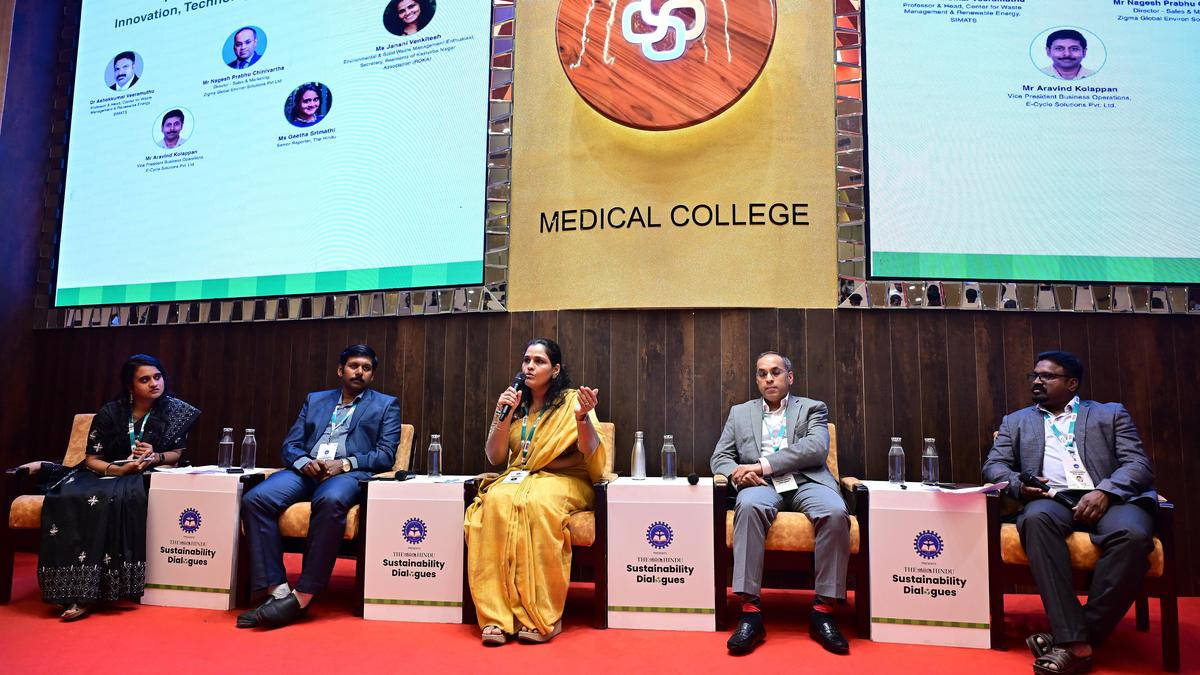
Ashokkumar Veeramuthu, Head, Centre for Waste Management and Renewable Energy, SIMATS; Nagesh Prabhu Chinivartha, Director-Sales and Marketing, Zigma Global Environ Solutions; and Janani Venkitesh, secretary, Residents of Kasturba Nagar Association, at a panel discussion on Tuesday.
| Photo Credit: B. VELANKANNI RAJ
India’s problems in managing its solid waste stems from its inability to develop a mechanism and infrastructure for handling garbage to indifference on the part of the civil society, speakers said at a panel discussion on ‘Future of Waste Management: Innovation, Technology, and Behaviour Change’.
The discussion was part of Sustainability Dialogues organised by The Hindu and Saveetha Institute of Medical and Technical Sciences (SIMATS) on the topic ‘Shaping Tomorrow’s Sustainable Narrative’.
The panellists listed the gaps in strategy, policy, and implementation of schemes, while acknowledging some of the positive models that have made an impact, like the Indore project and the decentralised model in Noida. They, however, believed that no model could be replicated blindly at other places; instead, there had to be local solutions and concerted efforts by from all sections. Refuse-derived fuel as an alternative for cement plants, inerts for road construction, and recyclables getting into the circular economy would have to be the way forward, they said.
Nagesh Prabhu Chinivartha, Director-Sales and Marketing, Zigma Global Environ Solutions, said the waste-to-wealth concept would be a myth once the waste reached the dump. It could work if only there was a good door-to-door collection and local segregation. “The only way Indians would realise that what they are doing is wrong is when it pinches their pockets,” he said. ,adding that collection of waste management cess as part of property tax would not work because it shifted the responsibility from the people to the civic body. “Citizens are to be blamed as much as the local body officials,” he added.
Ashokkumar Veeramuthu, Professor and Head, Centre for Waste Management and Renewable Energy, SIMATS, pointed to the gaps in waste management: poor source segregation, the gap between research and practice with most research projects ending up on the pilot scale, ignoring the public health aspect of waste management, and the disconnect among institutions, government, and the private sector. In several foreign countries, waste management worked because of clear policy framework and mechanisms in place. In India, a fine should be levied on bulk waste generators to start with, Dr. Ashokkumar added.
Aravind Kolappan, vice-president-Business Operations, E-Cycle Solutions, said in-depth metal extraction from e-waste is not allowed in India. E-waste recycling companies, instead, segregate the e-waste and do pre-processing. For example, rare earth metals are not extracted from the central core of the mother board in India. Companies accumulate them, smelt them into a different form, and export them. “Only if you do 100% extraction in India, will you be able to get the cost back and have a circular economy running,” he said.
Janani Venkitesh, environmental and solid waste management enthusiast and secretary, Residents of Kasturba Nagar Association, said the attitude of people towards waste could be gauged from the language they use for waste. Awareness campaigns seldom translate into long-term action. “There are lots of campaigns happening. We have been doing several programmes for sensitising people. But there has been no implementation of any of the solutions discussed. We find that the intent is missing among institutions and individuals,” Ms. Janani said.
The discussion was moderated by Geetha Srimathi, Senior Reporter, The Hindu.
Published – January 07, 2026 12:18 am IST