Koh Eweand
Qadir Kollol,BBC News Bangla
 Getty Images
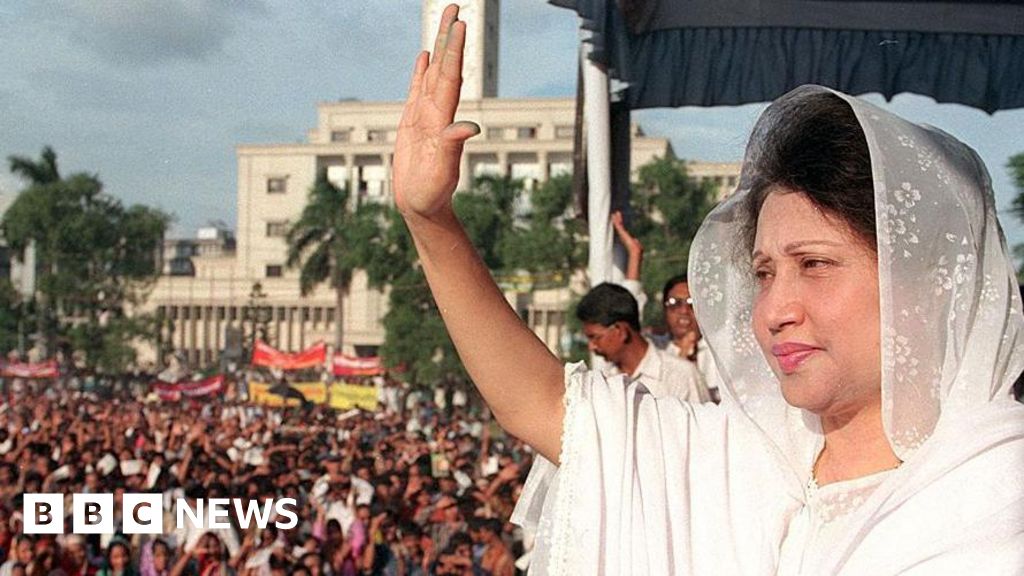
Khaleda Zia, who has died at the age of 80, was Bangladesh’s first female prime minister.
She was once described as a “shy housewife” to her husband Ziaur Rahman, a leading figure in the country’s struggle for independence who became the president in 1977.
But following her husband’s assassination in 1981, Zia rose to lead his Bangladesh Nationalist Party (BNP) and served two terms as prime minister – first in the 1990s and then in the early 2000s.
Her tumultuous public life did not end after her premiership. She was later convicted for corruption and spent years in prison, but was acquitted after a 2024 uprising that saw her long-time rival, Sheikh Hasina, swept from power.
An ‘uncompromising leader’
Begum Khaleda Zia was born in 1945 in Dinajpur, then part of British India and now in Bangladesh.
At the age of 15, she married Ziaur Rahman, then a young army officer.
In 1971, he joined a mutiny against West Pakistani forces and declared independence for Bangladesh.
After the military seized power in 1977, Rahman – who then became the army chief of staff – declared himself president. He reintroduced political parties and a free media, and was later endorsed by popular vote.
He faced as many as 20 military coups, and dealt with them brutally. There were reports of mass executions of soldiers.
In 1981, he was assassinated by a group of army officers in Chittagong.

 Getty Images
At the age of 36, Khaleda Zia became a widow.
Until then, she had kept a low profile and seemed to take little interest in public life.
But in 1982 she became a member of the BNP, the party founded by her husband, and later rose to become its vice-chairman.
That year – 1982 – was also when Bangladesh began nine years of military dictatorship, after its army chief seized power in a coup.
During this period, Zia embarked on a fervent campaign against military rule, staging a boycott of the army’s heavily-managed elections.
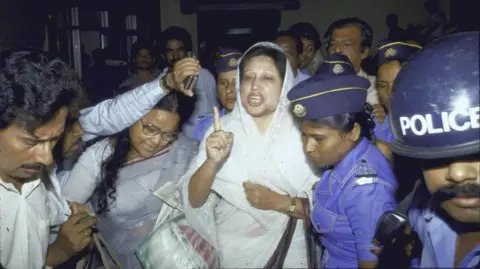
She was put under house arrest multiple times for her activism, but gained a reputation among the people as an “uncompromising leader”.
After the fall of the military government in 1990, Khaleda Zia and the BNP became the largest party in post-military elections, and she was sworn in as prime minister in 1991.
Having absorbed most of the powers of the old presidency, she was now the first female leader of Bangladesh, and only the second elected woman to lead a Muslim country.
With her ascension to the premiership, Bangladesh’s government returned to a parliamentary system.
Among the most notable reforms she implemented during her first term was making primary school education free and mandatory for all.
But in 1996 she would lose her bid for re-election to Hasina’s Awami League.
 Getty Images
In 2001, Zia had her revenge, having formed an alliance with a group of Islamist parties. Together, they won nearly two-thirds of the seats in parliament, but the BNP’s closeness to the Islamist parties would draw criticism over the years.
In her second term, Zia championed women’s issues, such as introducing a quota for female MPs and providing education for young women – in a country where 70% of them were illiterate.
The years in opposition
Soon after Zia ended her term in office in 2006, Bangladesh was gripped by riots in the political vacuum. Amid the unrest, the country’s interim government, backed by the military, banned most political activity and began a crackdown on high-level corruption, which cut across political lines.
Zia was arrested on charges of extortion and corruption. So was her great rival Hasina.
Both women, who had alternated from government to opposition for the best part of two decades, were suddenly mired in court cases.
Restrictions were lifted on Zia in the years after, and after losing a military-sponsored election in 2008 she became the opposition leader.
 Getty Images
The BNP lost its representation in parliament altogether after boycotting the 2014 election.
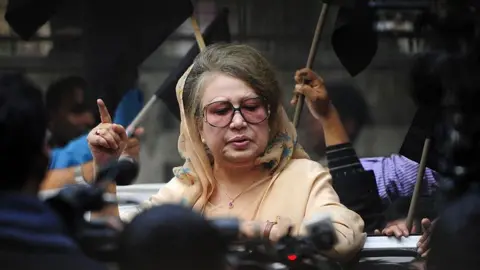
In 2018, Zia was convicted and jailed for five years after being found guilty of embezzling about $252,000 (£188,000) intended for an orphanage trust set up when she was prime minister.
She became the only prisoner locked up in Dhaka’s old – and now disused – central jail. The length of her sentence disqualified her from seeking public office.
She denied wrongdoing, and said the charges were politically motivated.
A year later, the then 73-year-old Zia was transferred to hospital for treatment for conditions including severe arthritis and uncontrolled diabetes.
She was eventually released from prison on health grounds and told to remain at home.
 Getty Images
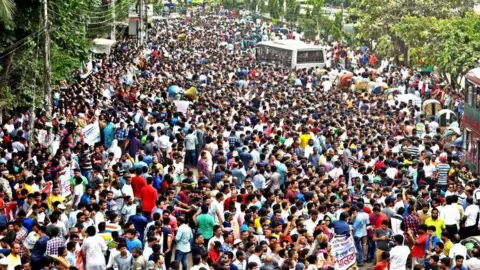
Tides turned yet again in 2024, when Hasina’s government was swept from power on a wave of popular discontent.
Hasina fled to India, and the interim government that replaced her ordered Khaleda Zia’s release and the unfreezing of her bank accounts.
By this time, she was suffering from a series of life-threatening conditions including cirrhosis of the liver and kidney damage.
In January 2025, the courts acquitted her, lifting travel restrictions and allowing her to travel to London for treatment.
But in the early morning of 30 December, she died in Dhaka after suffering from months of poor health.
She is survived by her elder son Tarique Rahman, who returned to Bangladesh in late December after spending years in exile in London, and who is widely seen as the frontrunner to become Bangladesh’s next leader. “Koko”, her younger son, died in 2015.