
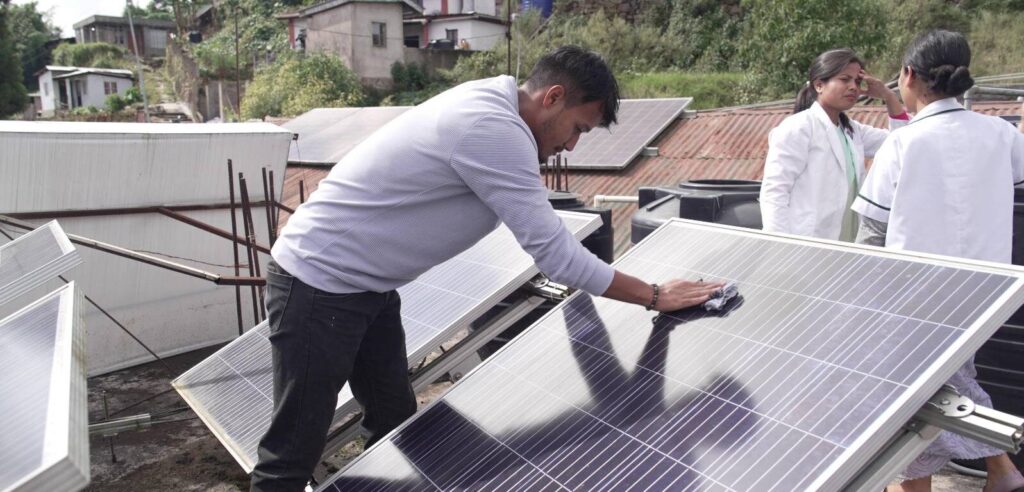
- Frequent power outages in Meghalaya’s hills, driven by extreme weather, terrain, and a fragile hydropower system, have long disrupted healthcare services.
- Soon after COVID-19, solar-powered electricity emerged as a practical solution amid a larger push to adopt renewable energy, especially in healthcare facilities, to reduce dependence on unreliable coal-based grid power.
- Solar power has now reached about 530 health centres in Meghalaya, allowing medical services to run more efficiently and without interruption.
When Evelyne Nongkseh’s newborn daughter developed jaundice in August 2023, her family of six was in panic. Nongkseh, then 30, had delivered her third child just two weeks earlier. She rushed to Gnanamma Healthcare Centre in her village Jaidoh in the West Khasi Hills, in India’s northeastern state of Meghalaya, hoping to get immediate treatment.
But when she arrived, there was no electricity at the centre and phototherapy unit that treats neonatal jaundice by breaking down excess bilirubin in an infant’s blood, was also not functioning. “I was worried sick,” Nongkseh recalls. “There was no electricity, and it was raining heavily. I had to go back home that evening.”
The next morning, the health centre’s administrator, Sahay Lily, suggested keeping the infant in the morning sunlight until a vehicle could be arranged to take them to a hospital in the nearest town, Nongstoin. The town, despite being located only 10 kilometres away took nearly two hours to reach because the heavy rains had damaged the roads. At Nongstoin’s hospital, Nongkseh’s daughter received the necessary treatment and recovered.
“The electricity problem is common in our village. Not just me, many parents have faced similar problems,” Nongkseh says. Her experience was once an everyday occurrence for healthcare workers, with frequent power cuts disrupting healthcare services in the region.
A clinic in the dark
In this hilly, rain-swept region of Meghalaya, frequent power cuts are usually driven by severe weather-related damage to infrastructure, the state’s difficult terrain, and the impact of heavy rainfall on its largely hydroelectric power system. This in turn has impacted the functioning of healthcare facilities.
Power cuts have forced health workers to deliver babies in candlelight, sterilise instruments in boiling water heated using charcoal, and even turn away patients when services could not be safely delivered. In many cases, vaccines would spoil when ice-lined refrigerators (ILR) shut down. Sometimes emergency procedures had to be delayed or dropped altogether.
For patients that would come in the night, the medical team would examine them using mobile phone flashlights and candles laments Lily, a nurse with over three decades of experience. Baby deliveries, she says, have been conducted in complete darkness.
The challenge was not limited to a few remote outposts. Sub-centres, primary health centres, and even larger facilities across the state struggled with unreliable power.
But things changed for the better during the COVID-19 pandemic.


The push for solar
When the entire country and the world was struggling to cope with the pandemic, Meghalaya too found itself confronting a public health emergency with limited infrastructure, shortages of skilled personnel, and an already fragile healthcare system.
As patient footfall surged in this period, the government of Meghalaya, along with the National Health Mission (NHM), planned for reliable backup electricity supply solutions, to make up for the irregular grid power.
“It was truly a matter of life and death,” says Ibamanlang Nongri, the state programme manager for the NHM in Meghalaya. “For healthcare delivery, uninterrupted electricity is crucial, because we are dealing with human lives.”
During that time, solar-powered electricity emerged as a practical solution amid a larger push to adopt renewable energy across sectors, especially in healthcare facilities, to reduce dependence on coal-based grid power. According to a Union Health Ministry’s report, 87% of India’s hospitals rely primarily on grid electricity.
Soon after, under the NHM and the Meghalaya Chief Minister Solar Mission (CMSM), the state began installing solar power in health facilities in partnership with SELCO Foundation, a non-profit that advances sustainable development by linking social innovation with decentralised renewable energy (DRE) systems.


The CM’s Solar Mission, launched in 2023 is a ₹500-crore initiative spread over five years and offers up to 50-70% subsidy for solar hybrid systems in hospitals, health centres, and other commercial establishments to address the state’s power deficit, ensure round-the-clock electricity, enable uninterrupted healthcare services, and reduce reliance on conventional grid power.
“In the first phase, around 100 health facilities were solarised,” Nongri says, starting with Ri-Bhoi and East Garo Hills districts.
Since then, the programme has expanded to more than 530 healthcare centres in the state, which include almost all sub-centres and Primary Health Centres (PHCs) in Meghalaya. Now the plan is to bring solar power to newly constructed sub-centres in the region as well.
Powering births
The Gnanamma Healthcare Centre, where Nongskeh was once turned away due to no electricity, now operates round the clock with solar power that was installed here in February 2025 supported by the Meghalaya government’s solar transition by Christian Health Association of India (CHAI) and World Resources Institute (WRI).
Almost immediately, the daily operations at the centre, which serves eight to ten villages with a total population of roughly 4,000 to 5,000 people, changed.
“Night-time deliveries are now conducted under bright lights,” Lily says. Vaccines are stored safely in ice-lined refrigerators (ILRs) that run without interruption. Nebulisation, blood tests, phototherapy, and laboratory work can now be carried out at any hour, she notes.
“The centre is brightly lit even when the village is dark,” she says. Additionally vaccination and medical camps that were often conducted in small halls with poor lighting and irregular electricity have been shifted to the Gnanamma centre.

Scaling solar across Meghalaya
Similar changes have unfolded at Mawlyngngad’s sub-health centre in the East Khasi Hills district. Onika Wankar, a mid-level health provider and community health officer, has worked there since 2020.
When she joined, there was no solar power. Electricity that came from the power station at Umiam dam was frequently cut. “Whenever there was less water, the electricity supply would be shut down,” she says, adding that deliveries would become extremely difficult to carry out. “We had to use candles and mobile phone flashlights, and even burn charcoal to keep a baby warm and boil water to sterilise instruments.”
But when solar panels were installed on the centre’s small tin roof in 2023, operations eased out. “Outpatient Department (OPD) attendance has increased from 10–20 patients per day to 40–50 now. We now have 24×7 electricity, so night-time work has become safe and manageable,” she says. “People have developed trust in the sub-centre.”
The need for financing and monitoring
Equipment that once sat idle, like oxygen concentrators, sterilisers, radiant warmers, and vaccine refrigerators, now runs reliably, bringing life and light back into the clinic. At Gnanamma, a six-kilowatt solar plant paired with 22.6 kilowatt-hours of battery storage provides up to three days of backup on cloudy days.
“The idea was to see how this facility could move towards net-zero electricity,” says Rishikesh Mishra, Programme Manager at WRI India, which is working to build evidence for scaling solar energy in challenging terrains like Meghalaya by providing technical support, data, and policy guidance.
Today, solar power meets nearly all of the centre’s energy needs from lighting and cooling to powering critical medical equipment. “In the last three months, grid electricity usage has dropped to zero,” Mishra adds.
However, he adds, “Solar should complement, not replace, existing systems.” He points out that demand-based system design, predictable financing, and strong monitoring are what make these systems sustainable in the long term.
Banner image: Solar panels installed on the roof of a healthcare facility in Meghalaya. Image by Pratik Chakraborty.

