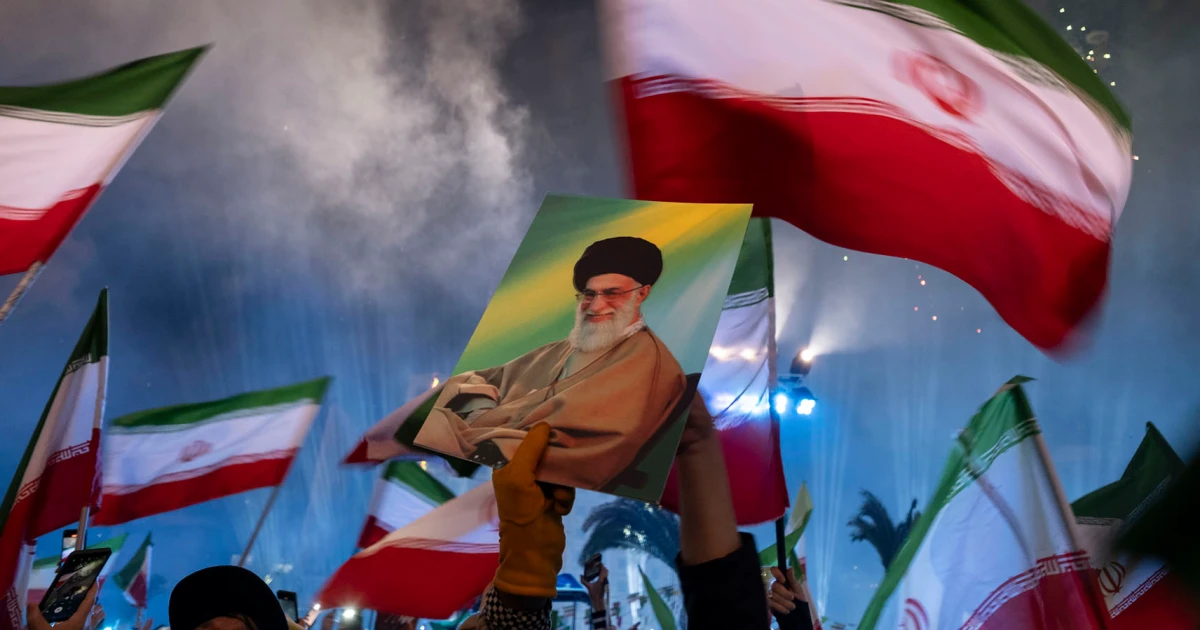
A heavy security presence accompanied a crowd gathered in a square in downtown Tehran earlier this week. The streets around them were closed.
But unlike a month ago when anti-government protests broke out across the country, this crowd carried pictures praising the country’s supreme leader, Ayatollah Ali Khamenei, footage taken Wednesday showed. Some waved Iranian flags, children had their faces painted and loud music played — something that was once uncommon in the hardline Shia Muslim country.
Technically the crowds gathered in Valiasr Square were there to celebrate the birth of Imam Mahdi, a prominent figure in Islam, prophesied to appear near the end of times and fill the world with peace, supported by Prophet Isa, as Jesus is known in Islam.
Politics was not far from the surface. Among the mostly religious songs and chants, supportive messages are shouted for the government and at one point the crowd shouted, “Death to America.”
Nearby, kiosks fly flags bearing the logo of Hezbollah, the Tehran backed militant group in Lebanon and take pictures in a cardboard cutout featuring its former leader Hasan Nasrallah who was killed by Israel in September 2024.
Traditionally attended by thousands of government workers and supporters of the theocratic regime which has been in place since 1979, this year’s Mid-Shab’an Eid celebrations appeared to be much smaller, perhaps a reflection of the shock many are feeling in the wake of last month’s protests and the bloody crackdown that followed.
Almost 7,000 were killed in the demonstrations across the country including Tehran, the U.S.-based Human Rights Activists News Agency said Thursday. The group, which says that it verifies each death with a network of activists on the ground in Iran and that its data goes through “multiple internal checks,” believes many more were likely killed. More than 50,000 have been arrested, the group says. Iran’s government says 3,117 people were killed in the unrest.
The scale of the protests and their intensity was “unprecedented,” according to Anoush Ehteshami, a professor of international relations at Durham University in the U.K. and the author of multiple books about the Middle East and Iran.
While it was hard to gauge the popularity of the regime, he told NBC News in a telephone interview Thursday that “there is massive unrest and unhappiness” among large swaths of the population.

People may be “cowed into silence for the moment,” he said, adding that didn’t change the reality for the regime which is isolated internationally and hit hard by sanctions imposed by the U.S. and other countries over its nuclear programme and for human rights abuses.
“It’s getting hammered in all directions and of course, its currency is falling off trees, absolutely worthless,” he said, referring to the country’s dire economic situation which has seen the rial hit record lows and inflation rates soar, leaving many struggling with the cost of living and rising prices on everyday goods.
Nonetheless, he said an “increasingly small number stand to still gain from the regime,” including government workers and members of the security establishment, as well as their families, which runs into hundreds of thousands of people in the population of 90 million people.
He added that the economy “is controlled by a cabal attached to the state machinery,” some of whom profit from the international sanctions. “Generally, they control trade, and control of trade gives them a monopoly,” he said. “A lot of these guys don’t actually want sanctions to be lifted.”

Talking to people inside Iran, no one really thinks things can return to the way they were before the protests, according to Trita Parsi, the executive vice president of the Quincy Institute for Responsible Statecraft, a Washington-based think tank. “It just cannot happen, not after this level of killing,” he added.
That fact that some Iranians had called for foreign military intervention was unprecedented, he said in a telephone interview Friday.
Some of those pleas came after President Donald Trump threatened military action to back up his promise to help protesters.
The U.S. military has moved aircraft and land-based air defense systems into the Middle East, while the Abraham Lincoln aircraft carrier and its attendant ships are getting closer to being within striking distance of Tehran. But American and Iranian officials met Friday for talks to try to avoid a war, according to two U.S. officials.
Parsi said there had been “significant rallying around the flag,” and a “huge surge of nationalism” after Israel and the U.S. attacked nuclear sites in the country in June. “That can happen again,” added Parsi, the author of three books about Iran. “We have plenty of data to see how air wars tend to push populations in the direction of nationalism, unity and rallying around the flag.”
In Tehran most are trying to push on with their lives. In the past throngs of people would have voluntarily organized celebrations for Imam Mahdi. On Wednesday, it was organized by the government.