
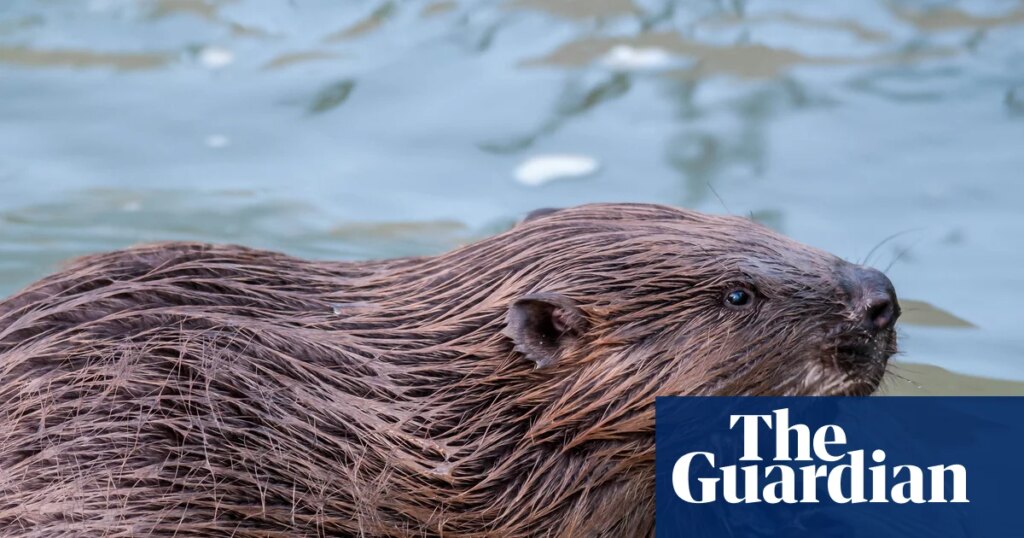
“I hate beavers,” a woman tells the beaver hotline. Forty years ago she planted an oak tree in a small town in southern Zurich – now at the frontier of beaver expansion – and it has just been felled: gnawed by the large, semi-aquatic rodents as they enter their seasonal home-improvement mode.
The caller is one of 10 new people getting in touch each week at this time of year. Beavers, nature’s great engineers, can unleash mayhem during winter as they renovate their lodges and build up their dams. For people, this can mean flooding, sinkholes appearing in roads and trees being felled. A single incident can clock up 70,000 Swiss francs (£65,000) in damages.
To cope, the beaver-rich canton of Zurich came up with the hotline. The local Beaver Advisory Centre is staffed by ecologists who give advice, assess damages and evaluate potential compensation (the oak tree-bereft woman is advised to wrap wire around the base of the other trees to stop the rodents’ chewing).
Part of the job is calming down people furious at their beaver neighbours. “Some farmers are so angry you can hardly understand them, but they calm down when you go and see them,” says first responder Caroline Nienhuis, a biologist from Fornat, the consultancy that runs the hotline.
Switzerland is experiencing a beaver boom. When top predators first recolonise a former habitat – such as when wolves, bears and eagles return to areas across Europe – the immediate reaction is often one of awe. As the animals spread, however, it can often lead to conflict. Population growth is usually slow when you first introduce a new species, then it moves exponentially.
In 2008, there were 1,600 beavers, and in 2022 (when the last full monitoring was done) there were 4,900, with numbers likely to have increased since. What is striking about the Swiss example is the degree to which citizens accept living alongside them. Unlike in most European countries, no beaver has been legally killed in Switzerland since they were reintroduced in 1956.
The Swiss approach is not hands-off in its rewilding: its success lies in extensive state management and support. Up to 1m Swiss francs (£930,000) can be allocated each year for beaver damage and prevention – the biggest such fund in Europe.
Peter Roos is a public works employee who maintains waterways, roads, streets and paths in the municipality of Hettlingen, home to 3,200 people – and now, a number of beavers. Roos says he calls the hotline up to 20 times a year.
The local beavers’ latest trick has been raising the height of their dam – an enterprise that risks flooding the sewage system. Discussing it on site, Nienhuis and Roos agree that the dam needs to be lowered to sort the problem out. The whole decision takes about 30 minutes.
“It’s about who’s got more patience: man or beaver?” says Roos. “Once you start manipulating their dams they get inventive and build new dams.” His latest task is to investigate a sinkhole that appeared in the local car park, which the wheel of a lorry fell into. “To keep beaver activity in check is a huge amount of work,” says Roos.
The culling controversy
Some argue that this proves large beaver populations are not compatible with large human populations. In Bavaria, about 2,500 are shot a year, which is 10% of the population, but the number continues to grow. Poland issues permits to cull about 6% of its beaver population each year (about 8,300 individuals).
But the effectiveness of culling is questioned in Switzerland. If a river section is favourable for one beaver, it is likely to be favourable for others. “It’s efficient to shoot a beaver – but only until the next beaver comes along,” says Nienhuis. “Then the same conflicts arise.”
Nienhuis says prevention and compensation are more effective. “It’s important people feel they can control beavers and their activity so they accept them. As soon as you lose acceptance from the local people it’s a problem,” she says. The biologist believes animals such as beavers, wolves and lynx should not be reintroduced without a system to deal with conflicts that inevitably arise. “If you say ‘deal with it yourself’ that is when illegal shooting happens.”
The costs of management are more than compensated for by the wildlife and ecosystem benefits beavers bring. Despite causing flooding in some areas, they reduce it in others as their dams slow the flow of water through the landscape, protecting communities downstream from flash floods. “We cannot build what they do. We would miss a huge opportunity if we went and shot them all,” says Cécile Auberson, who works for a national Beaver Centre (Nationale Biberfachstelle). They are, she says, the “most powerful force in river restoration”.
A boon for biodiversity
Marthalen is the largest beaver wetland in Switzerland and ecologists point to it as an illustration of why people should put up with them.
In 2011, a family of beavers moved into the plantation and dammed the small stream that runs through it, transforming four hectares into an alluvial forest, submerging old oak trees and felling others.
There has been an explosion of biodiversity in this swampy area. Calls of the black woodpecker and tawny owl reverberate about the woodland. It is a case study in how wild engineering by beavers can reshape ecosystems in the space of a few years. “The effects on biodiversity are just huge. No human-led projects would ever achieve those benefits,” says Auberson.
In habitats such as Marthalen, researchers have found up to six times more species of fish, amphibians, water insects, water plants and dragonflies, and up to 60 times more abundance than in the same rivers without beaver activities. “What the beaver can do and how this impacts nature is mind-blowing. It makes you realise how unnatural a lot of our nature is,” says Nienhuis.
Beavers are now doing free river restoration work on 2,000km of river in Switzerland they have already colonised. “If we integrate them intelligently they can save us money, and do it better than we can,” says Auberson.
‘People see it as a bit exotic’
Some areas are already managing their future of coexistence. Two years ago, beavers moved into the stream running through the village of Uhwiesen. In January 2024, after some extensive burrowing, a sink hole appeared on the road, and the following year there was another. The beavers felled 20 trees, turning the riverside bald. They had an appetite for the farmers’ sugar beets and brussels sprouts. Water levels were rising due to their dam building. “I was worried about flooding of the tennis courts and people’s homes,” says Oliver Kuhn, who is in charge of local maintenance in Uhwiesen.
The damage was averted by the construction of a netted beaver boundary, which cost 8,000 Swiss francs, shared between the municipality and the canton.
Now, most locals are fond of their new neighbours. Kuhn, who named the beavers Justin and Hailey (biber, pronounced “bee-ber” is German for beaver), has noticed kingfishers have come back since they arrived, as well as more dragonflies and bats.
“People see it as a bit exotic and unique that we’ve got beavers here. You can walk along here with your dog and see beavers – that’s special,” says Andi Pfenninger, who lives in Uhwiesen. “People see it as an enrichment of where they live.”
Find more age of extinction coverage here, and follow the biodiversity reporters Phoebe Weston and Patrick Greenfield in the Guardian app for more nature coverage