
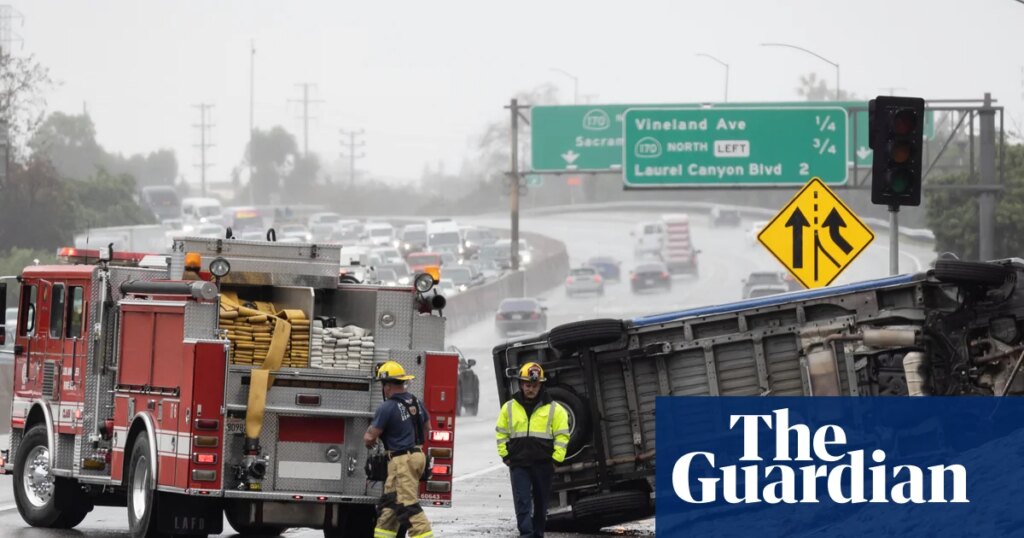
Southern Californians are facing an epic clean-up operation after the region’s wettest Christmas holiday in recent history turned areas of the state into a panorama of mud and debris.
A year ago, record wildfires scorched the dry neighborhoods of Altadena and Pacific Palisades. But now, in what scientists call “hydroclimate whiplash”, the picture is reversed after an atmospheric river off the Pacific brought the elemental opposites of winds and rain.
Southern California recorded its wettest Christmas Eve and Christmas Day ever, with Santa Barbara airport getting 5.91in of rain. More than 17in fell in one single area of the Ventura county mountains.
Christmas Eve and Christmas Day were the rainiest for many parts of southern California, with more than 10in of rain falling in parts of the San Gabriel Mountains in Los Angeles county.
The stormy weather brought down trees, caused hundreds of car crashes and knocked out power for thousands across the state. Hundreds found their homes and gardens hit by flows of mud.
The weather system spawned a tornado on Christmas, the National Weather Service confirmed, that damaged a home and a commercial strip mall in Boyle Heights.
With a wind speed of up to 80mph, the twister travelled for one-third of a mile soon after 10am on Thursday. It was classified as an EF-0 on the Enhanced Fujita scale. The destruction it caused included damage to the roof of a home, and breaking windows and tree branches, bending a utility pole and destroying commercial signage in a shopping plaza.
“The safety of every Angeleno is my top priority,” said Los Angeles’ mayor, Karen Bass, who earlier declared a temporary state of emergency, in a statement pointing to the tornado and “consecutive days of wet weather”.
Firefighters in Los Angeles county rescued more than 100 people just on Thursday, with one helicopter pulling 21 people from stranded cars. California’s governor, Gavin Newsom, declared emergencies in Los Angeles, San Diego, Orange, Riverside, San Bernardino and Shasta counties.
With the heaviest rains now past, there is still a risk of flash flooding and mudslides, the National Weather Service warned.
“Still not quite out of the woods, but for the most part, the worst is over,” said Mike Wofford, a National Weather Service meteorologist in Los Angeles. Forecasters anticipate a dry weekend before more rain around New Year’s Eve.
Sherry Tocco described to the Los Angeles Times how her mountain town of Wrightwood, 80 miles north-east of Los Angeles, was pummeled by rain that turned the roads into rivers and buried cars under rocks, debris and mud.
The river, she said, was raging before “it just came through and destroyed, took everything with it”. Tocco said firefighters helped her evacuate and she had slept in her car.
But what fell as rain in the lowlands fell as snow in higher elevations. As much as 2in of snowfall an hour fell in the Sierra Nevada mountains.