
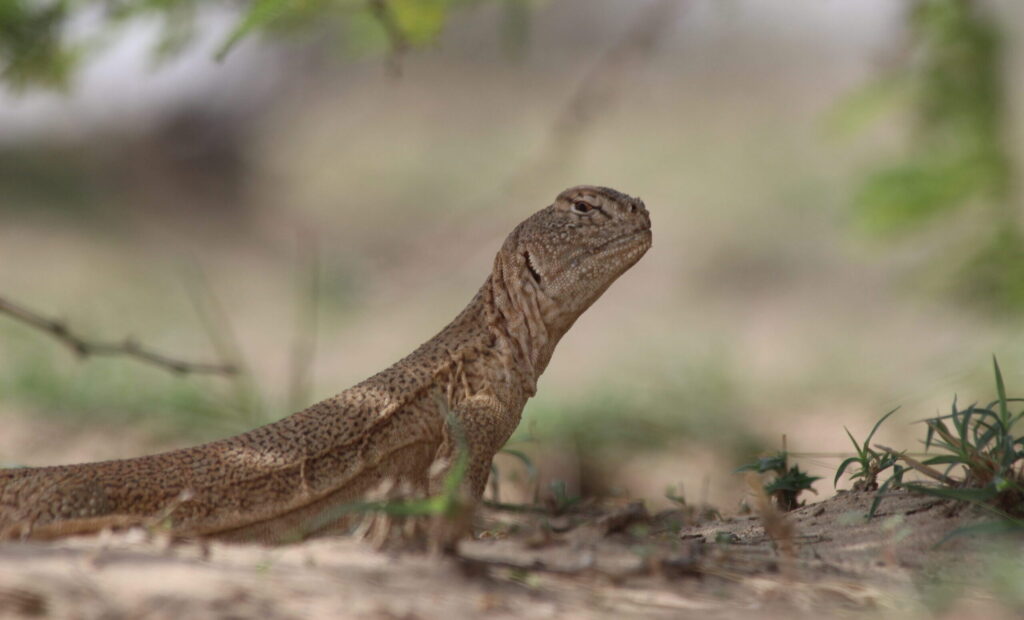
- A recent study explores how the spiny-tailed lizard adapts its diet to survive in the harsh conditions of the Thar desert.
- Challenging the notion that the species is predominantly herbivorous, the study found that it also eats insects ahead of the breeding season when food resources are scarce.
- The lizard however faces threats from hunting, habitat fragmentation and changes in land use from agricultural expansion in the Thar region.
In India’s harsh desert landscapes, a lizard isn’t just eating what’s available but precisely selecting nutrients, fine-tuning its diet to meet the changing demands of reproduction, growth and survival across seasons. While nutritional adaptations are well documented in tropical and marine ecosystems, far less is known about how animals in arid habitats cope with extreme temperatures and limited food availability.
A recent study published in Royal Society Open Science examines seasonal shifts in the intake and retention of macronutrients in the spiny-tailed lizard, Saara hardwickii, in the Thar Desert. The study was conducted in Jorbeer-Gadhwala Conservation Reserve, a landscape of sandy plains where plant availability fluctuates through the year. S. hardwickii, a typically herbivorous species, was also found to consume insects during the breeding period, highlighting how seasonal changes and physiological needs shape its foraging behaviour.
Dietary adaptations of spiny-tailed lizards
S. hardwickii inhabits the Thar Desert of northwestern India, as well as parts of Pakistan and Afghanistan. “Although the lizard is endemic and largely restricted to the Thar and Kutch regions, it is found in high abundance there, suggesting specialised adaptations that enable it to thrive in these harsh environments,” explains Mihir Joshi, the study’s corresponding author.
These adaptations are closely tied to biological processes, including growth, reproduction, and hibernation, which shape the species’ nutritional needs and metabolic activity. The intake and retention of macronutrients are critical for meeting changing nutritional needs and for coping with seasonal fluctuations.
While the species is typically active from February to October, it hibernates in burrows from November to February. The lizards mate during April and May and lay eggs from the end of May to July. To understand variations in the species’ nutritional intake, researchers recorded the amounts and types of food consumed across four months representative of four different seasons.
They also analysed the carbon and nitrogen content — used as proxies for carbohydrates and protein — in the plants and insects consumed by the species, as well as in their faecal matter. Notably, the abundance of plant species in the habitat did not align with their presence in the lizards’ faecal samples, pointing to a seasonally driven pattern of selective foraging.
Joshi recalls spending hours around the lizards’ burrows in the scorching heat to observe their foraging behaviour and collect samples. Together, these assessments set the stage for understanding how the species adjusts its macronutrient intake and metabolism across seasons.
An opportunistic insectivore
The study found that while S. hardwickii fed exclusively on plants in April and October, they also included insects in June and August during their breeding season. Consistent with this pattern, their diet was richer in carbon during October and April, and in nitrogen in June and August, suggesting that the species builds energy reserves ahead of hibernation and then protein reserves before breeding. The increase in dietary nitrogen is likely driven by the consumption of insects before the breeding period. “Breeding and hibernation require distinct macronutrients. How animals sense these changes and adjust their diet accordingly remains unclear,” Joshi adds.


“This is a very interesting lizard,” shares Sumit Dookia, a wildlife biologist who is not associated with this study. “In its early life, it feeds on insects to get the protein needed for rapid growth, but after a few months its diet shifts almost entirely to plants”. He further adds that after hibernation, in the month of February, they voraciously feed in green pastures nourished by winter rains and spring weather.
Male lizards often guard the best feeding patches, sharing them only with prospective mates. “During the monsoon, it’s common to see baby lizards feeding alongside adults, highlighting how diet is shaped by both resource availability and social behaviour,” Dookia explains.
Analyses of faecal samples revealed significant seasonal variations, suggesting shifts not only in intake but also in the metabolism and retention of macronutrients. The faecal carbon-to-nitrogen ratio was higher in June and lower in April, indicating that the lizards eliminate more carbon while preferentially retaining nitrogen during the breeding period.
According to naturalist Makarand Ketkar (not associated with this study), this shift likely reflects increased demand for proteins, calcium and other minerals during egg formation, along with the need to maintain energy balance ahead of hibernation. “Such dietary adaptations are seen not just in reptiles, but also in other species, including birds, insects and fish,” he adds.

Ecological implications
Seasonal changes influence not only what animals eat, but also how they process and retain nutrients, linking environmental shifts to internal physiological responses. Hormonal regulation of breeding and hibernation is also tightly linked with seasonal changes, suggesting a complex interplay of different factors, says Joshi.
The study highlights seasonal shifts in foraging behaviour, selective intake, and post-ingestive physiology, underscoring how closely these patterns align with the species’ life history events. “This is the first study to report these changes in a desert lizard and evaluate its adjustments through a nutritional lens,” explains Joshi. He adds that the species was once widely hunted for its oil and meat. While this threat has declined since the enforcement of the Wildlife Protection Act, hunting persists in pockets of its habitat.
“Beyond hunting, habitat fragmentation and changes in land use from agricultural expansion continue to threaten the species in the Thar region,” says Joshi.
This study links diet, physiology and seasonal change to provide insights about nutritional strategies that sustain life in extreme environments. “However, real-time tracking of diets across seasons remains a challenge in arid ecosystems,” says Ketkar. He further adds that nutritional composition can vary widely between plants and insects, and intensifying climatic changes affect plant growth, insect emergence, and breeding cycles, all of which can influence the species’ dietary adaptations.
Read more: The lizard caught between myth and modernisation
Banner image: The spiny-tailed lizard is endemic to the Thar and Kutch desert regions. Image by Mihir Joshi.

