
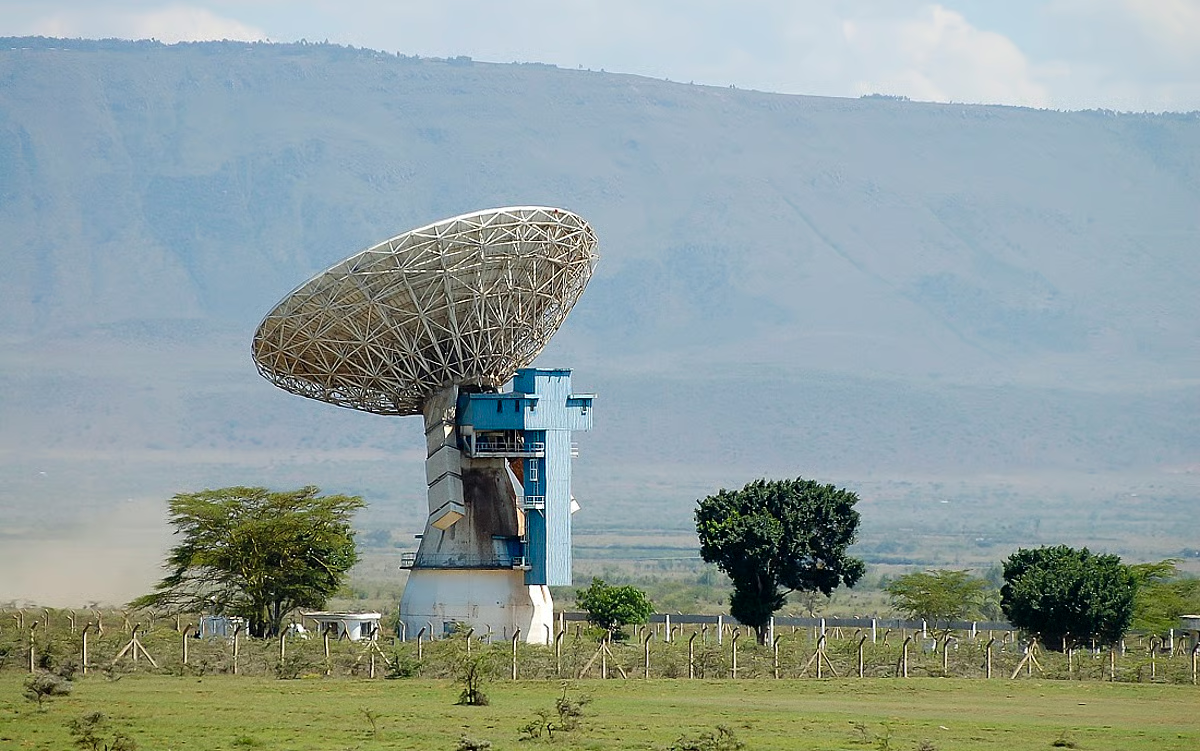
The Square Kilometre Array Observatory (SKAO), an international radio telescope project, is helping boost capacity for space science across Africa. South Africa, the host of the mid-frequency radio telescope, is benefitting immensely.
The observatory project is helping build capacity and interest in space science, one of the least common branches of the sciences in Africa. The continent produces the least percentage of the world’s scientific knowledge at about 2 per cent.
Jointly hosted by the governments of South Africa under the South African Radio Astronomy Observatory (SARAO) and Australia, and designed to be the largest project of its kind in the world, the scientific endeavour has seen the number of people specialised in astronomy grow in South Africa from less than five to more than 200 since 2017, when the first satellite dishes were erected on the project site in the Karoo desert.
Besides, it has issued 1,700 scholarships in different branches of space sciences to undergraduate students, with 80-90 per cent completion rates recorded for both.
“We have managed to grow the capacity for astronomy in South Africa to between 200 and 300 people from only a handful a few years ago. About 20 years ago, there were only about four people specialising in astronomy in South Africa,” said Adrian Tiplady, SARAO’s deputy managing director.
He added that 162 South African scientists were directly participating in “SKA science” at the moment, thanks to capacity building initiatives by the international project, including in engineering and in a range of “innovative technologies”, among them design satellite dishes.
In hosting the mid-frequency telescope, South Africa is also collaborating with eight African countries including Kenya, Ghana, Madagascar, Mauritius and Zambia. The other collaborators are neighbours Botswana, Mozambique and Namibia.
The countries have been benefiting from skill development in radio astronomy from SKA, including through the Transient Array Radio Telescope (TART) — an open-source, 24-element ‘interferometer’, said the official.
Ghana is leading in building its capacity among the partner countries, having converted a 32-metre redundant satellite telecommunications antenna at Kuntunse, near the capital Accra, into a functioning radio telescope, besides launching the Ghana Radio Astronomy Observatory in 2017, and conducting “first light” observations.
Kenya, on the other hand, has made some progress providing training in basic astrophysics and radio astronomy to students and professionals through the Development in Africa with Radio Astronomy (DARA) project. This is besides establishing a site as a radio astronomy observatory in the Rift Valley region.
“We have achieved many developments that are not being reported. For example, we have discovered a new giant radio galaxy, 32 times bigger than the size of the Milky way galaxy,” Tiplady told a media briefing during a project site tour.
The project was providing the environment suitable for maximising “the development of radio science”, leveraging on new ways of designing radio telescopes using non-conventional dishes to produce the “best signals,” Tiplady added.
“The nature of the radio telescope is that it is always expandable, always being expanded in a phased approach. This project has the potential for data intensive science, in searching the origins of the universe,” he explained.
The SKA-Mid (mid-frequency), as the South African telescope is known, is one of two telescopes that the SKAO is building. Its counterpart, the SKA-Low — which will consist of 131,072 antennas receiving low-frequency radio waves — is under construction in Wajarri, Australia.
Meanwhile the observatory’s growing telescope array, has achieved “first fringes” using two of its dishes, a milestone that could demonstrate it as operating as an ‘interferometer’ for the first time.
“This is the first true test that all our systems are working together, and that the SKA-Mid telescope is alive as a scientific instrument,” said SKAO Director-General Philip Diamond.
“Having each dish observe the sky individually is an achievement, but having them operate in concert as one telescope is a much bigger technical challenge, and our teams have now achieved that milestone.”
The observatory, like its counterpart Australia’s SKA-Low, is an array where many individual antennas are connected by optical fibre to act like one much larger telescope, equivalent in size to the distance between its furthest antennas. “Fringes” are obtained when signals received by two or more antennas are combined successfully.
Two of SKA-Mid’s 15-metre diameter dishes were used together to achieve the result, observing a radio galaxy estimated to be around 2.6 billion light years away.
“This source has been well studied so we know what the signal should look like, and that’s what we observed with this first fringes result. It confirms that all our hardware and software systems are working as we designed them to do, giving us confidence as we begin to commission the telescope,” said Betsey Adams, SARAO’s commissioning scientist.
“That includes seeing that the dishes can track across the sky in a coordinated way under the control of the telescope manager software, the receivers are being cooled to the required temperature of minus 250°C, the synchronisation and timing system is accurately timing signals from the different dishes to a billionth of a second, and the correlator is correctly processing and aligning the data.”
The observatory now has seven dish structures assembled on site at the Karoo, with a further 12 on their way from the manufacturers CETC54 in China.
When complete, the telescope will comprise 197 dishes, including the integration of the existing MeerKAT radio telescope built and operated by SARAO, the agency said on January 7.
The SKA-Mid telescope is being built and will be operated by the SKA in collaboration with SARAO and international partners including 16 partner countries. These include Canada in North America, and the European countries of France, Germany, Italy, the Netherlands, Portugal, Spain, Sweden, Switzerland, and the United Kingdom, with India, China and Japan being the only Asian participants.
The SKA-Mid will comprise 197 dishes when complete. This will include the dishes of the existing Meerkart telescope, a precursor to SKA-Mid, built and operated by SARAO, and which has been operational since 2018, a world-class telescope in its own right.
The telescope, originally a 64-dish array, has recently been extended by another 14, financed by SARAO, Germany’s Max Planck Society and Italy’s National Institute of Astrophysics, all of which are partners in the SKAO. All of the MeerKAT dishes will ultimately be integrated into the SKA-Mid telescope.
The newer MeerKAT dishes follow the SKA-Mid dish design of 15m diameter, compared to 13.5m for its original dishes, and are also slightly different. All the hardware and software for SKA-Mid is being developed in member countries globally.
Also present on the site is the Hydrogen Epoch of Reionisation Array (HERA) telescope, a separate international collaboration, led by America’s University of California, Berkeley, and built by local artisans in the Karoo. It will however not form part of SKA-Mid.
According to a 2020 article published in the journal Springer Nature Link by Simon T Berry, in addition to the observatory building the research capacity development aspects of the programme, South Africa and collaborating African countries will benefit in skills development, and reap “considerable social-economic benefits”, by participating at the forefront of the SKAO.
“Spin-off innovations in areas specific to the SKA’s computing activities will, through the industries with which SKA will be working to develop them, benefit other systems that process large volumes of data from geographically dispersed sources. Potential areas where innovations inspired by the SKA’s needs could have wider applicability include data management techniques, data mining and analytics, imaging algorithms, remote visualisation and pattern matching (all of which will have impact in areas such as medicine, transport and security),” it found.
These would be in line with the African Union’s STI Strategy for Africa (STISA-2024) strategy, a key pillar of the Union’s Agenda 2063, which aims to unlock innovation-led growth, create jobs, and enhance industrialisation.
Overall, the observatory is already detecting more objects in greater detail than before including the Cosmos gravitational waves and the galaxy according to Tiplady, having detected 85 known galaxies so far.
“We are now able to detect these objects because we are able to digitise data quickly, even if the amount of data that needs to be explained is so much,” he added.