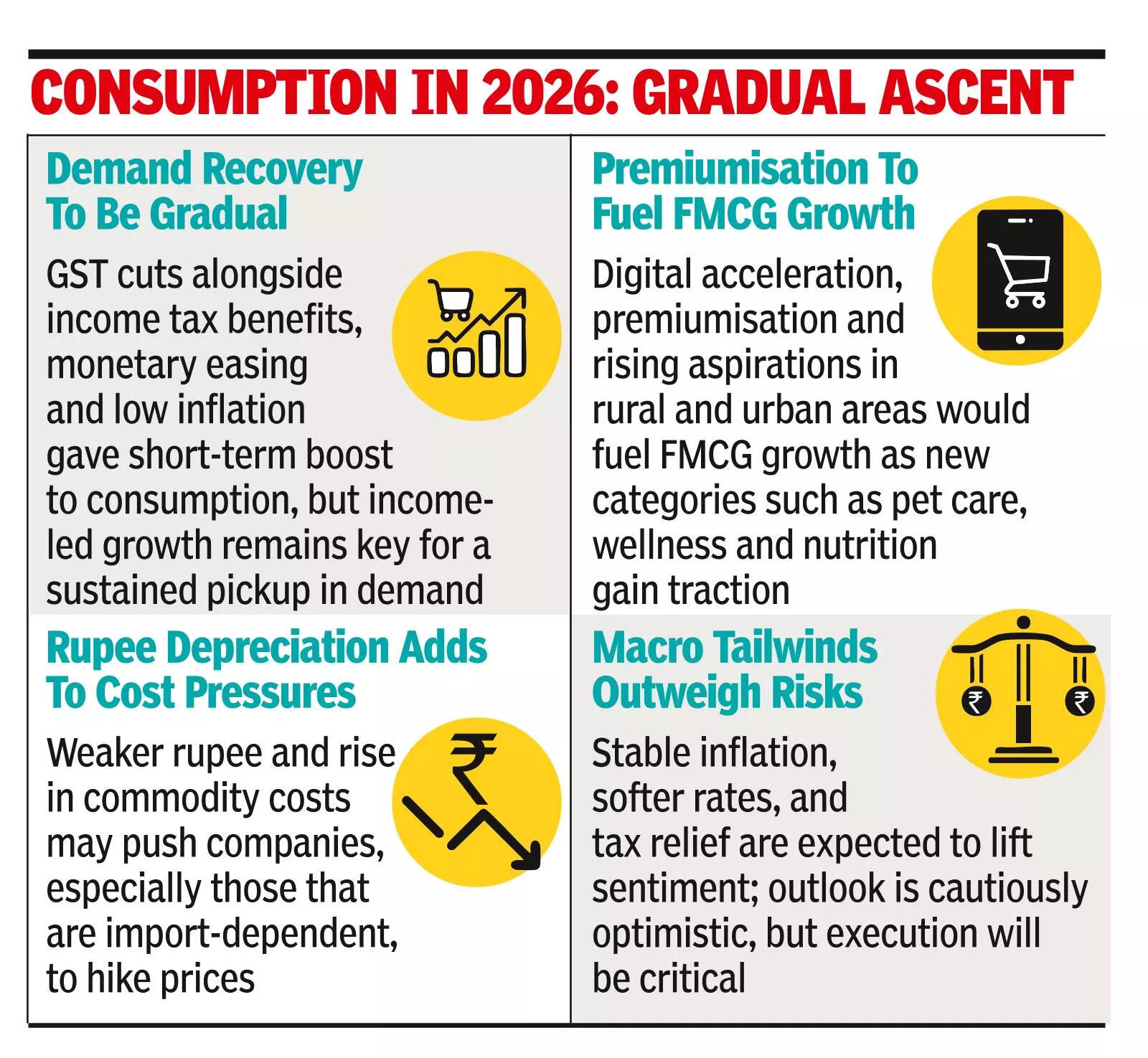
MUMBAI: After an uneven growth through the year, consumption is looking up but it is not galloping yet. India Inc is betting on demand to gather pace in 2026 but with a hint of caution – GST cuts alongside income tax benefits, monetary easing and low inflation is expected to leave more money in the hands of consumers, but company executives are weighing how far the GST reductions can sustain demand in the long-term unless it is supported by higher incomes. Besides, a weaker rupee risks raising costs for companies that are dependent on imports, pushing up prices. Some price hikes may already be taking effect. With GST cuts having given some short term fillip to demand, firms hope that the a mix of broader tailwinds will outweigh the risks, helping consumption in the coming year. The expectation, however, is not to see a sharp rebound immediately but rather a gradual uptick.
Consumption in 2026
“Currency volatility continues to be a watch point. We are intensifying our localisation efforts, driving cost optimisation, and taking calibrated pricing actions to manage margins effectively,” said Sandeep Sehgal, director and head of sales at Panasonic Life Solutions India. A mix of currency depreciation, adverse commodity costs and a scheduled energy regime changeover (change in Bureau of Energy Efficiency star rating norms) will lead to significant cost increase in cooling categories with ACs being the most impacted, said Kamal Nandi, business head and EVP, appliances business at Godrej Enterprises Group, projecting an imminent 5%-7% price hike for ACs and 3%-5% for refrigerators due to energy regime change. “We will aim to hold off the commodity linked price hike and monitor the impact over the next quarter,” said Nandi. At $1,300 per MT crude sunflower oil, every one rupee devaluation will increase import price by Rs 1.5 per kg, said Angshu Mallick, executive deputy chairman at AWL Agri Business, adding that the GST rationalisation, though, has been positive for consumption at least in the short term with products such as margarine and soya nuggets having become significantly more affordable. “This has already started to support demand growth in these segments,” said Mallick. While GST rejig is not a long-term substitute for income-led demand growth, it has acted as a timely catalyst, especially during festive and replacement cycles, and has supported a clearer pickup in demand, said NS Satish, President, Haier Appliances India which is targeting revenues of Rs 14,500 crore in 2026. “Sustained consumption growth will continue to depend on employment trends, income stability and access to credit,” said Satish. If stable inflation, softer interest rates, and targeted tax relief come together, consumption sentiment is likely to improve gradually, particularly in urban markets, said Akhil Jain, CEO & MD at fashion retailer Madame, adding that the outlook is “cautiously optimistic.” The ongoing digital acceleration and a trend towards premiumisation in both urban and rural areas are likely to drive the next phase of expansion in FMCG, said Manish Anandani, MD at Kenvue. “There is more money in consumers’ hands. So, hopefully that will drive growth,” said Sudhir Sitapati, MD & CEO at Godrej Consumer Products.