
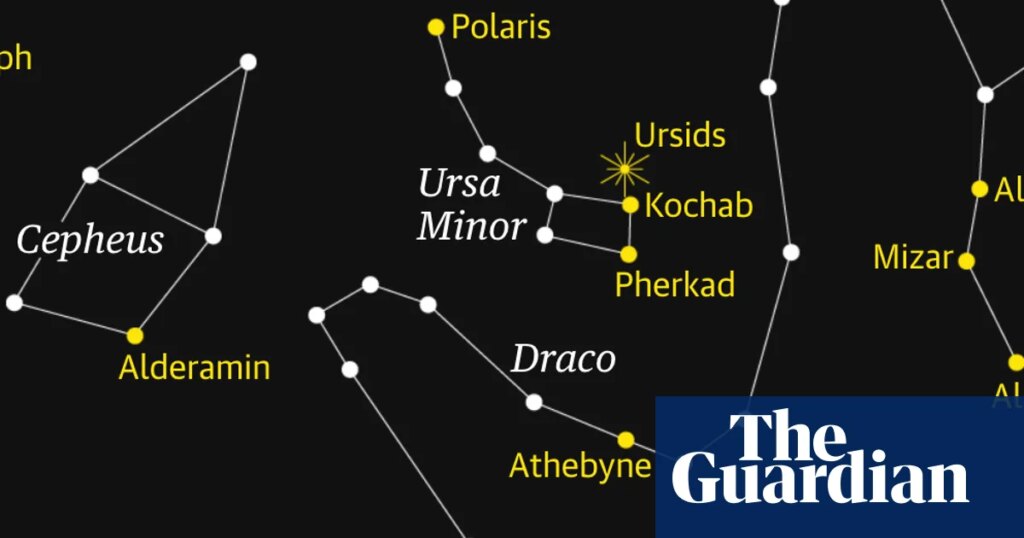
If the Geminids whetted your appetite for meteor showers, then you are in luck. This week it is the turn of the Ursids. Admittedly, they are nowhere near as plentiful as the Geminids, producing a maximum of just 10 meteors an hour, but there is a unique satisfaction to witnessing one of nature’s subtler events.
The dust grains that make up the Ursids come from the comet 8P/Tuttle, which was discovered in 1858 by the American astronomer Horace Parnell Tuttle, a prolific comet hunter.
The peak of the shower occurs on the night of 22 to 23 December. The meteors radiate from the constellation of Ursa Minor, the little bear. The chart shows the view looking due north at midnight, as 22 December becomes 23 December. Since Ursa Minor is circumpolar from the UK – visible all year round – the radiant will be visible as soon as the sun sets.
Meteor watching always requires patience, especially with a low-frequency shower such as the Ursids. Wrap up extremely warm, especially your feet, and take a deckchair and a blanket so you are not standing for an hour or more.
With the radiant being so far north, the Ursids are not visible from the southern hemisphere.