
- A study analysed over a thousand elasmobranch-related posts from social media and citizen science platforms uploaded from coastal Indian states, and identified 83 species, including rare and endangered species, some protected under Indian law.
- Reef-associated sharks, and coastal-dwelling sharks and rays were the most frequently observed. Almost 15% of species identified were critically endangered as per the IUCN Red List.
- The study authors share that such digital media data can fill gaps left by scientific research, which is often localised, misses interactions with rare species, and lacks socioeconomic nuances.
It was March 2020, and the COVID-19 lockdown had begun. Divya Karnad and her colleagues at InSeason Fish — an initiative promoting sustainable seafood consumption in India — could no longer approach fish landing centres or seafood restaurants for their work. They turn to social media and to their surprise, unearth a plethora of insightful photos of sharks and rays along India’s coastline. Posts from tourists, seafood consumers, fishers and others revealed a host of marine species — many that were on the IUCN Red List, and some that rarely even found adequate representation in existing scientific research.
“The lockdown led to this sudden boom of photographs being posted from fish markets and fish landing sites. There were selfies with baby sharks in the background, or photos of menus and dishes from restaurants,” says Karnad, who has been researching marine fisheries since 2010 and is a co-founder of InSeason Fish. Karnad is now based at the University of Exeter in the U.K.
The team analysed 1,293 elasmobranch-related posts, from six social media and citizen science platforms, uploaded from all coastal states. The findings were published in Aquatic Conservation: Marine and Freshwater Ecosystems, in November 2025.
The paper suggests that digital media can fill several gaps left by research to better understand not only elasmobranchs, but also the larger class of cartilaginous fish in India. Some of these gaps include a focus on charismatic species (such as the whale shark), geographical limitations to major landing sites, and lack of data from the public. Such gaps often play down socio-economic nuances that shape human-elasmobranch interactions.


Sharks on a plate
India ranks second in the world for its contribution to global shark fisheries, following Indonesia, and is among top ray fishing nations too. Previous research by Karnad looked at drivers of elasmobranch consumption in India, an overwhelming majority of which occurs in Goa and Tamil Nadu. The team surveyed 2,649 restaurant menus (of which 292 offered shark meat) between October 2020 and December 2021 and found that restaurants in India were a major stakeholder in domestic supply chains for elasmobranch meat. These findings supported other studies which found domestic elasmobranch meat consumption to be a driver of bycatch fisheries, where incidental catches are not thrown back but retained and sold because there is a market for them.
The recent study went a step further to paint a wider picture of elasmobranch perceptions and use over the decades, analysing posts from 2004-2022 from Instagram, Facebook, Twitter, Flickr, iNaturalist and Google Maps. “We realised that citizen science and social media platforms could give us the insights we couldn’t get from these individual studies,” says Karnad. “We haven’t had much conservation- or social science-oriented data on sharks and rays, and I think our data provides that.”
“Papers from U.S.A, Australia and other regions talk about the ‘Jaws’ effect that led to widespread fear of sharks and rays. But in India, for the most part, a majority of the posts talked about them as ingredients,” explains Karnad. “Though the number of post captions talking about the conservation status of the species were very few, they had a lot of engagement.”
Shruthi Kottillil, a co-author of the study, adds that people often posted about smaller sharks and rays in neutral ways, “whereas for bigger animals like the reticulate whipray, leopard whipray, manta ray, or bull shark, people were more sympathetic about it being caught or consumed.”
The study authors manually went through all posts to identify 83 species — 37 shark and 46 ray species. Reef-associated sharks, and coastal-dwelling sharks and rays were the most frequently observed. Almost 15% of species identified across platforms were critically endangered as per the IUCN Red List, while 29% were endangered and over 30% vulnerable.
They share that among all the species they documented, some were protected under the Wildlife Protection Amendment Act, 2022. However, of the most common species being consumed, based on their social media research, only one species was protected under the Act. Among the species they documented, some listed under Schedule I and II include whale shark (Rhincodon typus), smooth hammerhead shark (Sphyrna zygaena), widenose guitarfish (Glaucostegus obtusus), giant manta ray (Mobula birostris), bowmouth guitarfish (Rhina ancylostoma), bottlenose wedgefish (Rhynchobatus australiae), smoothnose wedgefish (Rhynchobatus laevis), porcupine whipray (Urogymnus asperrimus), and Chilean devilray (Mobula tarapacana).

Debating the role of media in conservation
Karnad shares that the surveys conducted by government research institutes on the species of sharks and rays being landed are restricted to specific ports and harbours. “Though they conduct many surveys, the coverage cannot be very extensive. Unfortunately, in India, people are bringing boats into every beach and landing there. They (government research institutes) cannot determine the full extent of what being caught where. Private institutes or researchers survey even smaller areas.” She adds that such surveys also don’t take into account the dynamic nature of people’s perceptions, and the constant shifts in harvest and use of sharks and rays.
Sudha Kottillil, another co-author of the paper, points to an underrepresentation of rays in the perspectives of consumers, a nuance that scientific research misses. “A lot of people associate use-oriented values to sharks and rays — they don’t see them as predators or dangerous animals, or from the conservation angle. There was also a bias towards sharks — even if there were charismatic rays like manta rays present in the photo, the captions largely mentioned only sharks,” she says.
Social media also reveals landings of rare species that systematic landing surveys don’t capture. “For example, the last time I encountered the broadfin shark [listed as endangered on the IUCN Red List] as part of a scientific study was nearly 10 years back. But I’ve come across it on social media posts more recently,” says Karnad.
Rajeswari B.T., who is a senior research assistant of the Oceans and Coasts programme at Nature Conservation Foundation-India, offers a different perspective based on her field work in Lakshadweep. “This is a fascinating initiative and makes use of the growing use of social media in places like Lakshadweep, where fishers and local citizens are sharing their unusual sightings all the time. Like all citizen science projects involving social media platforms, analysing this data for more scientific purposes will need a certain amount of care, given that it is still a small self-selecting community of people who use these platforms. But this is a wonderful start, and is very encouraging,” she says.
She offers the example of studies in North America that suggest that raccoons are increasingly domesticated, based on social media photos of their behaviour in cities from iNaturalist. “However, the photos are inherently biased as people will only take the photos when the racoons come near their homes. We must consider nuances beyond what social media can offer.”
Rajeswari, also a social scientist, pointed out that elasmobranchs are a part of Lakshadweep’s cultural makeup, and have been fished for centuries. “This is not merely about food but linked vitally to identity and local ecological knowledge. Any efforts need to build on this cultural foundation if we have to sustain elasmobranch numbers in Lakshadweep waters.”
Elasmobranch species may play such crucial roles among several fishing communities across the mainland. For fishers who dwell in areas with low resource availability, livelihood, sustenance and culture intertwine with many species, conservation may be an ideal that is difficult to relate to. Food is not just something that fills their stomach, but tied to identity, traditional skills, recreation, and well-being.
Read more: India’s nearshore fisheries overlap with shark and ray habitats
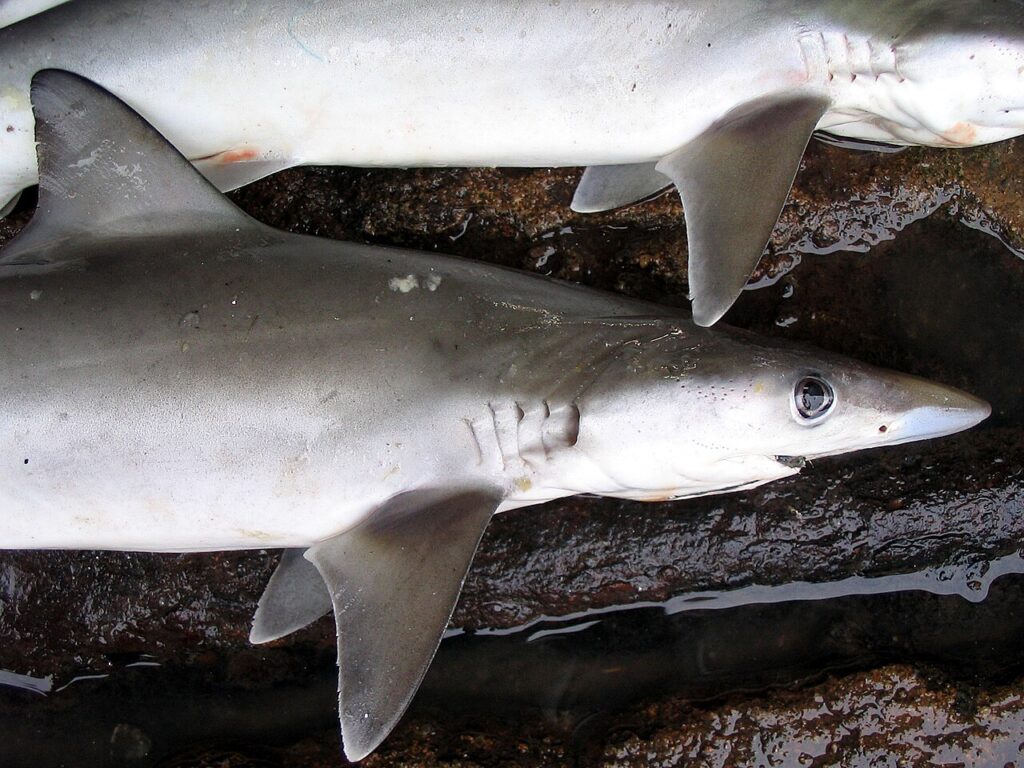
Banner image: Young milk sharks caught by fishers at a wharf in Mangalore, Karnataka. Image by Karunakar Rayker via Wikimedia Commons (CC BY 2.0).

