- A new study on urban nature-based solutions in the Global South finds that biodiversity is often side-lined in planning and implementation.
- A major gap is the absence of biodiversity baselines, making it difficult to assess ecological change before and after interventions.
- Researchers emphasise prioritising native species to support resilient, locally adapted ecosystems.
- Experts also flag implementation challenges in India, including knowledge gaps, weak institutional capacity, and limited community participation.
As the world looks for long-lasting solutions to environmental challenges, nature-based solutions (NbS) are often presented as a promising pathway. A new study assessing the benefits to biodiversity from NbS in urban areas of the Global South aims to better understand how effectively these interventions address urban challenges.
The study, published in Ecological Indicators, found that biodiversity is rarely the primary focus of NbS projects in urban areas. The researchers from the Indian Institute for Human Settlements (IIHS) and the Ashoka Trust for Research in Ecology and the Environment (ATREE) explain in the paper that most projects prioritised societal benefits, such as flood control or heat reduction, over climate mitigation and biodiversity conservation.
Ambiguity around nature-based solutions
According to the International Union for Conservation of Nature (IUCN), nature-based solutions (NbS) are “actions to protect, sustainably manage, and restore natural or modified ecosystems” while addressing societal challenges, to deliver human well-being and biodiversity benefits. The term is relatively recent and Western in origin. “The government of India prefers the term ‘ecosystem-based adaptation’, a subset of NbS that engages directly with climate-related challenges,” says corresponding author Jagdish Krishnaswamy, Dean at the School of Environment and Sustainability at the Indian Institute for Human Settlements.
Because the term NbS is not widely used in India, many initiatives go underreported, particularly in global research, he adds. Yet interest is growing, especially in urban adaptation and resilience, notes Aarathi Kumar of WRI India. Indian examples exist even if not labelled specifically as NbS, including multifunctional wetlands such as the khazans in Goa, the East Kolkata Wetlands, and urban biodiversity parks like the Yamuna Biodiversity Park.
Experts caution against treating all adaptation projects as NbS. Seema Mundoli of Azim Premji University says Global South cities differ widely in ecology, governance, and history. For instance, Cape Town and Bengaluru share the Global South label but have distinct contexts. In Indian cities such as Bengaluru and Mumbai, shared natural spaces also support livelihoods, making local context crucial. “Our allure is for generalisation, but without understanding local history, ecology, governance, and power relations,” she says.
Missing biodiversity measures
The researchers examined 67 studies published in English between 2013 and 2023 across 83 cities in the Global South. Of these, 55 studies evaluated biodiversity outcomes, and 43% identified specific flora or fauna, indicating a gap in measuring biodiversity gains. A major limitation was the lack of biodiversity baselines. None of the studies included the necessary pre-intervention assessments needed to measure biodiversity gains effectively.
According to ecologist Priya Ranganathan of ATREE, a co-author of the study, the absence of baseline data makes it difficult to fully understand the biodiversity benefits of a project. The study also highlights the absence of ecologists in many NbS projects as a drawback. Researchers found that having at least one ecologist or biologist in the author team significantly improved the reporting of species-level biodiversity outcomes, and the presence of a biologist increased the odds by nearly five times.
“Many projects around the world do not include ecologists. For instance, if they are going to put a floating island, an ecologist is needed to know whether the intervention will even suit the species they want to conserve, and what species are there to conserve,” Ranganathan explains.
She also raises concerns about how haphazardly NbS projects are often planned. Decisions may be made reactively. For example, building houses around a lake while leaving the remaining land as a buffer, and then constructing a dike after flooding to prevent water from spilling onto roads. Such measures can disrupt ecological connectivity, preventing fish from moving between water bodies.

Prioritising native biodiversity
Another drawback the study highlights is the tendency to count the presence of exotic and invasive species as benefits within net ecosystem services, despite NbS being defined around the use of native biodiversity. The researchers found that the use of exotic, and particularly invasive species in blue-green infrastructure can often lead to ecosystem disservices rather than benefits.
Ranganathan explains that urban planting decisions frequently prioritise fast growth, aesthetics, or food value for local communities. “But planners are not necessarily thinking about whether the species are native or not,” she says. She adds that non-native species often colonise faster than native ones. “The species that do best have no competition, and they can outcompete natives,” she warns.
The ecological consequences can be significant. Widespread non-native flora may alter soil and water quality in ways that require substantial effort to reverse. “Sometimes they change the soil quality, the water quality; you have to work doubly to try and manually overhaul,” Ranganathan notes. She emphasises the need for regulations that prioritise native species in NbS projects.
Krishnaswamy, however, calls for a balanced approach, noting that completely avoiding exotic species is often impractical in cities. “For instance, Bengaluru has quite a few exotic species, and many are supporting native biodiversity. We can’t become purists about native species in a city environment like we might in semi-wild or natural ecosystems. But there should be a balance, and native species should be prioritised,” he says.
Not just a checkbox
In the Global South, some NbS such as green roofs, urban forests, and urban green spaces are more popular and more reported than others. In urban India, there should be more focus on vertical gardening, permeable pavement, and green roofs, according to Ranganathan. She says there is a need to look at sustainable ways of growing a city and that these measures have a better chance of being implemented than creating a park.

Krishnaswamy agrees that green roofs can be a valuable NbS for India, but says their design must be guided by more rigorous questions. “Does it include different types of biodiversity? For example, are bees, birds or bats able to benefit from it or find habitats? Are they performing ecological functions? Do they help keep the neighbourhood cool? Not just aesthetically, but also functionally, is this good for the area?” he says. He adds that such questions should be integral to the planning process for all NbS projects.
Krishnaswamy also emphasises the need to unpack and clearly define the “nature” component, from baseline conditions to final outcomes. Doing so, he says, can help ensure NbS projects remain results-based interventions rather than a checkbox exercise.
Addressing the gaps
Nature-based solutions also risk being viewed too simplistically, even though in practice they require substantial pre-feasibility assessments to identify the right intervention for the right place and time, says Aarathi Kumar. She adds that this preparatory phase is often overlooked by stakeholders.
A major hurdle arises when NbS is introduced late in urban planning processes. This results in limited clarity on the training and skill sets required, realistic timelines for implementation and maintenance, and the funding needed to sustain projects. Kumar points out that many NbS initiatives are designed with timelines of two to three years, whereas seven to eight years is often necessary for them to fully mature and deliver benefits.
There is also a significant knowledge gap. “Urban planning education in India rarely includes ecology and is often limited to roads and infrastructure. Now, suddenly, if we want to integrate NbS in plans, planners are going to rely on whatever base knowledge they have,” explains Mundoli.
Experts further emphasise the need for meaningful community participation at every stage. This includes equitable sharing of resources so that poorer neighbourhoods also benefit from NbS projects, notes Ranganathan.
Krishnaswamy stresses the need to build NbS awareness across local communities, government agencies, and the corporate sector. He adds that institutional campuses can also play an important role in scaling up NbS by adopting biodiversity-friendly practices.
As a key takeaway, the study highlights the need for stronger documentation and evidence generation to improve understanding of NbS outcomes. Krishnaswamy also calls for a shift in perspective, arguing that NbS should be approached through a landscape ecology lens. “The focus should be on building a network of connected NbS sites so the city’s ecology can benefit overall,” he says.
Read more: Urban green spaces can save more lives if placed right
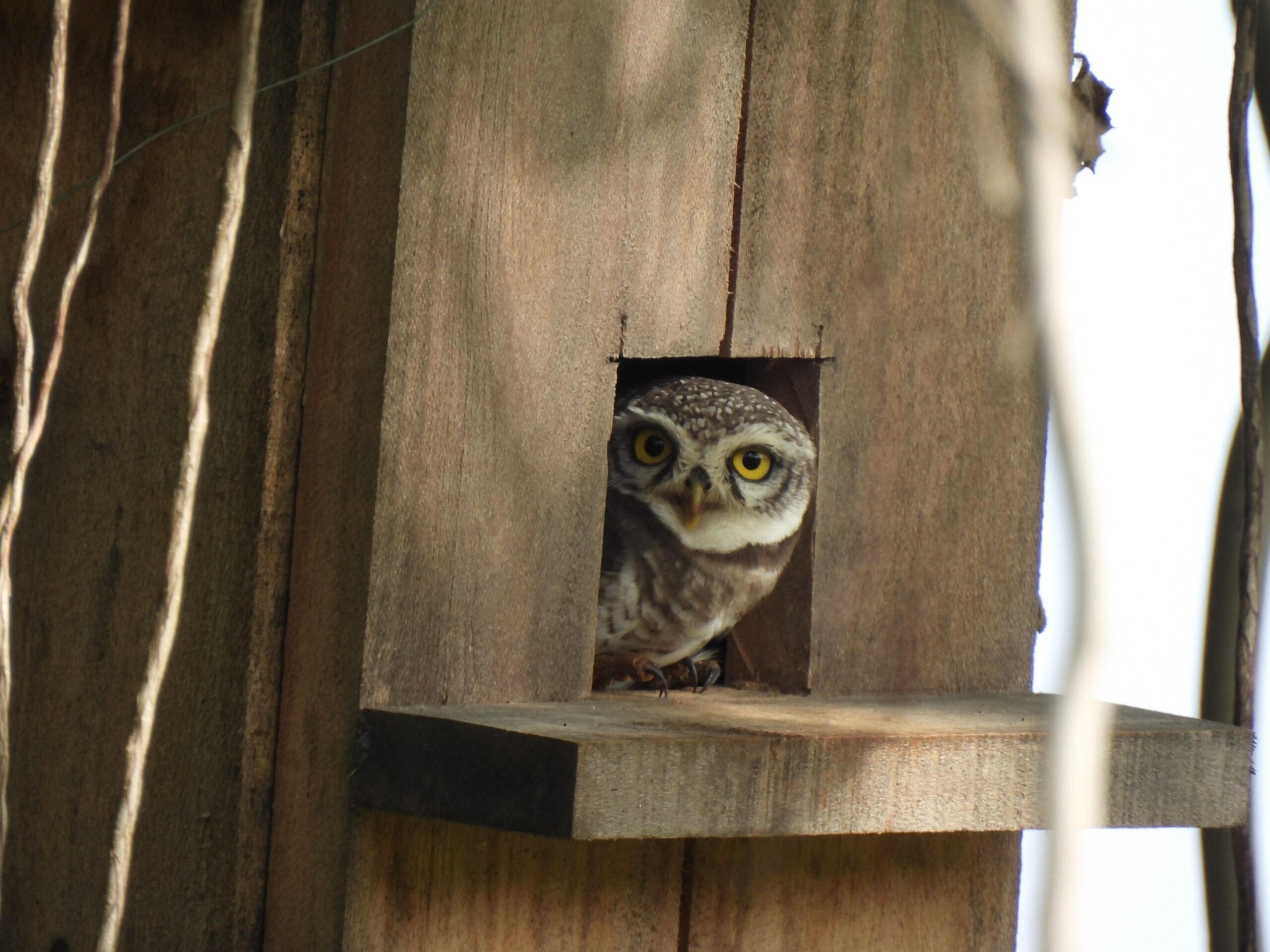
Banner image: A spotted owlet at IIHS Kengeri campus, Bengaluru. Image by Jagdish Krishnaswamy.