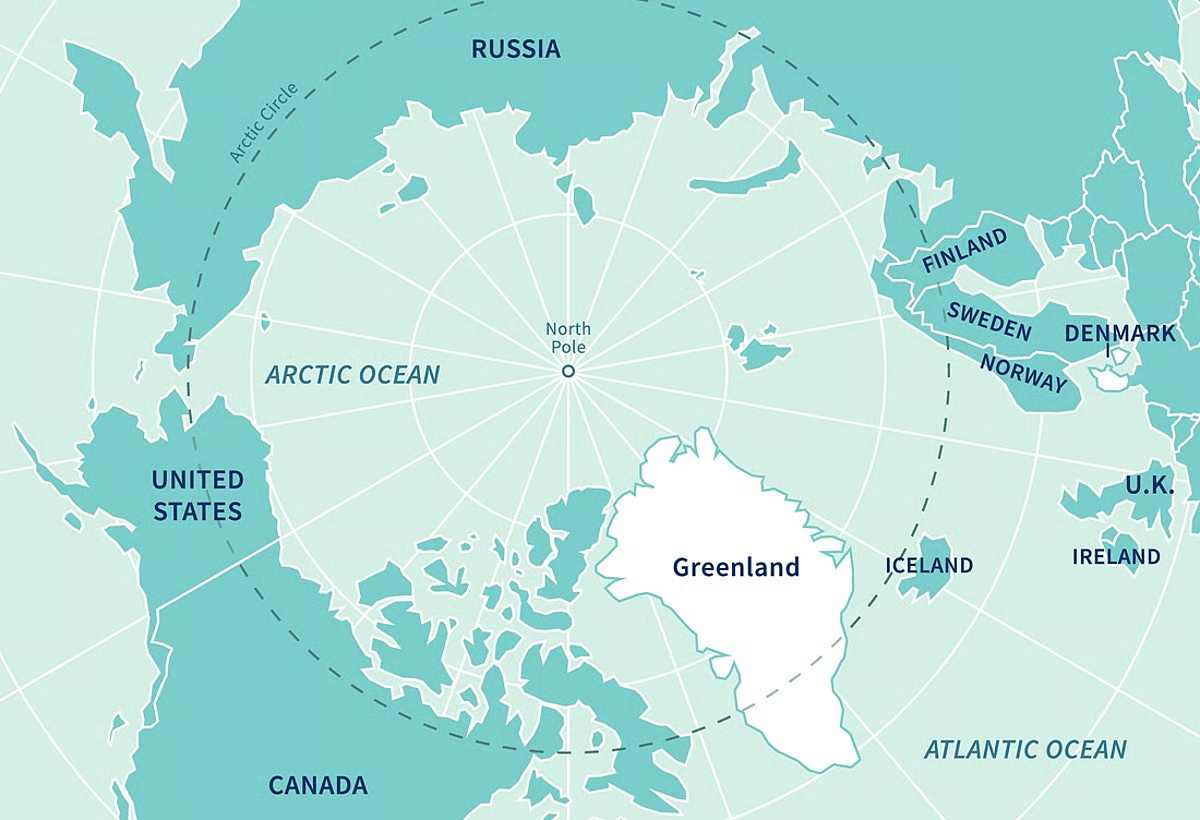
Arctic rivers, which pour vast volumes of freshwater into the Arctic Ocean, influencing seawater salinity, sea-ice formation and ocean circulation, respond differently to climate change, according to a new study.
While some areas are becoming wetter, others — such as the Mackenzie River basin — are experiencing declining runoff, according to the researchers.
In other words, the Arctic in general is not simply becoming wetter or drier — its water cycle is reorganising.
15 river basins
The research team developed a new way to assess river flow and runoff across the Arctic from space through the European Space Agency’s Earth Observation Science for Society STREAM-NEXT project.
A paper published recently in the journal Remote Sensing of Environment describes how scientists used satellite observations to estimate river discharge and runoff across the entire Arctic region between 2003 and 2022.
The team used data from the 15 largest Arctic river basins and then extended to ungauged regions, enabling the creation of a daily pan-Arctic dataset of runoff and river discharge based exclusively on satellite data.
The river basins include:
1. Kolyma
2. Lena
3. Mackenzie
4. Ob
5. Yenisey
6. Yukon
7. Indigirka
8. Mezen
9. Nadym
10. Northern Dvina
11. Olenek
12. Onega
13. Pechora
14. Pur
15. Yana
The researchers estimated that Arctic rivers deliver roughly 4,760 cubic kilometres of freshwater to the Arctic Ocean annually, consistent with gauge-based estimates and thereby increasing confidence in the new approach.
About 80 per cent of this freshwater originates from Eurasian river basins, highlighting the dominant influence of Siberian watersheds on Arctic Ocean conditions.
“One of the study’s most important findings is that Arctic hydrological change is not uniform. Between 2003 and 2022, trends in runoff varied widely across regions, as the map shows. Some areas experienced increasing runoff, while others showed declines,” a statement by the European Space Agency noted.