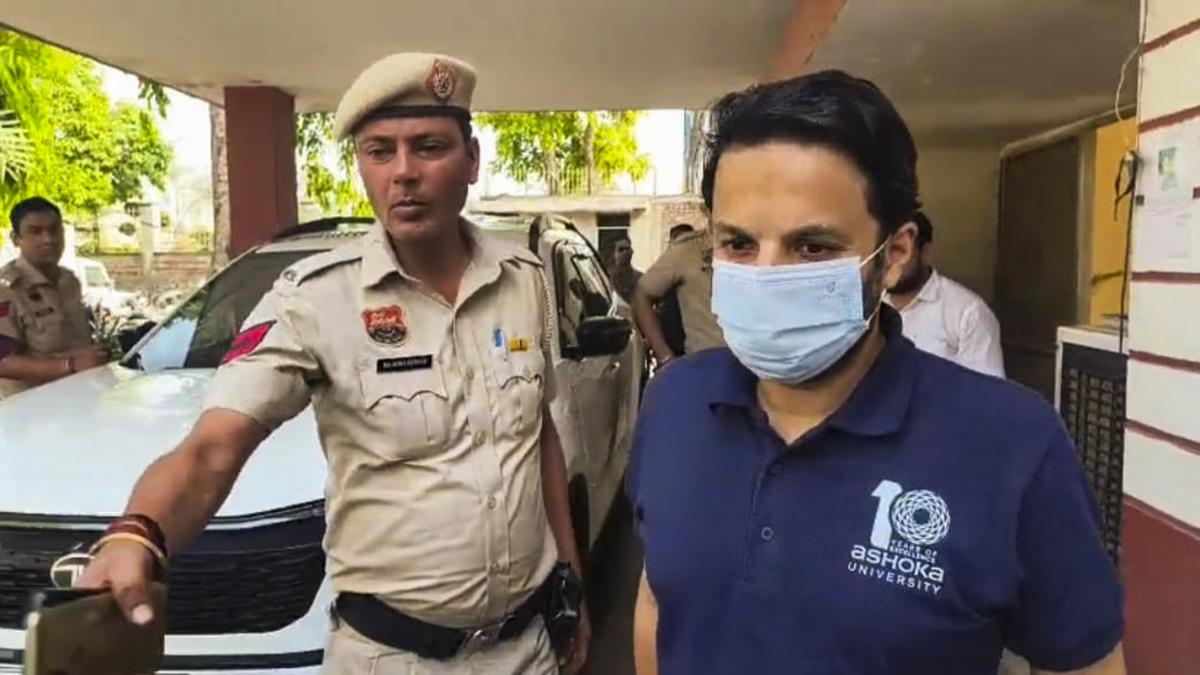
Ashoka University professor Ali Khan Mahmudabad being escorted by police personnel after his arrest, in Sonipat, Haryana, on May 18, 2025.
| Photo Credit: PTI
The Supreme Court on Tuesday (January 6, 2026) suggested that the Haryana government show Ashoka University professor Ali Khan Mahmudabad, facing criminal investigation for two contentious social media posts on Operation Sindoor, a “one-time magnanimity” by not giving sanction for his criminal prosecution.
A Bench headed by Chief Justice of India Surya Kant made the proposal to the State government after learning that Haryana has been sitting on the grant of sanction since August 2025, following the filing of the chargesheet against Mr. Mahmudabad in the trial court.
The trial judge would be unable to take cognisance of the case and move ahead with the proceedings unless the State government, which is the competent authority, grants prosecution sanction.
“The competent authority (Haryana government) can take a lenient view and as a one-time magnanimity not grant sanction so that the matter could be closed,” Chief Justice Kant observed.

Additional Solicitor General S.V. Raju, for Haryana, was granted six weeks to get instructions from the State and revert to the court on the suggestion. Meanwhile, the trial court would continue to not take cognisance of the chargesheet against the academician.
The Chief Justice, however, said Mr. Mahmudabad also had a duty to act responsibly.
“The moment they (State) says they are closing (the case), he should not start writing anything irresponsibly. If they show magnanimity, he should also be equally responsible,” Chief Justice Kant remarked.
Senior advocate Kapil Sibal, along with senior advocate Siddharth Luthra, for Mr. Mahmudabad, said “absolutely”.
Also Read | Haryana police yet to respond to notice over professor’s arrest: NHRC
Chief Justice Kant, towards the end of the hearing, expressed confidence that Mr. Mahmudabad would “behave responsibly”.
In an earlier order last year, the court had found that the academician was “entitled” to continue his writings, provided he did not comment on the cases under investigation against him. The Bench had further spared Mr. Mahmudabad from appearing before the Haryana Police Special Investigation (SIT) in connection with the investigation. This was after learning that he had already appeared before the SIT four times in the past and handed over his personal electronic gadgets.
The apex court had appointed the SIT to pour over the two social media posts, to sift through their phraseology to glean subtle nuances or possible “dual meanings” which may amount to a criminal offence.
Mr. Sibal had alleged the SIT travelled beyond its jurisdiction in a bid to expand the scope of the probe. It had even sought details of the professor’s foreign trips in the past. He had referred to a May 28, 2025 order in which the court had specifically asked the SIT to be “confined to the contents of the two FIRs”.

On May 21, the apex court had granted interim bail to Mr. Mahmudabad in the cases registered by the Haryana Police.
The court had suspected the academician of indulging in “dog whistling” through his social media posts. It had tasked the SIT, comprising three senior IPS officers, to “holistically understand the complexity of the phraseology employed and for the proper appreciation of some of the expressions used in the two online posts”.
The Haryana Police had arrested Mr. Mahmudabad on May 18. It was alleged that his social media posts on Operation Sindoor had endangered the sovereignty and integrity of the country.
The two FIRs — one based on a complaint by the chairperson of Haryana State Commission for Women, Renu Bhatia, and the other on a complaint by a village sarpanch — were lodged by Rai police in Sonipat district.
Published – January 06, 2026 02:35 pm IST