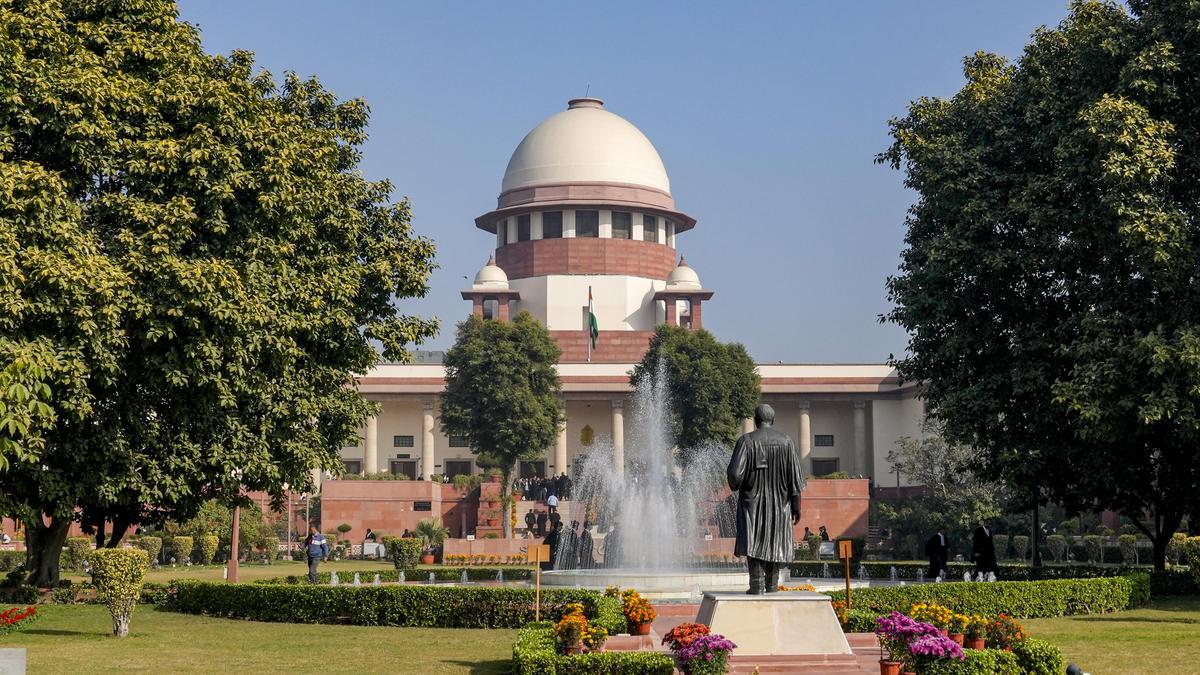
The Supreme Court. File picture
| Photo Credit: PTI
The Supreme Court of India on Wednesday (March 25, 2026) said the January 28 guidelines issued by the Ministry of Home Affairs on playing the National Song ‘Vande Mataram’ in full at public and ceremonial occasions are not a “threat to conform” and do not fall foul of constitutional freedoms.
“There is no threat to conform. It is only an advisory… The Ministry feels the National Song is as much an expression of the national identity. You may have a different point of view. But we feel you are having vague apprehensions of discrimination which do not have a clear nexus with the advisory now… But please come immediately to us as and when you feel you have been discriminated against or singled out on the plank of this advisory,” Justice Joymalya Bagchi addressed petitioner Muhammed Sayeed Noori, represented by senior advocate Sanjay Hegde.

Mr. Hegde began his arguments by noting that the Ministry circular made the singing of the National Song “mandatory” and compelled citizens to participate in a social demonstration of loyalty which goes against one’s individual conscience. He pointed out that the circular has instructed the three-minute National Song to be played before the 55-second National Anthem, reducing the status of the latter to an “epilogue”.
Chief Justice Surya Kant, heading the three-judge Bench, said there was absolutely nothing in the January 28 circular to show that people who did not play or sing the National Song would face penal or adverse action.
“Even if there is no penalty and even if today there is no legal sanction, there is a huge burden on somebody who refuses to sing or stand up,” Mr. Hegde argued.
“What is that burden in law here? The circular prescribes a protocol of when and how the National Song must be played, what is to be done when it is played, etc. We can understand if somebody sends you a notice saying you did not play or stand up for the National Song and your institution should be closed or derecognised as a result,” the Chief Justice reacted.
Solicitor General Tushar Mehta, who was present in the courtroom, intervened to emphasise that respect for the National Song was organic and, ideally, even an advisory was not necessary. He referred to Article 51A of the Constitution, which made it a fundamental duty to respect the National Flag and the National Anthem.
Mr. Hegde said the National Anthem and the National Song were distinct from each other. “The Constituent Assembly of India went over several iterations. It was on January 24, 1950 that Rajendra Prasad, as President of the Constituent Assembly, ended the controversy by saying ‘Jana Gana Mana’ would be the National Anthem and ‘Vande Mataram’ the National Song. When the Parliament subsequently inserted Article 51A [in the 42nd Constitutional Amendment], it spoke only of the National Anthem,” the senior advocate explained.
He said India was a country which paid equal respect to all religions and everyone’s individual conscience, even that of an atheist. Mr. Mehta retorted that it was not as if people were being compelled to sing bhajans.
Justice Bagchi referred to paragraphs in the January 28 circular, one of which said, “In all schools, the day’s work may begin with community singing of the National Song”.
“The expression ‘may’ means you could sing as much as not sing. It allows individual conscience to take the decision,” the judge said.
Mr. Hegde said patriotism cannot be compelled, provoking the Chief Justice to ask if “patriotism cannot be compelled even for the National Anthem”.
“Ultimately, if a Constitution has to mean anything as far as an individual is concerned, it has to protect the individual conscience. That is our national parchment. We tolerate. Tradition teaches tolerance,” Mr. Hegde submitted.
The court refused to entertain the petition, terming it “premature”.
Published – March 25, 2026 01:43 pm IST