Washington — The Supreme Court on Tuesday rejected a bid by the Trump administration to deploy National Guard members to the Chicago area while a legal challenge moves forward, delivering a setback to President Trump in his effort to use federalized troops in Illinois to ensure enforcement of federal immigration laws.
The high court left untouched a judge’s decision blocking the government from putting National Guard members on the streets of Chicago and surrounding areas. The Trump administration had urged the Supreme Court to allow the extraordinary move to deploy the troops over the objection of Illinois’ Democratic governor, arguing that federal courts cannot second-guess the president’s decision to call the National Guard into federal service.
But the Supreme Court declined the administration’s request to freeze that order in a decision that appears to be 6-3. Justices Clarence Thomas, Samuel Alito and Neil Gorsuch noted their dissents.
In an unsigned order, the Supreme Court found that “at least in this posture” the Trump administration has not met its burden to show that Title 10, the law Mr. Trump invoked, permits him to federalize the National Guard “in the exercise of inherent authority to protect federal personnel and property in Illinois.”
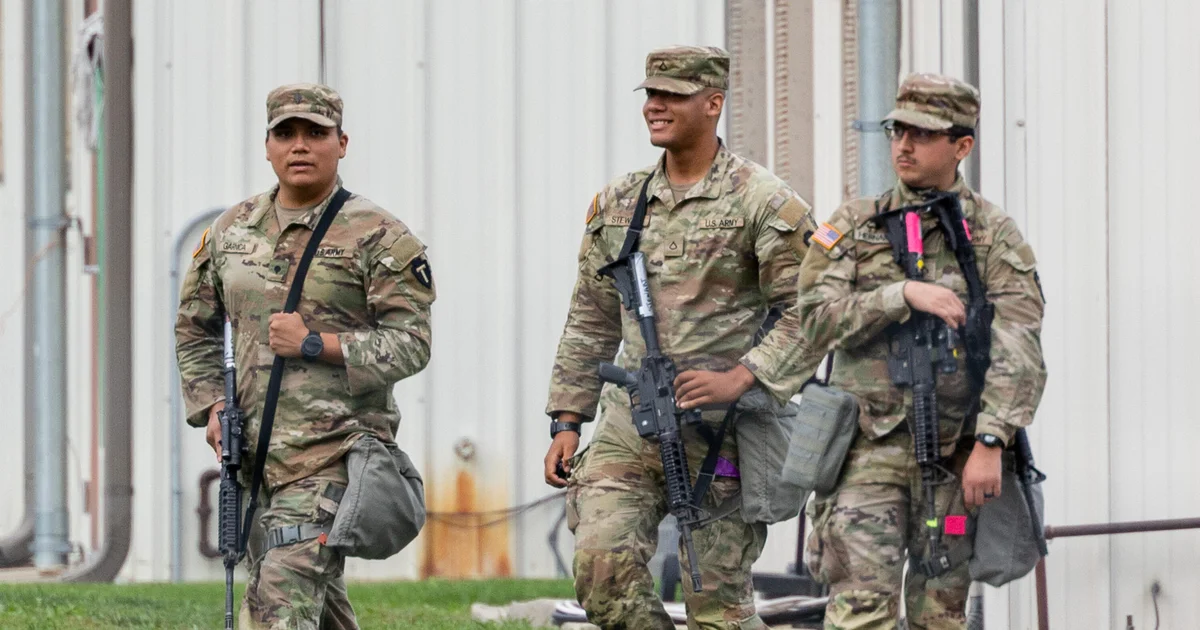
Mr. Trump has brought state-run National Guards under federal control in several U.S. cities as his administration has ramped up immigration enforcement operations. Mr. Trump has so far moved to deploy National Guard units in Washington, D.C., Los Angeles, Memphis, Portland and Chicago to protect federal property and personnel, and he has threatened to send troops to other major cities, including Baltimore and San Francisco.
Two West Virginia National Guard members who were sent to Washington, D.C., were shot in an ambush-style attack near the White House last month. One of the victims died and the other was severely wounded.
As for Illinois, the president issued a memo in early October claiming that federal facilities in the state “have come under coordinated assault by violent groups intent on obstructing federal law enforcement activities,” which he said hindered the execution of U.S. immigration laws.
The directive came after the processing center for immigrant detainees in Broadview, a suburb of Chicago, saw a rise in protests following the launch of an immigration enforcement campaign called Operation Midway Blitz in early September.
Dominic Di Palermo/Chicago Tribune/Tribune News Service via Getty Images
In response, Mr. Trump authorized the federalization of the Illinois National Guard under Title 10. The law allows the president to call into federal service members of a state’s Guard when he cannot execute U.S. laws with the “regular forces” or when there is a “rebellion or danger of a rebellion” against the government.
Roughly 300 troops from the Illinois National Guard prepared to mobilize. Members of the Texas and California National Guards also arrived in Illinois in early October.
Illinois Gov. J.B. Pritzker objected to the president’s move, arguing that there was no public safety need that required the deployment of National Guard troops. The state of Illinois and city of Chicago then sued the Trump administration, arguing Mr. Trump’s federalization of the National Guard is illegal. They sought a temporary order barring the government from mobilizing and sending troops to the Chicago area.
U.S. District Judge April Perry sided with Illinois officials and issued a temporary order blocking the Trump administration from ordering the federalization and deployment of the National Guard within Illinois. In her October decision, she called information from Department of Homeland Security officials about events in Illinois “unreliable.”
“There has been no showing that the civil power has failed,” Perry wrote. “The agitators who have violated the law by attacking federal authorities have been arrested. The courts are open, and the marshals are ready to see that any sentences of imprisonment are carried out. Resort to the military to execute the laws is not called for.”
A unanimous panel of three judges on the U.S. Court of Appeals for the 7th Circuit then allowed the Guard members to remain under federal service, but upheld the portion of Perry’s order forbidding them from being sent out to the Chicago area.
In their decision, the 7th Circuit judges found that the Trump administration failed to satisfy the conditions for invoking Title 10 to call the National Guard into federal service in Illinois.
“Political opposition is not rebellion,” the 7th Circuit judges wrote. “A protest does not become a rebellion merely because the protestors advocate for myriad legal or policy changes, are well organized, call for significant changes to the structure of the U.S. government, use civil disobedience as a form of protest, or exercise their Second Amendment right to carry firearms as the law currently allows.”
The 7th Circuit also found there is “insufficient evidence” that the demonstrations in Illinois have hampered the ability of federal officers to enforce immigration laws.
“Federal facilities, including the processing facility in Broadview, have remained open despite regular demonstrations against the administration’s immigration policies,” the judges said. “And though federal officers have encountered sporadic disruptions, they have been quickly contained by local, state, and federal authorities.”
In seeking emergency relief from the Supreme Court, the Trump administration argued that courts cannot review the president’s decision to call up the National Guard.
“A federal district court lacks not only the authority but also the competence to wrest control of the military chain of command from the Commander in Chief and to adjudicate whether the Governor of Illinois, rather than the President, should be in ultimate command of particular Guardsmen after the President has called them into federal service,” Solicitor General D. John Sauer wrote in a filing.
Sauer also argued violence and threats of violence have impeded immigration enforcement operations and forced the Department of Homeland Security to divert resources away from law enforcement activities to protect federal buildings and officers.
“The National Guard’s deployment would protect lives and federal property, deter acts of violence, free up resources for actual law enforcement, and assist federal law enforcement in carrying out their duties effectively,” he said.
Illinois officials, meanwhile, argued that state and local law enforcement have effectively handled the protests outside the Broadview facility. They warned that allowing National Guard troops onto the streets in the Chicago area could spark confrontations.
“[T]he unnecessary deployment of military troops, untrained for local policing, will escalate tensions and undermine the ordinary law enforcement activities of state and local entities, which would need to divert resources to maintain safety and order,” they wrote in a filing.
The Trump administration asked the Supreme Court to intervene in mid-October, but the high court sought additional information from government lawyers and Illinois officials about whether the term “regular forces” refers to the U.S. military.
Beyond Illinois, Mr. Trump’s use of the National Guard in Los Angeles and Portland has set off legal challenges brought by officials in those states. Two trial court judges in California and Oregon initially blocked the Trump administration from deploying National Guard units to areas of those states. But separate three-judge panels on the U.S. Court of Appeals for the 9th Circuit issued decisions allowing the Trump administration to deploy members of the California National Guard within Los Angeles and the Oregon National Guard in Portland while the legal proceedings continued.
The full 9th Circuit declined to reconsider the panel’s decision as to the California National Guard. A district judge in December then again blocked the Trump administration’s deployment, and that order has been appealed.
But as to Oregon, a federal judge held a three-day trial and issued a ruling last month finding that the president did not have a lawful basis to federalize the National Guard. She permanently blocked the Trump administration from deploying National Guard troops to Portland. The Justice Department appealed the decision to the 9th Circuit, and the chief judge for the appeals court allowed the Oregon Guard troops to remain under federal control while proceedings move forward.
While the 9th and 7th Circuits have split on whether Mr. Trump can send National Guard troops into cities, they agree that courts can review the president’s use of Title 10 to call the units into federal service.
In Washington, D.C., a federal judge ruled last month that his National Guard deployment there violates federal law. The judge paused her decision for 21 days to allow the Trump administration to appeal.