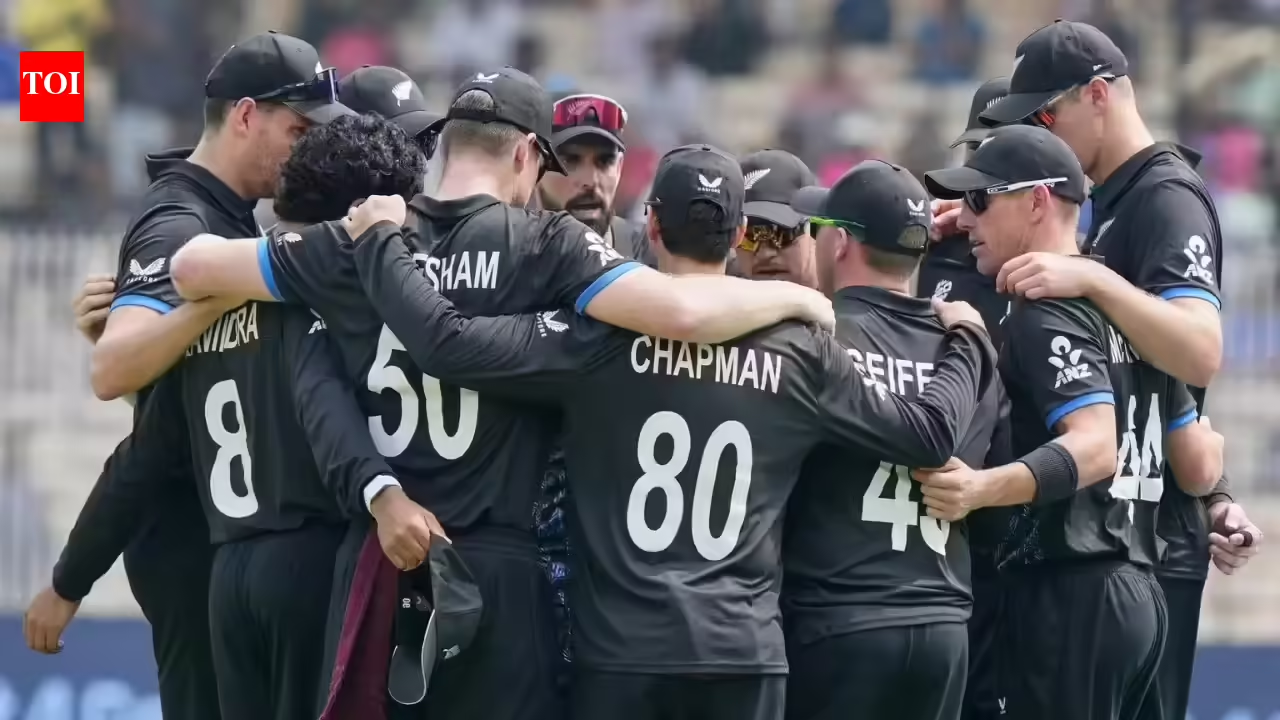
Big picture: Two teams among the middle powers
For New Zealand, the biggest challenge is the switch of venue. They played all of their games in Chennai and Ahmedabad, and relied on a balance between seam and spin that leaned towards the former, with Mitchell Santner the only frontline spinner and Rachin Ravindra or Glenn Phillips chipping in with the odd over. In Colombo, that balance is likely to reverse as the slower bowlers take centre stage, something Pakistan have deployed so effectively in most of their matches.
Santner’s men have not tinkered much with the batting order, which has held up remarkably well for the most part. Against weaker oppositions, some combination of openers Finn Allen and Tim Seifert, or top order batters Ravindra and Phillips, have showcased enough firepower to ease home. Opposition attacks have also struggled to puncture their way through, with New Zealand losing just 14 wickets in four games, the second fewest for any side in this tournament.
Unlike New Zealand, Pakistan know this city intimately well by now. Three of their four games may have been played at the SSC – the other Colombo ground – but their match against India here at the RPS was, like Saturday’s contest, also an evening game, giving them a valuable read into the pitch and conditions. It is the venue they used more spin on than any other, with captain Salman Ali Agha suggesting that would only continue in the Super Eight.
Pakistan’s top order has the explosiveness to blow teams away, even if they have struggled to translate that potential with form for Saim Ayub. Sahibzada Farhan at the other end has taken on the mantle for powerplay run-scoring as runs for Agha having dried up before the game against Namibia, and Babar Azam no nearer to maximising his ability. That fragility too quickly brings up a middle order comprising too many bowling allrounders or the untested Khawaja Nafay, a situation that led to a near-defeat against the Netherlands and a decisive defeat against India.
This is two teams situated among the middle powers of this World Cup, eager to demonstrate they’re better than what they managed against true superpowers like India and South Africa. What matters, ultimately, is which of them can show they’re better than the middle power they face off against on Saturday.
Form guide
New Zealand: WLWWL (last five completed matches, most recent first)
Pakistan: WLWWW
In the spotlight: Jacob Duffy and Abrar Ahmed
Team news
Abrar Ahmed is expected to come back into the side, but Pakistan will not want to make wholesale changes to a team that delivered so handsomely in their must-win game against Namibia.
Pakistan: 1 Sahibzada Farhan, 2 Saim Ayub, 3 Salman Ali Agha (capt) 4 Babar Azam, 5 Khawaja Nafay, 6 Shadab Khan, 7 Usman Khan (wk) 8 Mohammad Nawaz/Faheem Ashraf, 9 Salman Mirza, 10 Usman Tariq, 11 Abrar Ahmed
New Zealand will take a late call on Lockie Ferguson, who gets into Sri Lanka on Friday night after being granted paternity leave. It will be interesting to see how New Zealand manage to incorporate more spin into their XI to reconcile with Sri Lankan conditions. That might bring Ish Sodhi in for his first game this World Cup.
New Zealand: 1 Tim Seifert (wk), 2 Finn Allen, 3 Rachin Ravindra, 4 Glenn Phillips, 5 Mark Chapman, 6 Daryl Mitchell, 7 Mitchell Santner (capt), 8 Jimmy Neesham, 9 Matt Henry, 10 Ish Sodhi 11 Jacob Duffy
Pitch and conditions
The Premadasa surface is likely to be more conducive to spin bowling than its Sinhalese counterpart, and with bigger boundaries that makes run-scoring an even bigger challenge. A notable exception, though, was Zimbabwe’s high-scoring win over Sri Lanka on Thursday, on a belter of a batting surface. There is a mild chance of evening showers.
Stats and trivia
- Abrar Ahmed’s T20I economy rate against New Zealand is 8.44, more expensive than against any other T20I opposition.
- New Zealand’s collective strike rate at this tournament is 165.94, the highest for any side this tournament. Pakistan’s is 135.54, the lowest among teams to have qualified, though they have played all their matches on the slower Sri Lankan surfaces.
- While New Zealand have won 12 of their last 16 T20Is against Pakistan, Pakistan have enjoyed the better of their contests at T20 World Cups, winning five out of seven matches.
Danyal Rasool is ESPNcricinfo’s Pakistan correspondent. @Danny61000