
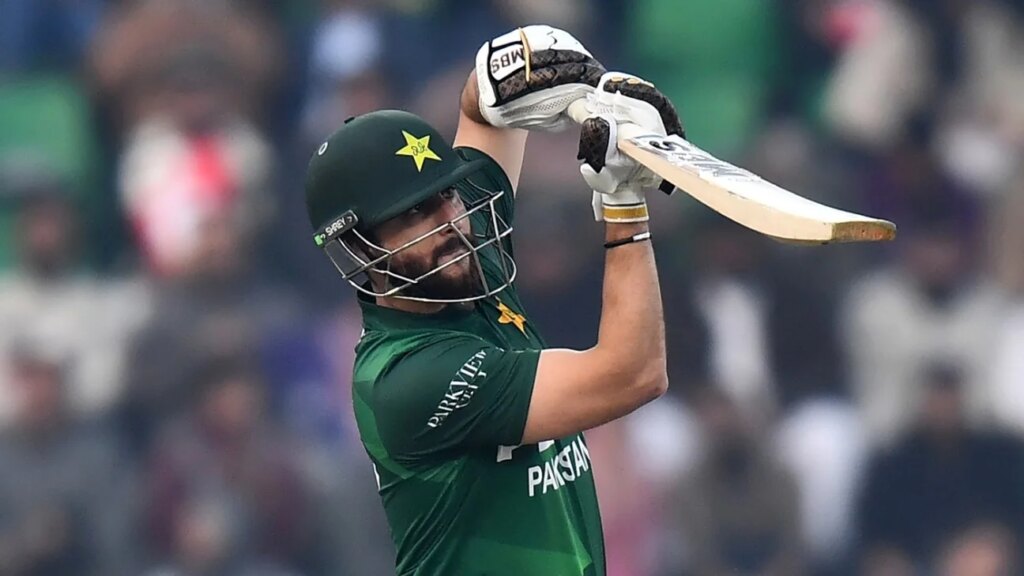
Since the end of the 2024 World Cup, no Full Member nation has played more T20I cricket than Pakistan’s 47. In that time, they have undergone extensive upheaval. There have been multiple captaincy changes, a complete overhaul of the coaching staff, and mixed results in international tournaments and series – they have won 27 games and lost 20.
Leading this renaissance has been Agha, who took over the side in March. His career stats of 856 runs at a strike rate of 122.63 in 45 T20Is aren’t too impressive, but the 32-year-old has found a rich vein of form for himself since November.
“I think there was a time between tri-nation series against Sri Lanka and Zimbabwe – maybe a month or so – for me to analyse my game… I was not doing well in T20s. I was doing well in Test matches and one-dyers, but I was not able to bring that game to T20s.”
It’s an admittedly small sample size. But following scores of 1, 0, and 1* to start the tri-series, Agha has struck 258 runs – around 30% of his T20I career runs – at a strike rate of 170.86.
“I used to go with [into] batting as a captain, but now, I’m not. I’m just going as a batter, [to] just go and express myself and enjoy the game. So I think I’ve learnt how to put that captaincy away when I go to bat and it’s certainly [changed] my technique as well. But I think mostly it’s mindset.”
On the other hand, a Pakistan batter who has been struggling is Babar. At the end of 2024, he was dropped for 10 months before being recalled in October. But his comeback hasn’t gone quite according to plan, as highlighted by a strike rate of just 117.01 over 11 innings.
“He has been working on his game, because he knows he needs to up his game,” Agha said when asked about Babar’s shortcomings. “Which is good. If the batter knows and he’s trying, that’s all you can do. And he’s a very, very key player for us in these conditions. Because he’s someone who will give us stability, that’s what his role is going to be… If he’s in form and scoring runs, Pakistan will mostly win games.”
“We’ll only play who [is] the best for the team. Fakhar in the last ten years has done amazingly well, same [with] Babar, and I support them fully. But what’s best for the team is what we’ll play.”
Looking ahead to the tournament opener against Netherlands, Agha was unsurprisingly questioned on whether there would be any added pressure on the side to perform, even against Associate nations, since they are forfeiting two points by boycotting the game against India.
“I don’t think there’s extra pressure. Whenever you come into an ICC tournament, you have to win almost all your games anyway. That’s the mindset we’ve come with, to play our best and win all of them.
“It is very important [to bring you A-game] because sometimes you haven’t played much against these sides, and we don’t really know their weakness and strength, and the players as well.”
There will also be one eye on the weather; there has been unseasonal rain in Colombo. Agha, however, approached the forecast with a focus on the on-field action instead. “The weather is not in our control. As a team, you only worry about what’s controllable. We [have] just won a series against Australia, and we just want to replicate that series here… Batting, bowling and fielding – just keep doing that in every single game.”