
It includes reducing leakage, improving reuse, harvesting rainwater and managing demand through better planning and pricing. Crucially, it highlights the need for baseline data, clear targets and regular monitoring to ensure that efficiency gains are real and measurable.
At the national level, the Bureau of Water Use Efficiency has been set up under the National Water Mission to develop water conservation codes, efficiency standards and guidance for water-using fixtures and equipment. While this marks progress, BIS-aligned standards and urban conservation codes are still being finalised. As a result, mandatory enforcement across cities has yet to begin.
Some cities, including Delhi, have initiated steps towards better measurement and demand management. In the NDMC area, a Rs 31-crore project to install over 20,000 smart water meters has been approved to improve billing accuracy, leak detection and monitoring of consumption, with completion expected by 2026. Smart-meter-based billing reforms have also been proposed under the Delhi Jal Board.
However, there is still no publicly reported evidence of a citywide reduction in non-revenue water. Smart metering, network zoning and leak-control systems have not been implemented across the entire city. This gap between policy intent and on-ground outcomes explains why Delhi’s water losses remain extremely high despite multiple initiatives.
Delhi’s water situation: Stress, losses, pollution
Delhi’s water crisis is shaped by three interconnected problems: high losses, excessive consumption and poor wastewater management.
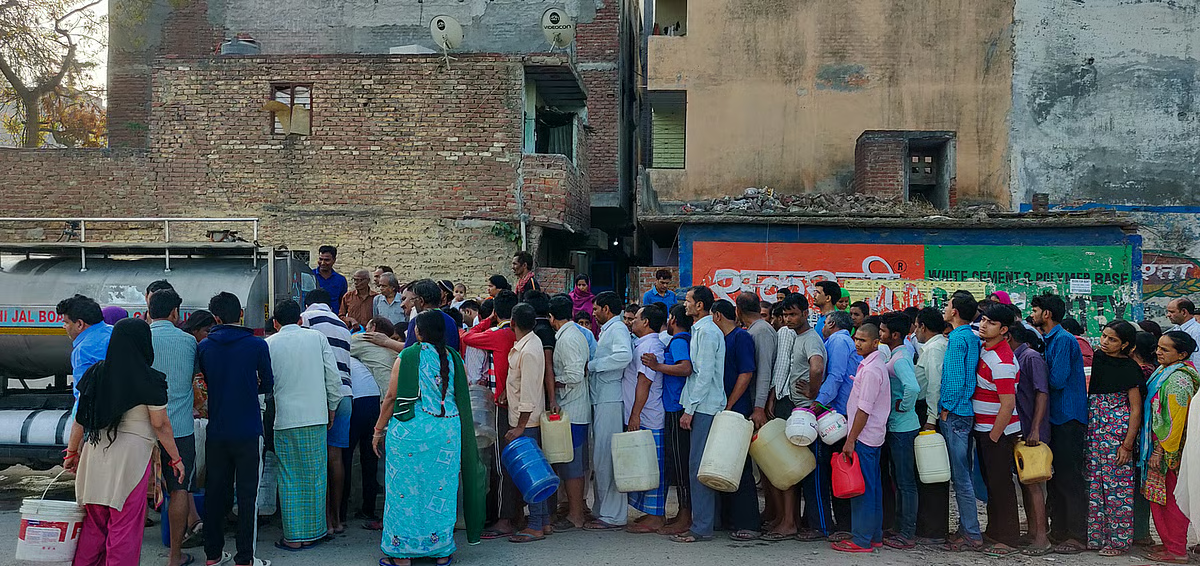
The city depends heavily on water imported from the Yamuna and Ganga basins, yet many neighbourhoods face irregular and unreliable supply. A major reason is that a large share of treated water never reaches users. The Economic Survey of Delhi 2023–24 estimates that around 58 per cent of the city’s water is non-revenue water, lost through leaks, illegal connections and poor metering. Media reports place losses at around 55 per cent, largely due to ageing pipelines and weak system control.
In effect, more than half the water Delhi treats disappears before it can be used, creating an artificial scarcity.
At the same time, over-consumption is widespread in affluent colonies, hotels, offices and government buildings, where water use far exceeds the national service norm of 135 litres per person per day. Large volumes are spent on watering lawns, washing vehicles, cooling and other non-essential uses, as documented in CSE’s water-efficiency and fixture-use studies.