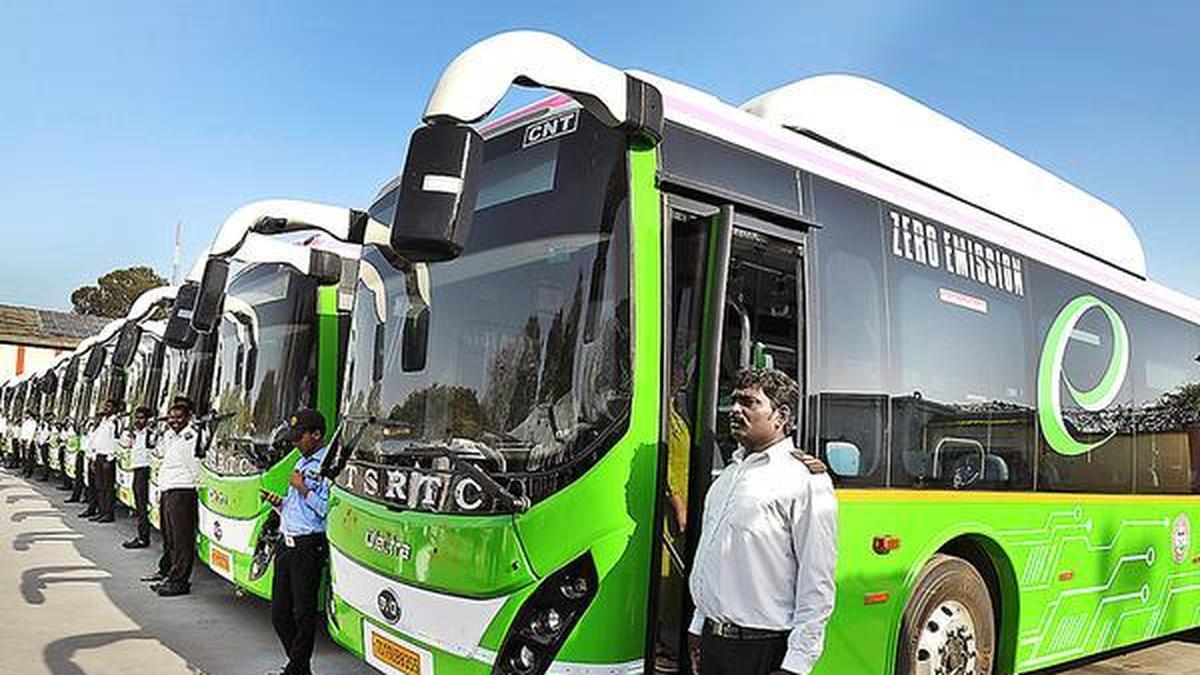
Telangana Government proposes to have electric buses as 80% of TGRSRTC’ total fleet. The image is used for representative purposes only,
| Photo Credit: NAGARA GOPAL
Telangana Government has decided to make it mandatory for schools and organisations with sizeable employees strength to ensure electric vehicles constituted at least 25% to 50% of their transport fleet.
A comprehensive policy in this direction is being actively worked out and the guidelines will be released soon. The Government is trying to ensure that 50% of the vehicles owned by different departments and officials are electric vehicles. Transport Minister Ponnam Prabhakar told the Legislative Assembly on Tuesday (January 6, 2026) that discussions were held with representatives of the companies manufacturing electric vehicles where they were asked to give concessions to Government employees who are opting for electric vehicles in place of those running on conventional fuels.
He was responding to the concerns expressed by the members over the increasing pollution levels in the State Capital which was next only to New Delhi. The Government had already put in place a comprehensive policy for promoting the use of electric vehicles exempting this class of vehicles from registration charges and motor vehicle tax.
EVs constitute 2% of total vehicles
As a result, sales of electric vehicles increased significantly in the recent months with EVs constituting 2% of the total vehicles in the State as against 0.03% two years ago. “The decision was taken in spite of the scope for losing ¤900 crore revenue through MV tax and registration charges,” he said.
While promoting electric vehicles for general use, the Government had also decided to replace the buses owned by the Telangana State Road Transport Corporation (TGSRTC) with the electric ones. Accordingly, 875 buses, constituting 8.84% of the fleet were hired and deployed. This was in addition to the 2,800 electric buses being procured under the PM E-Drive scheme for city operations.
“Of the total TGSRTC fleet, 35% is proposed to be electric by 2030 and 80% of the fleet will be electrified by 2035,” he said. The TGSRTC was therefore opting for retrofitting of the existing buses with electric engines so that the buses operating within the limits of the Outer Ring Road were either electric or retrofitted ones.
Simultaneously, steps were initiated to book cases against vehicles plying without valid fitness and pollution under control (PUC) certificates. As many as 22,340 cases were registered against vehicles plying without fitness certificates in the past 24 months and another 27,976 cases against vehicles without valid PUC. The Government had collected ₹4.28 crore and ₹2.39 crore respectively for the violations.
The Transport department had already migrated to the SARATHI App and migration to the VAHAN scheme of the Central Government would be completed in six months. Steps were taken to integrate the pollution testing centres spread across the State with the remote server located at the Transport Commissioner’s office.
Published – January 06, 2026 05:17 pm IST