
- A rehabilitated cinereous vulture in Madhya Pradesh crossed into Pakistan after release, highlighting the species’ long-distance transboundary movements.
- Telemetry studies from across countries show vultures routinely return to the same wintering grounds in the subcontinent, driven largely by food availability rather than fixed migration routes.
- Researchers say tracking data has exposed major threats beyond protected areas, underscoring the need for coordinated cross-border conservation.
A cinereous vulture rescued in Madhya Pradesh earlier this year, rehabilitated at Bhopal’s Van Vihar National Park and later released with a tracking device, was found injured in Pakistan after crossing the border.
The case has added to a growing record of tracking vulture movement across India, Pakistan, Nepal and Central Asia, using telemetry to follow routes, wintering grounds and threats.
The two-year-old female cinereous vulture was rescued on January 22, 2026, from Parsulia village in Madhya Pradesh’s Shajapur district after being found injured. It was first stabilised at Van Vihar National Park and later rehabilitated at the park’s Vulture Conservation Breeding Centre. The bird, which had suffered a leg injury, was ringed, microchipped and monitored under veterinary care before being fitted with a GPS-GSM telemetry device on March 25 with support from WWF-India and Bombay Natural History Society. Released near Halali Dam in Raisen district, it crossed into Pakistan by April 6.
Soon after, its signal stopped. Later, the bird was recovered in Khanewal district in Pakistan by local residents who then alerted wildlife officials. The bird is currently recovering at a rehabilitation facility there.
The cinereous vulture is listed as near threatened on the IUCN Red List, and BirdLife International’s 2021 assessment describes it as a full migrant with a decreasing global population. The species is also listed under Appendix II of the Convention on Migratory Species, while in India it is protected under Schedule I of the Wild Life (Protection) Act. According to the latest state vulture census conducted from February 17 to 19, 2025, Madhya Pradesh recorded 12,981 vultures, reflecting a 19% increase in the last one year alone.
“The cinereous or black vulture is largely a wintering bird and it migrates to India from North Pakistan, Baluchistan and Central Asia,” shares vulture biologist Vibhu Prakash via email. “A small population also breeds in Himachal Pradesh. It usually arrives by October and returns by March-April.”
Prakash, former deputy director of the Bombay Natural History Society and now an independent researcher based in Vadodara, says that the movement was normal. “The bird must have been migrating back to its breeding grounds in the Himalayas and Central Asia,” he says, adding that the rescue and rehabilitation would not interfere with the natural instinct to fly back when it’s time.


Vultures migrate long distance
Long-distance vulture migration to and from India is not new. In 2025, an injured Eurasian griffon vulture treated and released near Halali Dam travelled over 4,300 km to Kazakhstan before returning to India. The movement reinforced Madhya Pradesh’s growing use of post-release tracking to study how rehabilitated vultures move and the threats they face. At Van Vihar, the programme now includes rescue, treatment, rehabilitation, tagging, release and post-release monitoring.
A 2024 regional study in Kazakhstan and Uzbekistan fitted nine cinereous vultures with GPS-GSM tags. Tracking showed that six migrated to India, two wintered near the Pakistan border, and one in Tajikistan. Researchers also found that the birds returned to the same wintering sites each year.
According to ornithologist Alyona Kaptyonkina of the Biodiversity Research and Conservation Center in Astana, India and Pakistan are critical wintering grounds because they provide reliable food sources such as livestock carcasses. “India and Pakistan are absolutely critical to the survival of the Central Asian population of cinereous vultures and for vultures in general,” she says, adding: “Places such as Bikaner in Rajasthan provide a predictable and abundant food supply (livestock carcasses) that is essential for the survival of young, inexperienced birds. The fact that our birds are returning to the exact same spots every year proves that these are not random stops, but essential, permanent fixtures in their life cycle.”

The movement of vultures between Madhya Pradesh and Pakistan reflects a wider regional pattern also seen in Nepal’s telemetry data. According to Nepal-based conservation biologist and ornithologist Krishna Prasad Bhusal, who is affiliated with the Biodiversity Research Institute at the University of Oviedo and the IUCN SSC Vulture Specialist Group, telemetry studies have shown that vultures routinely cross borders as part of their normal ecology rather than occasional dispersal. Tagged white-rumped and slender-billed vultures from Nepal’s Chitwan and Shuklaphanta regions regularly move into Uttar Pradesh and northern India, while an endangered Egyptian vulture tracked from Nepal also returned after travelling to India.
Both Kaptyonkina and Bhushal point out that telemetry has also helped identify threats beyond protected areas, including NSAID contamination, poisoned carcasses, electric poles and direct persecution such as hunting. They stress that effective vulture conservation in South Asia depends on coordinated cross-border monitoring and collaboration.
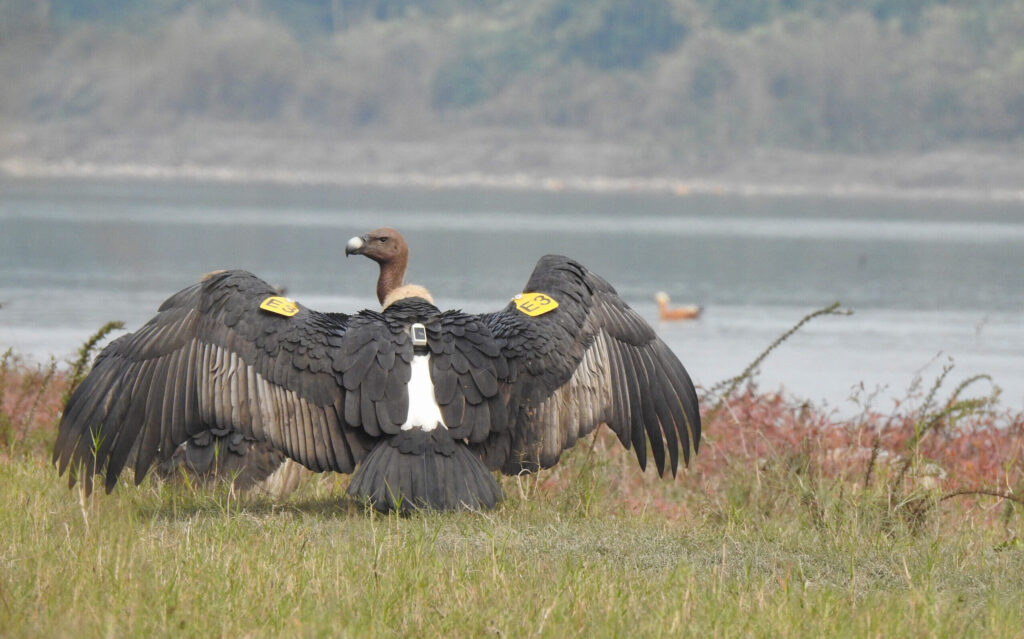
Banner image: A white-rumped vulture fitted with a tracking device in Nepal. Image by Krishna Prasad Bhushal.
Read more: Deccan’s vultures in decline

