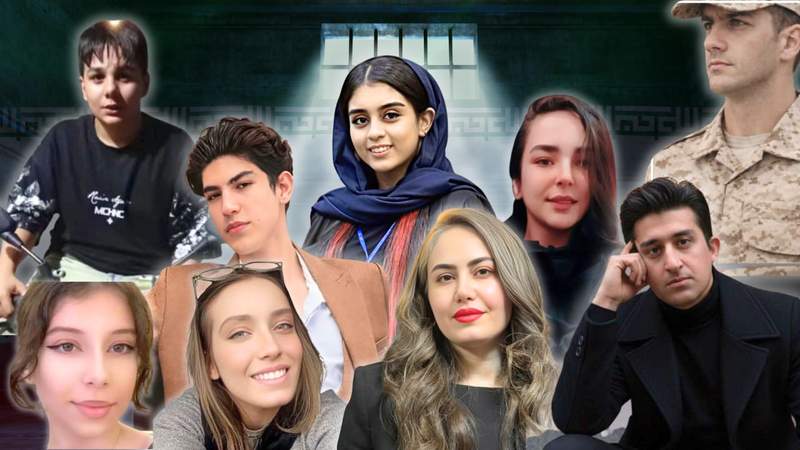
IRAN AFFAIRS: Since protests began on December 28, more thousands of Iranians have been arrested for “crimes against the state,” and many face long-term imprisonment or worse, execution.
Throughout the month-long war between Israel, the US, and Iran, much attention has been focused on military operations, personnel targeted, and the strain on the world’s economy as the Strait of Hormuz shipping lane has been affected. Largely absent from international focus is the fate of innocent Iranians still trapped inside the Islamic Republic – with both Israel and the US framing their actions, in part, as support for the Iranian people against the regime.
Since protests began on December 28 – and since the horrifying days of January 8 and 9, when the regime unleashed a deadly crackdown on protesters across the country – more thousands of Iranians have been arrested for “crimes against the state,” and many face long-term imprisonment or worse, execution.
Some of these people went to protest for their future. Some posted anti-regime messages online. And some simply belonged to the wrong generation at the wrong moment in the Islamic Republic.
Now their names are found in prison records or human rights organizations’ reports, as their families struggle to discover the truth of where their family members are held and, in some cases, their ultimate fate.
Since the January 2026 uprising, Iran’s rulers have re-energized their efforts to crack down on all forms of popular dissent, and many executions have already been carried out.
On March 19, Iranian authorities publicly hanged three young men – 19-year-old wrestler Saleh Mohammadi, 21-year-old Saeed Davoudi, and Mehdi Ghasemi – all arrested during the January protests and convicted of “waging war against God,” according to the judiciary’s Mizan News Agency.
ON TRIAL for his life: Saleh Mohammadi, the 19-year-old wrestler publicly hanged by the Islamic Republic on March 19, appears in court alongside codefendants Saeed Davoudi and Mehdi Ghasemi after their arrest during the January protests. (credit: Screenshot from Iranian state TV)
Rights groups said the executions followed grossly unfair trials built on torture and forced confessions. Saleh, who turned 19 in prison on March 11, had been sentenced to death by a Qom court less than three weeks after his arrest over the alleged killing of a security agent, a charge he denied. He told the court his confession had been extracted under torture, but his claims were dismissed, and he was ultimately publicly hanged at the alleged crime scene. Amnesty International later cited a source who said his hands had been fractured from beatings.
“Executing these young protesters in public, after sham trials built on torture and forced confessions, is state-sanctioned murder designed to terrorize the population and send a clear message: any act of dissent will be met with death,” said the Center for Human Rights in Iran, after the executions were announced.
Since the war began, the internet in Iran has once again been cut by the regime, now stretching into its fourth week, leaving many citizens in the dark and unable to communicate with one another or find out the truth about family members who have disappeared into Iran’s infamous security system.
Amnesty International warned in February that at least 30 people, including children, were facing the death penalty in connection with the uprising, while many more had been subjected to incommunicado detention, torture, forced confessions, and grossly unfair fast-tracked trials.
In Iran, the futures of those in detention now rest entirely in the hands of the state.
Part one: The confirmed and best-documented cases
The names below are among the best-documented young detainees and defendants to emerge from Iran’s post-uprising crackdown. Some have been named directly by human rights organizations, such as Amnesty International, as among those facing death sentences or capital charges. Others have been corroborated through a combination of rights reporting, credible media coverage, and family or activist testimony. The Jerusalem Post has done its utmost to corroborate the stories listed here.
In Iran, even reaching that threshold can take weeks.
DIANA TAHERABADI | Age 16 | Karaj
Diana Taherabadi was asleep when they arrived.
According to reporting close to the family, the 16-year-old from Karaj was arrested on January 25 after five officers entered her family’s home at around 8 a.m., confiscated the family’s cellphones, and took her away in handcuffs. She was transferred to Kachoui Prison, while the family was warned to stay silent.
She has since been brought before judicial proceedings in Karaj and been informed she could face a death sentence, though authorities have reportedly withheld key details from the family, including the identity of the presiding judge. She was also reportedly referred for a forensic mental competency evaluation, a chilling bureaucratic step in a case involving a child.
Under international law, executing someone for an offense allegedly committed while under 18 is prohibited.
Her family remains terrified and largely in the dark.
SHERVIN BAGHERIAN JEBELI | Age 18 | Isfahan
Of all the faces to emerge from the crackdown, perhaps none is more haunting than that of Shervin Bagherian Jebeli.
Days after his arrest, Iranian state television broadcast what rights groups described as a forced-confession propaganda video of the 18-year-old from Isfahan. Seated across from an interrogator, frightened and clearly disoriented, Shervin was told he was accused of moharebeh – “enmity against God,” one of the Islamic Republic’s most notorious capital charges.
Amnesty later identified him among those at risk of the death penalty after expedited, torture-tainted proceedings.
He then asked the question that sent chills down the spine of Iran watchers worldwide: “Can you tell me what moharebeh is, please?”
The answer came coldly: “Execution.”
Shervin broke down.
The exchange was later circulated widely online and became one of the clearest public glimpses into the regime’s handling of young detainees. He was reportedly arrested on January 12 and later transferred to Dastgerd Prison.
He was old enough to be accused, still young enough not to know what the charge meant.
SHAHAB ZOHDI (also rendered Zahdi)
Among the names already carried into the capital punishment system is Shahab Zohdi.
Amnesty International named him as one of eight individuals sentenced to death in February 2026 after what it described as grossly unfair, fast-tracked trials linked to the uprising. Zohdi was convicted alongside Mohammad Amin Biglari, Ali Fahim, Abolfazl Salehi Siavashani, Amirhossein Hatami, Shahin Vahedparast Kolor, Saleh Mohammadi, and Yaser Rajaifar in a case tied to the alleged burning of a Basij base.
The death sentences were issued by Branch 15 of the Revolutionary Court of Tehran on February 9, roughly a month after the arrests, and, according to Amnesty, were tainted by forced confessions, denial of access to independent counsel, and incommunicado detention.
His exact hometown is not clearly established in the most authoritative public records. Iran International reported in February that Zohdi, who is the sole custodian of his child, “is being held in poor conditions and denied contact with the outside world in Qezel Hesar Prison while facing the risk of imminent execution.”
The 38-year-old has raised his child alone for the past 15 years, after his wife died five months after their child’s birth.
His fate is currently unknown.
PARNIAN KHODABAKHSHI | Sharif University of Technology
For many Iranians, few institutions symbolize youthful promise like Sharif University of Technology, also known as the “MIT of Iran.”
That is what makes the case of Parnian Khodabakhshi so painful.
Human rights organization Hengaw identified 20-year-old Khodabakhshi as a materials engineering student at Sharif University, arrested on February 27 after security forces reportedly raided her home. Reports linked her detention to the display of the Lion and Sun flag, the historic Iranian emblem that has reemerged as a symbol of anti-regime defiance.
Hengaw reported, “At the time of her arrest, Telegram channels affiliated with Iranian security institutions, including one known as ‘Nakhsa,’ claimed that she had been detained for allegedly bringing a Lion and Sun flag onto the university campus.”
Her whereabouts have since remained unclear.
At the time of writing, there was no solid public confirmation that she had already been sentenced to death. But the pattern is the same as in the cases of so many others – a visible student, publicly identified, taken in a wartime climate where symbolism itself has become a threat to the state.
For students like Khodabakhshi, a gesture can become a file. And once a file is opened in Iran, the rest can move very quickly.
SHAKILA GHASEMI | Age 26 | Kerman | Baha’i
Not everyone caught in the crackdown was taken from a protest. Some were swept up in the wider climate of fear that followed.
Shakila Ghasemi, a 26-year-old Baha’i woman from Kerman, was arrested at her home in early February after approximately 12 plainclothes agents searched the property and confiscated personal belongings, according to Human Rights Activists News Agency (HRANA). The agents reportedly claimed to be searching for firearms, though none were found.
Two to three days later, she made a brief phone call, asking her family to bring her laptop charger. When relatives arrived to deliver it, they were told that no person by that name was in custody, and the charger was refused.
It is a small glimpse into the vast chasm that is Iran’s security system and how families are kept in limbo.
Her twin sister, Shaghayegh, described her as social, energetic, fluent in English and Turkish, learning German, and working as a graphic designer while also employed at a medical clinic. Her case appears to be part of a broader winter wave of repression against Baha’i citizens in Iran.
MASTOUREH NARIMANI | Teacher | Ahvaz
The Islamic Republic has always had a particular fear of people who can organize others or think for themselves. That is why teachers and students pose such a threat to the regime.
Teachers’ unions and activist networks have identified Mastoureh Narimani as among those detained in the post-uprising crackdown. Publicly available details about her case remain limited, but her detention fits the pattern of pressure on teachers, union figures, and civic organizers.
Iran International reported that Narimani, reputedly a fourth grade teacher and a teachers’ union activist, was arrested on January 11 in the city of Ahvaz and “faces security-related accusations over what authorities described as ‘sending videos and footage to foreign media outlets,’ according to sources.”
At the time of writing, no reliable public record appeared to establish that Narimani had formally been sentenced to death. But in the current Iranian climate, the gap between arrest, disappearance into the system, and the risk of execution can be alarmingly short.
AHOURA SAFAYI (RAD) | Age 16 | Gorgan, Golestan province
Among the names circulating through activist and diaspora networks is Ahoura Safayi (or Safayi Rad), who campaigners identify as one of the young detainees taken in connection with the protests.
His current location, legal status, and formal charges remain unconfirmed in stronger public documentation.
According to Tavaana: E-Learning Institute for Iranian Civil Society, Safayi Rad has reportedly been subjected to torture following his arrest, with claims that he was forced to give a confession under duress. The organization also said he has been denied contact with his family since his detention.
The reported treatment of Safayi Rad, who is described by campaigners as a teenager, has raised serious concerns among activists about his physical and psychological condition, as well as potential violations of the rights of minors in custody.
What these names show
Taken together, these cases show the shape of the Islamic Republic’s crackdown with disturbing clarity. The regime is not only targeting seasoned dissidents or opposition figures it can easily brand as enemies. It is reaching for the young, the promising, the educated, the socially visible, and those with the ability to influence others.
Each of them had a future ahead of them. Now each sits inside the machinery of a state that has turned youth and aspiration into vulnerabilities.
Part two: The names they want you to forget
The following individuals have been named by activists, diaspora networks, and social media accounts as being held and at risk of execution following the January 2026 uprising.
Their cases have not yet been fully independently verified by major human rights organizations, such as Amnesty International, Iran Human Rights, HRANA, and Hengaw, because Iran’s communications blackout, mass arrests, and deliberate opacity make independent confirmation extraordinarily difficult. For that reason, some of the surnames have been removed to protect identities.
Amnesty has warned that the real number of people at risk is likely significantly higher than the names currently documented.
This is where the story becomes harder to document and, in some ways, darker to look at.
There are the names we know well enough to publish with confidence. Then there are the names where the circumstances are still surrounded by darkness, where the only known verification of the victim is from family comments or campaigners.
SEYED PEYMAN HOSSEINI | Reported profession doctor | Nourabad, Lorestan Province
Activist reporting has identified Seyed Peyman Hosseini, described as a doctor from Nourabad in Lorestan province, as among those arrested during the post-uprising crackdown.
According to information circulating in activist networks, Hosseini had treated injured protesters in the nearby town of Noorabad Delfan before his arrest. Reports further allege that he has been subjected to pressure in detention to give a forced confession, and that security-linked media have since circulated edited footage portraying him as cooperating with authorities.
He is said to be facing accusations including involvement in protests, damage to government property, and alleged links to foreign actors – charges that, in Iran’s current climate, can carry severe legal consequences.
At the time of writing, no formal indictment has been publicly confirmed, and details regarding his current location, legal representation, and condition remain unclear. Activist reporting has identified Seyed Peyman as among those arrested in Nourabad, in Lorestan province, during the post-uprising crackdown.
Beyond that, little has been independently nailed down. No formal indictment is publicly available. No lawyer has surfaced. No family interview has entered the human rights sphere.
ILYA BEN RASHID | Reported age 22 | Shahinshahr, Isfahan
Among the more unusual names to emerge through activist channels is Ilya Ben Rashid, a detainee whose case has begun to take clearer shape, though it remains only partially documented in stronger public reporting.
According to information shared by activist accounts, including Ebrahim Allahbakhshi, Ben Rashid, a 22-year-old from Shahinshahr in Isfahan province, was arrested by security forces on January 12.
The reports state that he was held in solitary confinement for six days and subjected to beatings during that time. He is also said to be facing charges including “moharebeh” (enmity against God) and “propaganda against the regime,” both of which carry serious legal consequences under Iranian law.
At the time of writing, his current location, legal status, and access to legal representation remain unclear, and his case has not yet been fully corroborated by major human rights organizations. Among the more unusual names to emerge through activist channels is Ilya, a detainee whose case remains largely opaque.
Campaigners say he has been detained since the January crackdown and may be facing severe charges. But his location, legal status, and background remain largely unconfirmed in stronger public reporting.
For now, he exists in the public eye largely as a name moving through the underground bloodstream of Iranian dissent.
REZA DALMAN | Sharif University of Technology
Some of the names now circulating belong to people who, under other circumstances, would have passed entirely beneath the radar of the state.
Reza Dalman, a master’s student in computer engineering at Sharif University of Technology, is one such case.
According to HRANA News Agency, citing a statement from Amirkabir-affiliated sources, Dalman was arrested by security forces at his residence on the evening of March 18.
As of the time of writing, there is no publicly available information regarding the reasons for his arrest, his place of detention, or any charges brought against him.
His case reflects the recognized pattern in which students – even those with no known public profile – are swept up in the security crackdown, with little immediate transparency about their fate.
MOHAMMAD REZA DIYANATI | Age 17 | Zarrin Shahr, Isfahan province
Mohammad Reza appears on activist lists compiled in the weeks following the January crackdown, lists that human rights groups have broadly described as credible in pattern but difficult to independently verify in full because of the information blackout. According to IranWire, Diyanti was arrested on January 6 and transferred to an unknown location.
That is how the system operates.
A person can be arrested, moved, questioned, and threatened before the outside world has even established where he is.
ABOLFAZL MOHAMMADI | Age 20 | Sabzevar
Abolfazl Mohammadi, a 20-year-old from Sabzevar, is among the young detainees identified in rights reporting as having been arrested during the January protests.
According to HRANA News Agency, Mohammadi was arrested in Sabzevar on January 4 and later transferred to Mashhad Prison.
At the time of writing, no public information appears to be available regarding the charges against him, and little else has emerged about his legal status or condition in custody.
His case is one of several reported by HRANA involving young protesters detained across Mashhad, Sabzevar, and Juyin, with families and observers often left waiting for even the most basic information.
FOAD (FAWAD) NIKPEI | Reported age 17 | Marivan, Kurdistan province
Foad (also rendered Fawad) Nikpei, a 17-year-old Kurdish boy from the village of Ni in Marivan, has been identified in rights reporting as among those detained in connection with the protests.
According to a report cited by Hengaw, Nikpei was arrested on January 5 following a raid by security forces on his family home, which was reportedly carried out with violence.
Reports further indicate that he had previously been injured during the “Woman, Life, Freedom” protests, with dozens of pellet fragments said to remain lodged in his foot.
At the time of writing, no publicly available information has emerged regarding his current whereabouts, legal status, or condition in custody.
MINOO ROZEHDAR | Tehran
Minoo Rozehdar, a Tehran resident and mother of three, is another case that has drawn concern in rights reporting, though key details about her situation remain unclear.
According to HRANA News Agency, Rozehdar has been out of contact for approximately two months, with no confirmed information about her whereabouts or condition. Her lawyer, Ali Sharifzadeh, has stated that no security or judicial body has formally acknowledged responsibility for her arrest.
In response, her family has filed a kidnapping complaint and missing person report with the Tehran prosecutor’s office, underscoring the uncertainty surrounding her case.
HRANA previously reported that no official explanation has been provided regarding her legal status or detention. In April, Rozehdar had been sentenced by Branch 26 of the Tehran Revolutionary Court to 14 months in prison and a fine, on charges including propaganda against the regime and spreading false information, with the sentence suspended for four years.
At present, the lack of confirmed information about her detention has heightened concerns among her family and observers.
KAMELIA NAZARI | Reported age: 18 | Shiraz
Kamelia Nazari, reported to be an 18-year-old from Shiraz, is among those identified in activist reporting as having been detained in connection with the post-uprising arrests.
According to information shared by activist accounts, including material circulated by Ebrahim Allahbakhshi, Nazari was arrested by security forces on January 10 outside her home and has since been held in Adelabad Prison in Shiraz.
Reports indicate that weeks after her arrest, her family remains unaware of her legal status or the charges against her. In a brief phone call, she is said to have told relatives that she is being taken for repeated interrogations and subjected to psychological pressure aimed at extracting a confession.
At the time of writing, her case has not been fully documented by major human rights organizations, and key details regarding her condition and legal proceedings remain unclear.
And one more: the case that remains too murky to anchor
One name that has circulated widely enough to merit mention, but still not enough to be treated as a fully confirmed profile, is that of a young Iranian military conscript identified in various reports as Javid Khalis, Javid Khales, or Javid Khaled.
According to activist accounts that have since been amplified by the US State Department’s Persian-language account, the young soldier was allegedly sentenced to death after refusing orders to fire on protesters.
If true, it would be one of the most chilling cases of the entire crackdown – a conscript facing capital punishment not for attacking the state, but for refusing to turn his weapon on civilians.
At the time of writing, however, the identity, exact spelling, detention status, and legal record of the case remain too unclear in public documentation to state more firmly.
What the silence means
The Islamic Republic has a long record of using incommunicado detention as a weapon.
Authorities have subjected detainees to torture and other ill-treatment, and those detained are at serious risk of grossly unfair trials, forced confessions, and, in the worst cases, secret or arbitrary executions.
Amnesty and other rights groups say the current wave of arrests has followed the same pattern seen after previous uprisings, only this time it is wider and under the cover of blackout conditions.
So, while it may seem unusual for a national publication such as the Post to cite names without any verification, that is precisely what the Islamic Republic wants. That is why this article has been split into two: verifiable and unverifiable. Because Iran is not like the West, there are few public records on offer as evidence, beyond what the state is willing to acknowledge.
Those listed in part two may be no less at risk than those in part one; their cases have simply not yet fully surfaced. With thousands massacred in January and thousands more arrested, there will be stories revealed for years to come.