
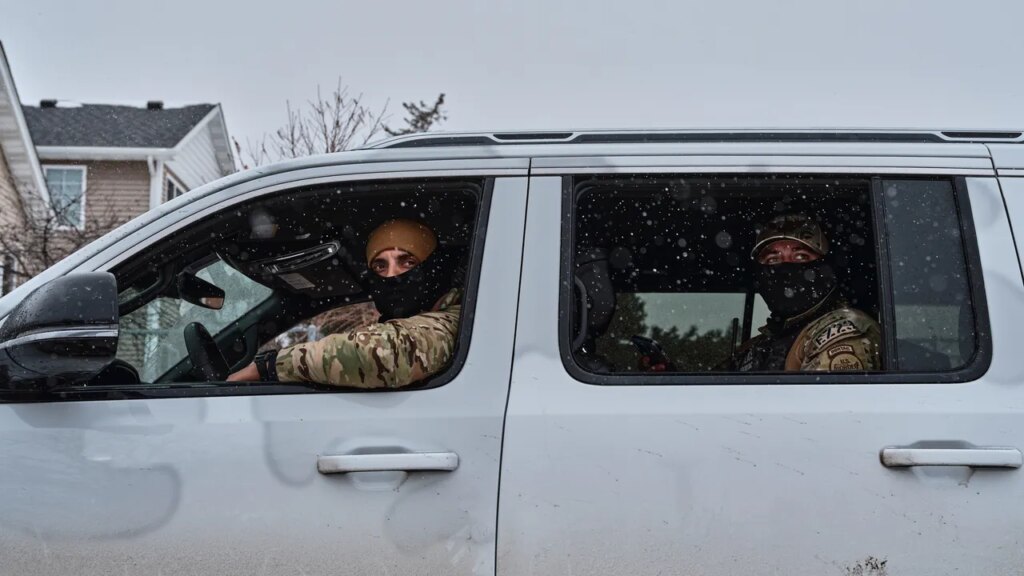
“Is that the one we were following before?” Sam asked.
“No, that was an Expedition. This is a Suburban,” John, who was driving, replied. He took out a pair of binoculars and looked at the license plate, which was out of state.
“Oh, yeah, this is the intimidator guy,” he said, without elaboration.
A license-plate check with other observers in their chat confirmed that the car was a known ICE vehicle. Maintaining about a block of distance between them, John and Sam began following the S.U.V. (The A.C.L.U. has said that following law enforcement vehicles at a safe distance is legal as long as active operations aren’t obstructed and traffic laws are obeyed.) The Suburban’s driver soon became cognizant that he was being followed, and a game of cat and mouse began. At one point, the S.U.V. made a U-turn and drove past us. The driver, who wore glasses and no mask, gave a little wave.
“That was the first unmasked one I’ve seen,” John said.
Later, after temporarily parting ways with the S.U.V., the observers met it at a right angle at an intersection. John reversed, backing up and then stopping along the side of the street to avoid the impression that he was seeking an active confrontation. The S.U.V. turned into the oncoming traffic lane so that it now directly blocked us. For a minute, nothing happened. Then the S.U.V. pulled up alongside us, and its passengers rolled down their windows. This time they wore face coverings. In the back seat, one of the men held his phone camera out. (ICE uses facial-recognition technology to identify people.) The driver of the S.U.V. made a pointing gesture at John, then drove on.
“It probably already was, but now your car is, like, completely made,” Sam said.
“I’ve had them film it so many times,” John said.
They decided not to continue following the S.U.V.
The volunteer observation system has the flaws common to any vigilante system. Observers can get overzealous, and have misidentified ordinary people as federal agents. But John and Sam clearly felt that, without their observation, nobody would be holding ICE accountable. Local law-enforcement agencies, for the most part, have not intervened in ICE actions.
“We have a paramilitary force in our city acting beyond the Constitution consistently,” Sam said. “Clearly, they are just racially profiling people straight up, right? Complete violations of the Fourth Amendment, everywhere.”
“I just worry, like, what does it get us? I agree with you, but how do you enforce the Constitution?” John said.
They sat for a minute.
“You drive around,” John said.
“You drive around the neighborhood with a friend and make the best decisions you can,” Sam agreed.
Some restaurants in Minneapolis now keep their doors locked. The owners of a small neighborhood restaurant in South Minneapolis, a married couple who asked to stay anonymous because they feared retribution from the government, told me that they have started driving their nonwhite employees to and from work to try to protect them. (They submitted the necessary I-9 forms to the U.S. Citizenship and Immigration Services for all of their employees on hiring, they said, although the wife added, “We’re not document experts.”) When I met the couple at their restaurant one morning before lunch service, they both started to cry. The husband, who is a person of color, described how he now carries his passport card with him at all times, as does their son; the wife, who is white, feels less threatened. They listed several restaurants in the area that have made the decision to close, either to protect their staff or because their workers were too afraid to come in.
“It feels like there’s a really broad swath of people that they are going after that has less to do with their, like, actual status and more to do with just vibes—you know, do you have an accent? What color is your skin? Are you going to culturally relevant grocery stores or restaurants or churches?” Athena Hollins, a state representative from a district in St. Paul, told me. “That’s reflected across the Twin Cities, because we’ve had so many people who have been detained who are U.S. citizens.”