A quick admission: I absolutely love an elliptical or cross trainer. They don’t always get the plaudits they deserve, but these low-impact cardio machines not only put less strain on your joints than a treadmill but also help you get an impressive, full-body workout. Whether you hop on one to warm up before an intense strength-training session or use it to gently burn calories while listening to your favourite podcast, the elliptical or cross trainer can strengthen muscle, reduce fat and improve cardiovascular fitness.
However, there is a catch in that these machines vary wildly in their design – and therefore the emphasis they place on different muscles. Traditional elliptical machines eschew moving handles, instead opting for static poles, while cross trainers usually have dynamic handles that recruit the muscles in your back, shoulders and arms. On top of this, stride length, the shape of the handles and the positioning of the footplates can make a big difference to the type of workout you’ll have.
They can vary considerably in their weight and size, but are usually bulkier and more cumbersome than, say, a compact treadmill. Home gym aficionados beware: you’ll likely need a fair amount of room for one of these. If you have enough space, though, an elliptical or cross trainer can be a valuable addition to your home training setup.
At a glance
Why you should trust me
I’m a keen fitness fan who does gym-based strength training and kickboxing classes, as well as outdoor trail runs, cold-water surfing, and more. As a result, I’ve often been tasked with testing fitness technology for magazines, newspapers and websites. I’ve always been one to get stuck in, whatever I’m testing, whether that means surfing in the latest smartwatch or feeling the burn to test a set of connected kettlebells.
I’m also a strong believer that you have to use new tech to get a grasp of how it fits into daily life, so I’ve always sought to test a product for as long as possible and in the correct environment. With exercise ellipticals and cross trainers, that meant getting hands-on experience, no matter how sweaty it made me.
How I tested
As with any modern piece of fitness equipment, the only way to ascertain whether it’s any good is to don your gym kit and get stuck in. So, after researching the newest and most popular models on the market, I set about trialling all eight of them.
Most of my testing was carried out in purpose-built boutiques or customer experience centres because accommodating so many examples of such gym equipment in my home is not easy. I did manage to squeeze a couple into my garage via short-term loans, though.
During workouts, I used a smartphone-based decibel reader to get a sense of how loud they were in use, and I also tested any connected or online features, which often meant downloading relevant apps and trialling their workout content.
Where trainers had displays, I used these to log in to apps, such as Spotify and YouTube, and I also used any built-in Bluetooth speakers (if this function was offered). For each model, I made notes on ease of use, build quality and any features, as well as the overall size of the machine. If it had transport wheels, I used these to move the trainer around, simulating how easy it would be to manoeuvre in a domestic environment.
The best cross trainers and elliptical machines to buy in 2025
Best cross trainer overall:
BowFlex Max Trainer M6
BowFlex
Max Trainer M6
from £1,149.99
What we love
Great lower-body workout and fairly compact
What we don’t love
Could be better for upper body; can’t adjust stride length

Being a petrolhead, I have to confess I was initially drawn to the BowFlex Max Trainer M6 because its LCD console reminds me of the dials found in a Mk3 Golf GTI. However, that’s not all that’s special about this cross trainer.
Blending the motion of a stair-stepper with that of an elliptical machine, it has relatively compact dimensions and provides 16 resistance levels, enabling it to offer punishing, connected workouts.
Those looking for powerful upper-body workouts or large, adjustable stride lengths may want to look elsewhere, but if you’re searching for a cross trainer that’ll have your glutes and quads burning in rapid time, look no further.
Why we love it
Most elliptical machines offer a gentle, calorie-burning workout, but the Max Trainer M6 is among the few that have left me fully gassed, with slightly weak legs at the end of a workout.
This is because of its combination of elliptical and stepping motion, favouring shorter strides and an emphasis on downward pressure instead of the large strides of traditional machines. The handles are also intriguing as they offer a plethora of grip options, opening up the possibility of training multiple sections of the upper body (back, biceps, triceps and so on). But they’re fairly short, not offering a great range of motion to really work the upper body.
The machine instantly connects with the BowFlex Jrny app, which is the company’s answer to Peloton, offering video-based workouts to make the experience more interactive. You’ll need an internet-connected smartphone or tablet, but the sessions are good, if limited, providing guided workouts that span all manner of fitness goals.
Small(ish), quiet and relatively easy to move around, this is one of the few ellipticals that can be put away in the corner of a garage or living room without too much impact on living space.
It’s a shame that … it doesn’t offer an adjustable stride length, and it will feel too much like a stepper for true elliptical fans.
Dimensions: 66 x 117 x 163cm (WLH)
Weight: 61.7kg
Drivetrain: front-drive with magnetic resistance (16 levels)
Stride length: 38cm
Connectivity: Bluetooth (for Jrny app access and HR tracking); USB charging port; media shelf for device placement
Folding? No
Noise level: about 45dB
Maximum user weight: 136kg
Built-in entertainment: no; burn rate dial and basic LCD, supports third-party workouts including Jrny via smartphone, tablet or laptop

BowFlex
Max Trainer M6
from £1,149.99
What we love
Great lower-body workout and fairly compact
What we don’t love
Could be better for upper body; can’t adjust stride length
Best value elliptical trainer:
Horizon EX-59

Horizon
EX-59 Elliptical
from £699.99
What we love
Great build quality; good value
What we don’t love
Resistance slow to adjust; display and speakers poor
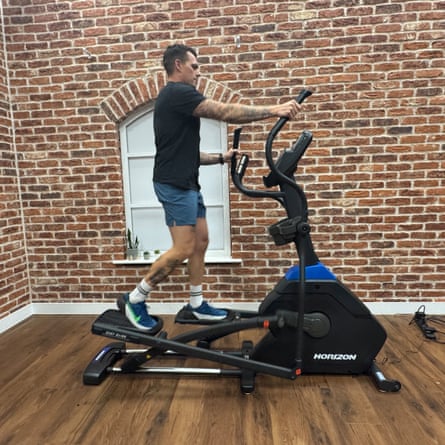
Although it’s not the cheapest elliptical trainer on this list, the Horizon EX-59 is still my top value pick thanks to its array of features, robust build quality and a relatively low price.
Why we love it
A smooth, front-mounted flywheel provides 10 levels of quiet resistance, and oversize pedals accommodate a variety of different-sized users. With a stride length of 46cm, it’s not dissimilar to the larger elliptical machines you might find at a gym – meaning it feels more natural and less intense than a stepper or cross trainer.
The EX-59 connects to third-party apps via Bluetooth, but it won’t automatically adjust the resistance like some rivals do. As with most Horizon fitness equipment, this model works with the brand’s @Zone app, which provides several high-quality on-demand workouts and training plans for free. There’s not a huge amount of content geared towards elliptical training, but most treadmill and exercise bike high-intensity interval training sessions work just as well.
To me, it’s not the prettiest fitness machine, though it certainly does the job, offering drinks holders, a place to stash your smartphone or tablet, and a built-in heart-rate monitor on the static handles.
The build quality is great, especially considering the price, although that doesn’t extend to the LCD display and console, which are basic. During testing, I found the changes to resistance inputs slow to react: not great if you’re indulging in a Hiit session and you need to spike the heart rate quickly. Similarly, the built-in Bluetooth speakers aren’t really worth the hassle of tethering a device – you’d get better sound quality out of a tin can. Instead, bring a pair of headphones, fire up the @Zone workout app and make the most of those free on-demand classes.
It’s a shame that … the Bluetooth speakers are tinny, and ECB magnetic brake resistance is slow to react to inputs.
Dimensions: 61 x 186 x 167cm (WLH)
Weight: 74.5kg
Drivetrain: front-drive with ECB magnetic resistance, electronically adjustable (10 levels)
Stride length: 46cm
Connectivity: Bluetooth speakers, device rack, USB rapid-charge port; compatible with popular fitness apps via Bluetooth FTMS
Folding? No
Noise level: about 42dB
Maximum user weight: 136kg
Built-in entertainment: no touchscreen; has Bluetooth-enabled speakers and a tablet holder for external content
Horizon
EX-59 Elliptical
from £699.99
What we love
Great build quality; good value
What we don’t love
Resistance slow to adjust; display and speakers poor
Best foldable elliptical trainer:
Technogym Elliptical

Technogym
Elliptical
£3,940
What we love
Classy, quiet and compact
What we don’t love
You need a separate device for classes

If money’s no object, it’s worth a visit to Technogym’s London Mayfair store, which is packed with drool-inducing fitness equipment that will make any home workout space feel like a five-star hotel.
This elliptical trainer is part of the brand’s focus on the home and, as such, it folds upright to minimise its footprint in your living room, home gym or – in my case at least – cobweb-strewn garage.
As a result, it shuns the traditional front- or rear-mounted flywheel for a suspended set of footplates and a resistance system that’s in its upright body. This helps save space but still offers a comparable, almost anti-gravity upper- and lower-body workout to other premium elliptical machines.
With 25 difficulty levels and up to 600W of electrically adjustable resistance (up to 160 strides a minute: good luck with that), the elliptical packs a mean punch – and it works perfectly with the brand’s digital workout portfolio. Having said that, although there’s a basic screen to show all the usual important data, you’ll need to bring your own device if you want any sort of guided workout.
Why we love it
Technogym’s “sessions” are up there with some of Peloton’s interactive classes, although you’ll need to provide your own tablet, smartphone or laptop. Unlike other fitness apps, there are plenty of elliptical-based classes to enjoy, which makes the experience feel much more enjoyable.
Indeed, where some elliptical trainers can send me to sleep, the instructor in Technogym’s interactive classes will have you hanging off the unit, torching your glutes and pummelling your quads. It will keep you coming back for more.
The movement itself takes a bit of getting used to: the stride isn’t quite as obvious as the larger units found in commercial gyms. I had to adapt my approach to get the most out of it, and I found it lacked the multiple grip positions and range of motion for effective upper-body focus training.
Regardless, this trainer has Technogym quality baked into its core. It offers a huge spread of resistance levels, is virtually silent, and is all wrapped up in one of the most compact, storable and classy units on test.
It’s a shame that … you have to bring a device to enjoy a workout, and Technogym’s monthly subscription fees are, predictably, expensive.
Dimensions: 65 x 162 x 160cm (WLH)
Weight: 100kg
Drivetrain: front-drive electronically adjustable magnetic resistance
Stride length: not specified
Connectivity: tablet-compatible console for use with Technogym’s apps
Folding? Yes (folds to 75cm length for compact storage)
Noise level: about 36dB
Maximum user weight: 130kg
Built-in entertainment: no built-in screen; designed for tablet use via console
Technogym
Elliptical
£3,940
What we love
Classy, quiet and compact
What we don’t love
You need a separate device for classes
Best compact cross trainer:
JTX Strider-X8

What we love
Super compact and affordable
What we don’t love
Small footplates won’t suit larger feet
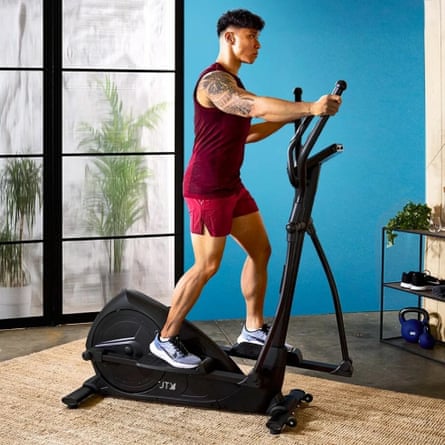
The JTX Strider-X8 was one of the most compact true ellipticals I got my hands on: it’s just 130cm long. The BowFlex Max Trainer M6 will fit better into tight spaces, but it doesn’t offer the same kind of traditional elliptical stride.
Why we love it
The Strider-X8 provides 41cm of glorious gliding, corralled by a 7kg inertia-enhanced flywheel at the rear. It’s quiet, although perhaps not as whisper-quiet as some rivals, and offers 16 levels of easily adjustable resistance.
However, there are a few compromises. The compact proportions restrict the maximum user height to 5ft 9in, which means even a vertically challenged individual like myself is butting up against the limits. The build quality isn’t a strong point: the console, complete with basic display, looks and feels a bit like an oversized school calculator. However, this trainer is very much at the budget end of the budget spectrum. JTX offers a two-year at-home warranty, which should give some peace of mind for those worried it may not go the distance.
Weighing 51kg, the Strider-X8 isn’t something you will want to pick up and heft around, but it’s easy to tip it on to its transport wheels and stash it somewhere convenient. Without going for a foldable, there are few cross trainers that can compete with it in terms of space-saving – and I managed to cram it into the corner of my busy garage with little stress.
The workout experience is largely fine, although the smaller footplates will be a problem for users with larger feet. It connects seamlessly with third-party apps and can even be used with virtual training software, such as Zwift.
The digital console is basic, but it all works, with a simple dial adjusting the levels of resistance. There are even 18 built-in programs for those who simply want to hop on and work out.
It’s a shame that … parts of the machine feel cheap, and the built-in heart-rate monitoring is useless.
Dimensions: 70 x 130 x 169cm (WLH)
Weight: 51kg
Drivetrain: 7kg inertia-enhanced flywheel and electromagnetic resistance
Stride length: 41cm
Connectivity: Bluetooth to fitness apps (such as Kinomap, iConsole+), built-in Polar heart-rate receiver (chest strap), hand pulse sensors
Folding? No; includes transport wheels
Noise level: about 38dB
Maximum user weight: 120kg
Built-in entertainment: no; LCD console with 18 workouts
What we love
Super compact and affordable
What we don’t love
Small footplates won’t suit larger feet
Best full-body trainer:
Schwinn 590 Elliptical

Schwinn
590 Elliptical
from £1,499
What we love
One of the best full-body workouts on test
What we don’t love
It’s expensive, and speakers are mediocre
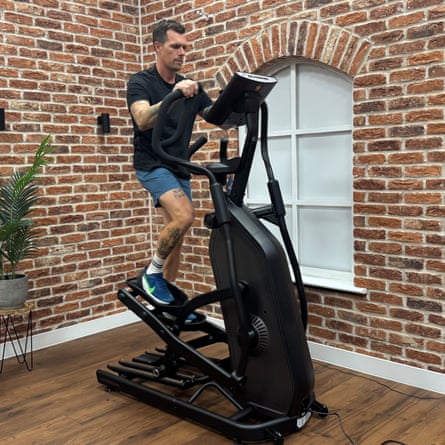
Schwinn packs a lot into its relatively compact 590 Elliptical, including the ability to electronically adjust the platforms to simulate gradients of -5% to 15%. Along with the multitude of upper-body handles, this sees it bundled into the cross-trainer category (despite its name). I found it offered one of the best full-body workouts on test.
There are built-in speakers that are of mediocre quality (they’re better than those found on the Horizon EX-59 but still not brilliant) and a 7in digital display that allows for rapid leaps in resistance.
Why we love it
There are handle-mounted controls for both the incline/decline and resistance settings, which is a welcome premium touch, and the unit is compatible with a multitude of virtual training software, including Zwift and Schwinn’s recommended Jrny app.
The 25 levels of resistance, the ability to adjust the incline and decline, and the multiple grip locations ensure the Schwinn provides one of the best and all-encompassing full-body workouts on test. With a pronated grip on the horizontal handles, I found it possible to work the big muscles of the back and the lats, while a supinated grip on the inner-most handles would place more emphasis on the shoulders and rear deltoid muscles.
It’s a similar case for the lower body, as adjusting the decline and incline places a focus on muscles in the legs that I rarely use. Start playing around with body positioning, and it offers all of the benefits of a static hold with dynamic movement.
Of course, you can adjust the intensity as you want, but I found the unit to be one of the best for working up a sweat. It all comes in one of the most compact and easy-to-store packages on this list, too.
It’s a shame that … the built-in speakers aren’t really worth the effort, and it’s an expensive machine.
Dimensions: 86 x 148 x 173cm (WLH)
Weight: 96kg
Drivetrain: front-drive with magnetic resistance, electronically adjustable (25 levels)
Stride length: 51cm
Connectivity: Bluetooth (heart-rate enabled and built-in speakers), USB charging port, tablet/media holder, Jrny and app compatibility
Folding? No; includes transport wheels
Noise level: about 32dB
Maximum user weight: 147kg
Built-in entertainment: no; a 7in full-colour LCD with workout programs and connectivity
Schwinn
590 Elliptical
from £1,499
What we love
One of the best full-body workouts on test
What we don’t love
It’s expensive, and speakers are mediocre
The best of the rest
Sole E35 elliptical cross trainer

Sole
E35 elliptical cross trainer
£1,799
What we love
Great for taller users
What we don’t love
Takes up a lot of space
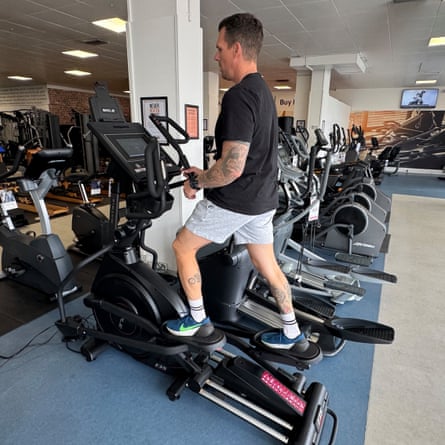
Best for: taller users
With a generous 50.8cm stride length and oversized footplates, the Sole E35 is designed for taller and larger users, offering multiple handles and grip positions for a full-body workout.
To me, it’s also one of the better-looking elliptical machines on this list, with modern styling and a sleek 10.1in touchscreen to use for a number of built-in workout sessions and longer-term fitness plans, as well as popular streaming apps, such as YouTube, Disney+ and more.
There’s a built-in fan for keeping users cool, although it’s not hugely effective, as well as a set of speakers for streaming music. These are perfectly adequate, but don’t expect room-filling sounds.
The 9kg flywheel provides plenty of resistance though, and with the FTMS protocol, it syncs up with Zwift and the brand’s own Sole+ app, offering a huge array of virtual workouts.
It didn’t make the final cut because … it’s a large and heavy machine that requires plenty of storage space.
Dimensions: 60 x 177 x 177cm (WLH); weight: 110.8kg; drivetrain: front-drive with computer-controlled magnetic ECB resistance (20 levels); stride length: 50.8cm; connectivity: Bluetooth audio speakers, USB charging port, wifi, Sole+ and Kinomap app compatibility, tablet holder, wireless charging pad; folding? No; includes front transport wheels; noise level: about 35db; maximum user weight: 158kg; built-in entertainment: 10.1in touchscreen with built-in apps (YouTube, Netflix, Disney+ and so on), wifi and screen mirroring
Sole
E35 elliptical cross trainer
£1,799
What we love
Great for taller users
What we don’t love
Takes up a lot of space
Matrix Fitness E30

Matrix Fitness
E30
from £2,249
What we love
Excellent quality
What we don’t love
The quality comes at a high price
Best for: gym quality at home
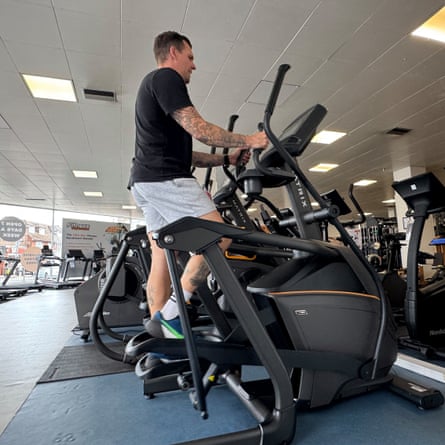
It’s a little tricky to get your head around how the Matrix E30 works. On paper, it’s one of the more compact elliptical trainers I tested, yet it still manages to offer a 51cm stride length. This is all down to the clever, and quite complex, suspension system that houses the oversized footplates and traditional elliptical handles.
Matrix kit is often found in commercial gyms and that’s pretty obvious here, as the build quality is excellent. It also sports a 10.5kg flywheel, which is one of the heaviest on test. It allows for 20 levels of resistance and is capable of a pretty hardcore workout.
An updated XER console has a crisp 10in touchscreen that takes care of most of the functionality, as well as allowing access to a handful of streaming apps and virtual training programs.
If you don’t want to pay for yet another monthly membership (Matrix suggests iFIT), it can also play nicely with whatever third-party apps you like to use and features 11 built-in workout programs.
It didn’t make the final cut because … it’s expensive, and the screen isn’t overly impressive.
Dimensions: 73x 166 x 148cm (WLH); weight: 126kg; drivetrain: suspension elliptical front-drive with ECB magnetic resistance, electronically adjustable (20 levels); stride length: 51cm; connectivity: wifi, Bluetooth, USB port and entertainment apps (YouTube, Netflix and so on); folding? No; noise level: about 38dB; maximum user weight: 147kg; built-in entertainment: 10in touchscreen with apps, media streaming, web browser (XER console)
Matrix Fitness
E30
from £2,249
What we love
Excellent quality
What we don’t love
The quality comes at a high price
Life Fitness E1

Life Fitness
E1
from £2,145
What we love
Fuss-free and simple to use
What we don’t love
Feels basic compared with competitors
Best for: build quality on a budget
Life Fitness is another brand often selected by commercial gyms for its reliability, and this also filters down into its domestic range.
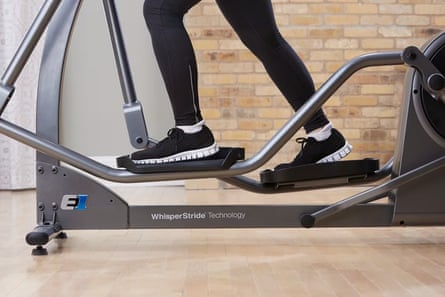
Considering how basic the E1 feels compared with some rivals, the price seems high, but this is a fuss-free elliptical with a massive fixed stride length, oversized footplates and an impressive spread of smooth and natural-feeling resistance. It’s also quiet.
The basic digital Go Console lacks the flashiness of a massive interactive touchscreen, but it has 13 workout programs that are easily accessed via large and obvious buttons, great for those not fussed about binging Netflix during a workout. During testing, I found the lack of a touchscreen quite refreshing: it was easy to hop on and work out without the faff of connecting Bluetooth-enabled devices.
Heart-rate monitoring is fairly reliable via its handles and sports the FTMS protocol for third-party app integration, but it also works perfectly well without it, and its built-in programs span hill training and fat-burning sessions.
It didn’t make the final cut because … it feels expensive for what it is and looks dated.
Dimensions: 77 x 209 x 150cm (WLH); weight: 96kg; drivetrain: front-drive with ECB magnetic resistance, electronically adjustable (20 levels); stride length: 51cm; connectivity: Go Console with LCD, Bluetooth telemetry heart-rate monitoring, 13 pre-loaded workouts; folding? No; noise level: about 32dB; maximum user weight: 182kg; built-in entertainment: no built-in media apps; simple display for workout metrics and an integrated accessory tray for external device placement
Life Fitness
E1
from £2,145
What we love
Fuss-free and simple to use
What we don’t love
Feels basic compared with competitors
What you need to know
What is the difference between an elliptical and a cross trainer?
The two terms are often used interchangeably, but there are subtle differences. A standard elliptical machine focuses on the forward and backward pedalling motion with fixed handles, providing a low-impact cardio workout that mimics running without the joint stress. A cross trainer typically includes moving handlebars that allow you to work your upper body as well, giving a more complete, full-body workout. In most modern home fitness equipment, “elliptical” and “cross trainer” usually describe the same type of machine.
How much should I spend?
Entry-level elliptical trainers start at about £400 and offer basic stride motion and limited resistance levels. Spending more than £1,000 typically gets you a sturdier build, smoother motion, more resistance levels and better consoles with Bluetooth or app integration. At the top end (£2,000+), you’ll find commercial-grade machines with advanced consoles, streaming services, more compact footprints, greater levels of resistance and suspension technology that greatly reduces noise and wear.
How much room do I need at home?
Ellipticals tend to be large machines, with footprints ranging from about 150cm in length and 70cm in width, all the way up to 200cm in length and 80cm in width, or more. You’ll also need to consider ceiling height – especially with front-drive machines, as pedals can lift you an additional 30-40cm off the ground.
What features should I look out for?
Stride length is a key factor: shorter strides (about 40-45cm) are suitable for smaller users, while taller users will benefit from 50cm or more. Look for adjustable resistance levels and incline options if you want to vary the intensity and muscle groups worked. Consoles with Bluetooth and app support can help track progress and keep workouts engaging, and some higher-end models include large touchscreens with streaming apps, fans, speakers and wireless charging pads. If space is a concern, compact or folding designs are worth exploring.
Are there any maintenance concerns?
Ellipticals are generally low-maintenance compared with treadmills. Most use magnetic resistance systems that don’t require ongoing adjustment as a treadmill’s belt does. Look out for manufacturer warranties that cover any wear and tear. Suspension ellipticals – which remove the traditional track and wheel system – tend to be even quieter and need virtually no lubrication.
For more ways to get fit at home:
The best treadmills, tested by our expert runner
Personal trainers on the best home exercise kit
Leon Poultney is a lifelong fitness enthusiast who can often be found trying not to kill himself on a mountain bike/surfboard/other extreme thing, often at the request of an editor. He’s been writing about consumer technology for longer than he cares to divulge. Whether he’s getting to know the latest connected kettlebells or partaking in CrossFit sessions, Leon is always putting his body on the line for great editorial