
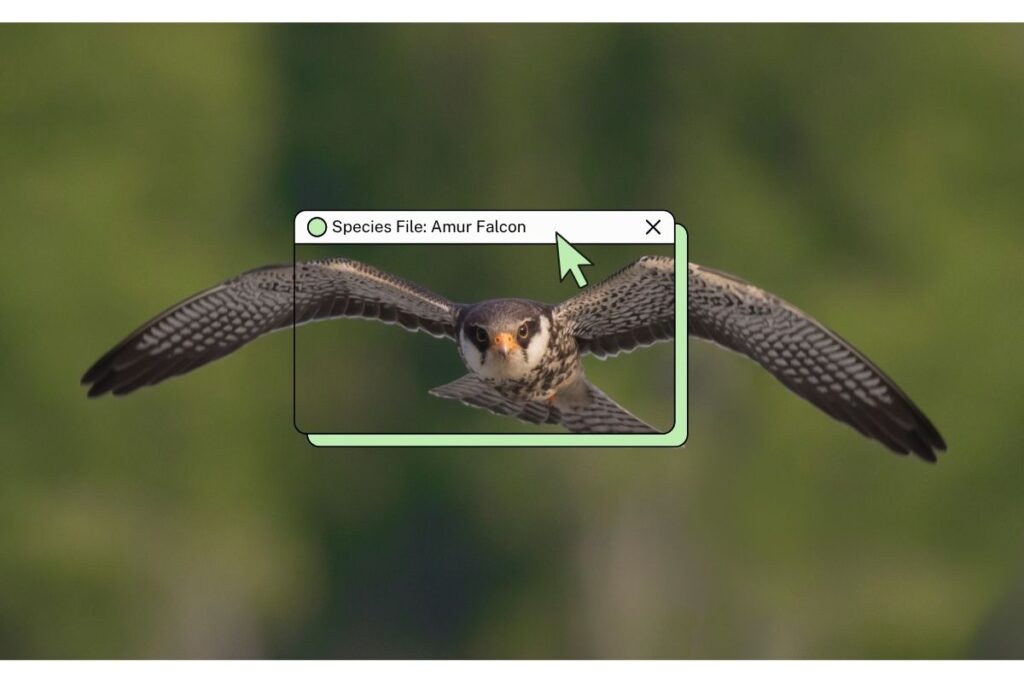
Species File: Exploring India’s biodiversity, one species at a time.
Three Amur falcons tagged in Manipur were recently seen wintering in Africa. The birds covered thousands of kilometres, across land and ocean within days, shows tracking data, highlighting their scale of migration.
The Amur falcon (Falco amurensis), a small bird of prey, is found across open forests, grasslands, wetlands and agricultural landscapes. They breed in southeast Russia and northern China, and migrate through India to southern Africa for the winter, covering over 20,000 kilometres every year. During this journey, they stop over in northeastern states such as Nagaland and Manipur, where large flocks roost in large numbers.
According to the International Union for Conservation of Nature (IUCN) Red List of Species, the Amur falcon is listed as Least Concern due to its wide range and large population. Estimates suggest there are between 2,00,000 and 7,00,000 mature Amur falcons globally. However, its migratory behaviour makes it vulnerable at key stopover sites. The species is protected under Schedule IV of the Indian Wildlife (Protection) Act, 1972. India is also a signatory to the Convention of Migratory Species (CMS) under which it is obligated to provide safe passage and ensure conservation of migratory species.
The Amur falcon faces multiple threats, including hunting during migration and habitat loss at roosting sites, and changing weather patterns. These pressures can disrupt migration and reduce survival during long journeys.
In recent years, conservation efforts in northeast India have helped transform former hunting grounds into safe stopover habitats, with community-led protection playing a crucial role in safeguarding the species. In an earlier story that Mongabay-India published in 2022, Bano Haralu, managing trustee of Nagaland Wildlife and Biodiversity Conservation Trust, said, “The Amur falcon has become an opportunity of a lifetime for us Nagas to see how conservation can turn things around. It has become a mascot of conservation.”
Read more about the Amur falcon in our stories on how India moved rapidly to protect the species from mass-hunting, and the threats it faces along its migratory routes.
Banner image: Amur falcon. Image by Touhid biplob via Wikimedia Commons (CC BY-SA 4.0).