
- Global talks on climate finance struggled to keep pace with reality. But in 2025, developing countries intensified their calls for developed countries’ obligations.
- With limited international support, India looked inward for solutions, testing new rules, state-level experiments, and financial tools.
- As climate impacts get more visible, the green sector, like renewable energy, adaptation, and disaster response, receives increasingly more space in India’s annual budget.
Since 2017, the union government has tabled the annual budget on February 1. When union Finance Minister Nirmala Sitharaman finished presenting the 2025 budget, a familiar pattern emerged. Allocations for renewable energy, irrigation, disaster response and resilience had increased. None of these heads were labelled as climate finance. Yet all of them paid for climate action.
Together, these heads account for billions of rupees in public spending.
This domestic expenditure on climate action far exceeds the climate finance India receives from international sources. It highlights a core reality. In India, and countries like it, climate action is financed mainly through local resources rather than global funds, despite the country’s limited role in causing the climate crisis and its high vulnerability to climate impacts.
This has caused frustration among developing countries. This was evident during COP29, held in Baku in 2024. It was described as a “finance COP,” and was expected to deliver a new climate finance goal- the financial support from developed to developing countries for meeting climate goals. India, along with other developing nations, argued that the scale of finance must reflect real needs. It also stressed that public finance, not loans or private capital, should form the backbone of support.
But the New Collective Quantified Goal (NCQG), agreed at the last minute, drew criticism from developing countries. India formally registered concerns, both over the way the agreement was reached and over the final figure of $300 billion.
The money question lingered
Although Baku gavelled a finance deal, climate finance remained at the centre of climate diplomacy through 2025. The issue also dominated domestic transition debates. The mid-year climate talks in Bonn reflected this tension. The meeting was delayed by nearly two days due to disagreements over the agenda. Developing countries pushed for formal discussions on the climate finance obligations of developed nations. They also raised concerns over unilateral trade measures such as the European Union’s Carbon Border Adjustment Mechanism.
Finance discussions in Bonn included the Baku-to-Belém Roadmap. The roadmap aims to mobilise $1.3 trillion in climate finance from all sources by 2035. Yet disagreements over responsibility and scale continued.
In July, the International Court of Justice issued a landmark advisory opinion on climate change. It affirmed that countries have legal obligations under international law to address climate change and uphold climate justice. The advisory stressed that wealthy, high-emitting nations must lead emissions reductions and provide reparations for climate harm. It strengthened the legal position of vulnerable countries seeking support.
Brazil, the host of COP30 — described as an “implementation COP” — pressed countries to find ways to mobilise climate finance- the $1.3 trillion Baku-to-Belém Roadmap. However, a report released two days into the summit highlighted the gap between ambition and reality. It is estimated that developing countries, excluding China, would need $2.4 trillion annually by 2030. This requirement could rise to about $3.2 trillion by 2035.
These assessments also exposed other limitations. For instance, the World Bank, which plays a central role in channelling climate finance, faces capacity constraints. Private investment, long projected as a solution, continued to fall short. Risk perceptions and systemic biases against emerging economies kept capital costs high. It made green transitions more expensive for developing countries.
At the same time, new ideas began to emerge. Economists Abhijit Banerjee, Esther Duflo, and Michael Greenstone proposed a framework combining taxation, direct benefit transfers, and insurance. The aim was to raise and distribute climate finance more effectively and equitably.
Brazil also introduced a new forest finance mechanism, the Tropical Forest Forever Facility. The proposal sought to channel funds to tropical forests through a different approach to conservation finance. The debate around it highlighted long-standing gaps. These included the exclusion of indigenous and local communities, as well as challenges in defining forests and measuring degradation.
Overall, the global climate finance picture remained bleak. For India, the dilemma was especially sharp. Rapid growth and development needs go hand in hand with the demand for deep emissions reductions. India, therefore, continued to push for greater clarity, equity, and scaled-up financial support.


Turning inwards
Even as global climate finance remained difficult to mobilise, India continued to work to strengthen its financial ecosystem. Its efforts focused on creating clearer signals for investors and expanding domestic sources of climate-related finance. In May, India introduced a taxonomy for sustainable investments. The aim was to help capital flow towards climate-relevant activities. Before this, in April, India also proposed mandatory emissions-intensity targets for high-emitting industries to prepare the Indian industry for emerging markets where carbon emissions will increasingly shape competitiveness.
The Securities and Exchange Board of India (SEBI) took further steps in this direction. It revised disclosure norms for listed companies, including a clearer definition of value chain partners under its Environmental, Social and Governance reporting framework. The move sought to improve transparency and accountability across corporate supply chains.
Exploration of new avenues for climate finance also continued. Reserve Bank of India Governor Sanjay Malhotra proposed creating a shared pool of bankable climate projects. The idea was to reduce risks and make it easier for financial institutions to invest in climate-related activities.
Climate stress is becoming especially acute in Indian cities. Falling groundwater levels and rising temperatures have increased pressure on urban infrastructure. An RBI report has highlighted the need to strengthen the revenue base of urban local bodies. Transfers from higher levels of government often come with strict conditions, underscoring the need for local tax collection and fiscal autonomy.
With limited access to multilateral climate funds, some states began exploring alternative ways to finance their climate priorities. Kerala, for instance, has been looking at less bureaucratic options, including partnerships with startups. The state estimates that it will require more than ₹900 billion by 2030 to meet its climate goals.
The year also saw the first payout under a new extreme-weather insurance scheme in Nagaland, the first Indian state to insure its entire geography against heavy rainfall. Since then, several other states have shown interest in parametric insurance for disaster finance. However, the Nagaland experience raises a few concerns as well. Payouts covered only a fraction of actual losses, and the rising frequency of extreme weather events could make premiums unaffordable over time.
As the need for climate finance intensifies, several experiments hit the ground, and their limitations also surfaced. For example, several studies highlighted the limitations of the carbon market. Farmers involved in carbon projects in Haryana and Madhya Pradesh reported negligible financial returns. India’s draft climate finance taxonomy also drew criticism for including coal within its scope, raising concerns among climate experts.
India is expected to submit more ambitious Nationally Determined Contributions in the near future. Higher ambition will require significantly more finance. How India balances this need with limited global support will shape its climate trajectory in the years ahead.
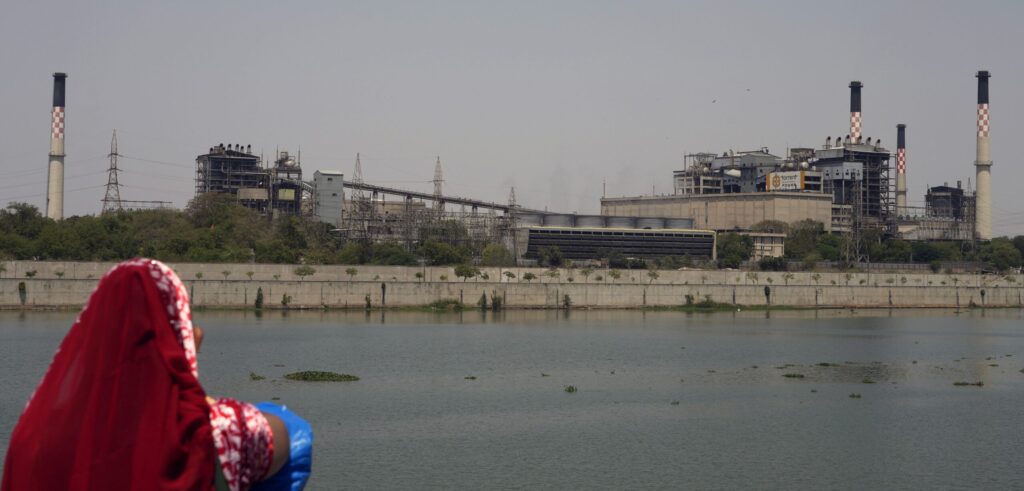
Banner image: A woman looks at a coal plant in Ahmedabad, Gujarat. (AP Photo/Ajit Solanki)

