
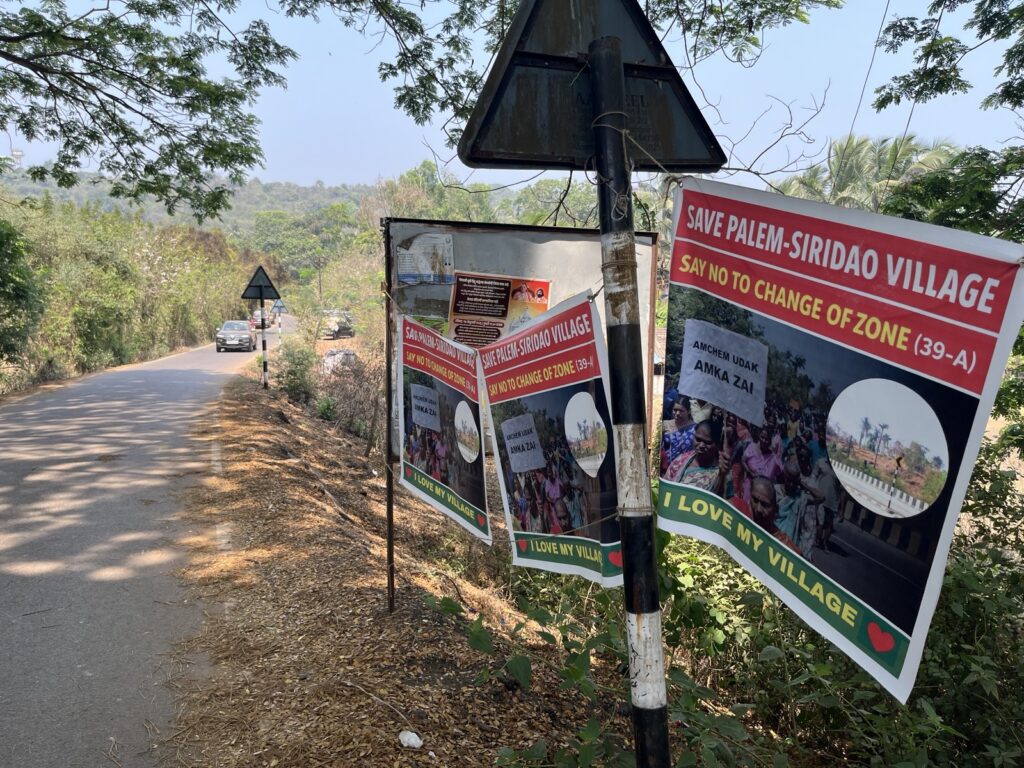
- A controversial amendment to Goa’s Town and Country Planning Act has sparked major protests over fears it will enable development on natural and agricultural land.
- The amendment, Section 39 (A), allows landowners to seek reclassification of orchards, paddy fields, and no-development slopes as settlement zones, enabling the construction of housing projects.
- The measure was introduced amid a real-estate boom driven by buyers from major Indian cities seeking luxury second homes in the coastal state.
- A campaign under the banner Enough is Enough is demanding the amendment’s complete rollback and stronger protections against future land conversions.
The orchard behind Tushar Gawas’s village in Siridao grows peppers, cashews, and medicinal plants on a hill that was once considered too steep to build on. On January 26, however, the government reclassified the land as a settlement, paving the way for its construction. Gawas filed an objection against the motion, but the government rejected it. They said his objections lacked detail.
The orchard in Siridao, in the coastal state of Goa, is one of hundreds of orchards, paddy fields, and hilly slopes — together the size of 133 football fields — to be recategorised as settlements, primed for setting up housing projects, establishments, and other types of infrastructure. The provision allowing for such sweeping changes across Goa’s landscape is Section 39 (A) of the Town and Country Planning Act — a clause the government describes as a tool for correcting errors in existing land use plans.
The Town and Country Planning department is led by cabinet minister Vishwajit Rane, who, apart from holding the post of Town and Country Planning Minister, is also listed as a director of Karapur Estates, a real estate firm with a history of applying for zone changes.
So far, more than 9.5 lakh (950,000) square metres of land have been re-classified as settlements under 39 (A), bolstered by a steady rise in demand for real estate by migrants from big metro cities. “This government seems to believe that infinite real estate growth is possible in an extremely finite system,” said Solano Da Silva, an assistant professor at BITS Pilani, Goa, who has studied the impacts of Goa’s land use planning. “Goa has a history of progressive, forward looking provisions when it comes to planning, but amendments like 39 (A) are a smack in the face of that legacy.”
Under the banner “Enough is Enough”, a citizen-led campaign is demanding the complete rollback of 39 (A). Widespread resistance to the amendment is forcing some politicians to reconsider their support for it, including those in the incumbent BJP government. On March 25, Chief Minister Pramod Sawant declared that all lands notified for re-zoning under 39 (A) within his Sanquelim constituency would be suspended — a result of the agitation.
Far from being satisfied, protesters are calling for more than just lip service. Justice Ferdino Rebello, an architect of the Enough is Enough movement and a former chief justice of the Allahabad High Court, has proposed the adoption of a land protection law that would prevent Goa’s agricultural lands — including paddy fields and orchards — from further conversion.
A massive protest
Under 39 (A), landowners — firms or individuals — can make a request to change protected land parcels into settlement zones for a fee, deviating from the state’s 2021 Regional Plan. The Town and Country Planning Board reviews the request, and upon granting its preliminary approval, calls for objections and suggestions from the public via a gazette notification for a period of 30 days. A final decision is taken by the Chief Town Planner, taking objections into consideration.
In practice, having objections taken into account has proved challenging, said Tahir Norohna, an architect and urban planner who’s been a vocal critic of 39 (A). “Even when villagers travel long distances on an unreasonably short notice to register their objections, the TCP Board replies with copy-paste language, saying the objections lack detail,” Norohna said.
After the government reclassified the orchard in Siridao village to a settlement, Gawas and 18 other residents wrote a lengthy letter to the TCP Department in February 2026, attaching historical maps and surveys to prove why the provision should not be implemented in the area. Among them were topographical contour maps prepared by the Survey of India (SOI), which said the slope of the land parcel had a gradient exceeding 25% — too steep for hill cutting or construction, as per the state’s Regional Plan.
The Town Planning Board had accepted the re-zoning request in part because the land owner, Dempo Properties and Investments, had hired a private engineering company to carry out its own survey. Alcon, the engineering company, concluded that the slope’s gradient was less than 25%, contrary to the SOI’s maps.


Though 39 (A) prohibits construction in eco-sensitive areas, including slopes with steep gradients, the new survey’s findings nullified this exemption. “The government accepted Alcon’s report without any verification, or justification as to why it was accepted over the Survey of India,” said Gawas, a party worker with the Goa Revolutionaries Party.
Queries sent over email to the TCP’s Chief Town Planner, Vertika Dagur, about how the TCP approves requests for spot zoning changes, went unanswered.
The government agreed to suspend the provision within Siridao only after protests against the issue gained traction. The protest was championed by Viresh Borkar, a first-time MLA from the Goa Revolutionaries Party who went on a hunger strike from February 21 to 26 demanding 39 (A) be rolled back entirely. On February 23, hundreds gathered around TCP Minister Vishwajit Rane’s house echoing the same demand.
The government agreed to suspend 39 (A) within Borkar’s St. Andre constituency on February 26. “We’re not satisfied by the suspension. A suspension is a temporary measure. We want it to be scrapped entirely, and all over Goa,” Borkar told Mongabay-India.
Norma Alvares, a senior advocate in the Bombay High Court called the suspensions arbitrary. “It’s not clear under which provision of law these suspensions have been announced,” she said.
Alvares is preparing to represent a Public Interest Litigation against 39 (A) in court on April 28. “Planning is a right of the entire citizenry. It has to be done by experts as a whole. If an individual is allowed to choose the zone for his own plot, then there’s no planning in it at all,” she said, adding, “This makes it a violation of Article 21 of the Constitution, because the Supreme Court has held the right to planned development is part of Article 21, the right to life.”

An unprecedented real estate boom
So far, the government has received over 1,346 applications for spot zone changes under 39 (A). The surge in demand for buildable land is driven, in part, by homebuyers from cities like Delhi, Mumbai, and Bengaluru looking for a second home, a report by Savills India, a real estate consultancy, says. High-end, gated apartment complexes are most sought after today.
According to Sandesh Prabhudesai, a veteran journalist based in Goa, these residential projects are coming up amid an already unregulated tourism market. A 2020 report by KPMG found that 59% of hotels and 100% of flats and vacation homes catering to Goa’s tourist influx were unregistered with the Department of Tourism.
“None of the developers who are seeking conversion of land into settlements have said they are for tourism projects. But these residential projects are being advertised as holiday homes or luxury stays, which would ultimately serve tourists. These are not housing projects for Goans,” he said.
Several village panchayats have demanded carrying capacity studies be done to determine whether the land can accommodate additional settlements. Built-up areas grew by eight times between 1973 and 2022, from 22.2 square kilometres to 180.94 sq. km. Sporadic urban development in Goa, along with the decline of native vegetation cover, has exacerbated local hydrological processes and led to increased runoff and reduced water retention in the state, a study by researchers from the Indian Institute of Science noted.
Despite some Opposition MLAs calling for a discussion on the 39 (A) issue, Goa’s assembly session was abruptly adjourned on March 16 and passed without one. Vishwajit Rane told the Assembly that the law would be implemented as passed by the House. “Only 0.2% of Goa’s Regional Plan has been converted,” he said, adding, “As far as provisional clearances are concerned, this does not mean all provisional clearances will be passed. We have a scrutiny committee that will ensure that all legislative guidelines are followed based on which final clearances will be given.”
The lack of political will to stop provisions like 39 (A) isn’t surprising, Prabhudesai said. He published an article naming 30 former and sitting MLAs who had applied for spot zone changes under 39(A) and other amendments preceding it, several of whom have business interests in tourism and real estate.
Among them is TCP Minister Rane, who is listed as a director of the Karapur Estates, a real estate firm which applied for spot zoning changes in Bicholim village under both 39 (A) and its predecessor, Section 17(2).


Historical resistance to conversions
Goa is the earliest state in India to have designed a Regional Plan (RP) — a forward-looking, statutory document that blueprints Goa’s land use while projecting for future growth. Since 1986, the plan’s objective has been to preserve Goa’s ecosystem while encouraging sustainable growth. It demarcates settlement zones, economic activity zones, no development zones, agricultural land, orchards, and other types of land use. The RP 2021, currently in effect, allocates around 22% of Goa’s land mass to settlements.
Land use planning has always been fraught in Goa: a revision of the 2011 Regional Plan was scrapped due to public outrage over disproportionate allocations to settlement zones. When it was time to design the RP 2021, public participation was made a central tenet of the process. Maps and surveys were sent to the panchayat level for deliberation before being drawn up and finalised.
However, parallel efforts have tried to introduce greater flexibility within the RP’s bounds. The 39 (A) provision is the third amendment within a span of eight years that attempts to make spot changes to the Regional Plan with limited public participation.
The first cut came in 2018, when the then TCP Minister Vijai Sardesai, leader of the Goa Forward Party and a key ally of the BJP, introduced Section 16 (B) to the TCP Act. It enabled landowners to apply for spot zoning changes to the TCP Board, but was challenged and stayed by the Bombay High Court in 2018, after PILs alleged it violated Article 14 of the constitution — the right to equality.
When Vishwajit Rane took over the portfolio in 2022, he announced that zone changes under 16 (B) would be null and void. But he also introduced the second cut — Section 17(2), which allowed applicants to request spot land zoning changes to “correct” errors in the Regional Plan. The powers of this amendment were later read down by the Bombay High Court in March 2025 for giving the executive unchecked, discretionary powers to make land zone changes.
Unhappy with the Court’s ruling, the Goa government is challenging its decision in the Supreme Court, the proceedings of which are ongoing. Before it was read down, 25 lakh square metres of land had been converted under 17(2).
Section 39 (A) was introduced in 2024 as a replacement for 16(B), while proceedings against 17(2) were underway. “To avoid the unconstitutionality challenge facing 17(2), the government brought in minimal public participation aspects into 39 (A) by providing a 30-day window for objections when the notification is published. Only written objections submitted to the head office are considered, and even then we’ve seen hundreds of villagers travel long distances to make their objections heard,” said Norohna.
Like its predecessors, a public interest litigation has been filed challenging the application of 39 (A). “All three amendments share the same objective, which is to turn no-development slopes, orchards, and paddy fields into settlement zones,” said Alvares.

Running into the law
Goa’s colonial history and unique land ownership structure has meant that in several villages, large tracts of land have been re-zoned and sold without deliberation at the panchayat level. Some common and agricultural lands are governed by village Communidades, Portuguese-era institutions that are controlled by gaunkars — descendants of village founders. While the land was historically leased to tenants in exchange for cultivation, today tenants’ settlement rights are documented in Forms I and XIV of Goa’s land records, and recognised by the state.
To facilitate spot zoning for tenanted agricultural lands, some landowners are initiating “negative declaration” proceedings with their tenants. Through this process, tenants agree to remove their names from the documents for a price, citing that they have no claim, making it easier to sell land to developers.
Former Sarpanch from Parcem village, Ajay Kolangutkar, said residents were unhappy with the clandestine way in which land was being converted and sold to developers. Parcem falls in Pernem taluka, where some of the highest tracts of natural and agricultural land have been re-zoned for settlements. “Residents do not want an influx of tourists here at the cost of their traditional lands,” he said.
Zone changes for cultivable land are also problematic because of protections under other laws, according to Justice Ferdino Rebello. The Code of Communidades was amended in 2025 to say that agricultural land could not be used for any other purposes apart from agriculture, Rebello said. “If you use it for any other purpose, the land reverts back to the Communidade. Section 39 (A) of the TCP attempts to bypass this law,” he told Mongabay-India.
Rebello has proposed a Consolidated Land Protection Bill which would broaden the definition of agricultural lands and prohibit them from being used for non-agricultural purposes. It seeks to restrict the sale, transfer, and gifting of agricultural lands to only agriculturalists and residents who have lived in Goa for at least 30 years, “so that any development in Goa conforms to the principles of sustainable development, polluter pays principle, precautionary principle, intergenerational equity.”

Though the Regional Plan offers a blueprint for what Goa’s development could look like, effective land use planning still has a long way to go in the state, said Da Silva of BITS Pilani. “The Regional Plan is absolutely clear about its limitations,” he said, referring to incomplete records and maps of khazan lands, tenanted lands, and forest lands. “They weren’t mapped at the time because ironically, government departments did not provide that information,” he added.
In recent years, the state’s agricultural and environmental departments have produced reports and data that could play an instrumental role in future land use planning amid a steadily changing climate, including climate action plans, soil degradation atlases, and wetland maps. “The TCP Minister is right about the Regional Plan needing correction. But these are the types of corrections and inclusions it needs to be making,” Da Silva said.
Read more: South Goa tourist hubs found highly vulnerable to climate change
Banner image: Banners hung along the road to Paliem Siridao village. Image by Hagen Desa.

