
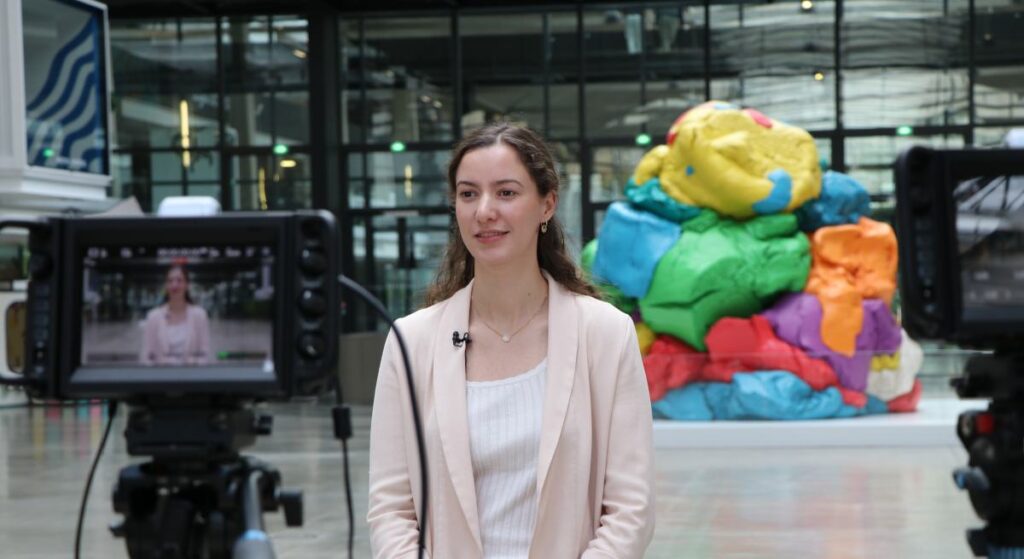
Camille Bouget discusses how artificial intelligence is impacting innovation in the treatment of diseases affecting the immune system.
“Immuno-inflammatory diseases are often described as niche. They are not,” explained Camille Bouget, the CEO and co-founder of healthcare start-up Scienta Lab.
With as many as one out of every 10 people in Western countries potentially impacted by an immuno-inflammatory condition, she noted, symptoms are often debilitating, with the available therapeutic options frequently, deeply inadequate for a significant proportion of patients.
Which is why in 2021 Bouget co-founded Scienta Lab, a biotechnology company that aims to advance research within immunology via modern technologies such as artificial intelligence and EVA, the organisation’s multimodal AI model purpose-built for translational research in immunology and inflammation.
She said, “It was designed to answer the concrete questions that R&D teams face throughout drug development: which therapeutic targets are worth pursuing, which preclinical biological signals are robust enough to carry forward into clinical trials, and which patients are most likely to respond to a given candidate drug?”
Applied across multiple stages of the pipeline, she explained, early on EVA can estimate therapeutic efficacy prior to a patient beginning treatment. As the programme advances, EVA can evaluate whether molecular signals observed in animal subjects are likely to translate to humans and at the clinical stage, it will support the identification of patient subgroups for more precisely designed trials.
“The primary beneficiaries are biopharmaceutical and biotech companies working in immunology and inflammation. Ultimately, however, the downstream beneficiary is the patient: better-designed trials, fewer failed programmes and faster access to treatments that genuinely address unmet needs in diseases like rheumatoid arthritis, lupus and inflammatory bowel disease,” she said.
Why AI?
A persistent challenge for Bouget and the industry she operates within, has been in properly communicating the complexity of what they do, in a manner that is accessible for all of the major stakeholders, be they investors, partners or the broader public.
“Immune diseases are notoriously difficult to characterise”, she noted, as often even the experts don’t always know how to measure them, what might prompt a flare-up or why a treatment is effective for one patient, but fails to work for another.
She said, “Convincing people that AI can meaningfully navigate that complexity without overpromising requires constant effort”, especially when you are a young deep-tech in an industry that is currently dominated by what she referred to as larger key players.
She is of the opinion that the implication for patients is significant, not least because the immunology drug development pipeline has historically suffered from high late-stage attrition and programmes failing at phase II or phase III after years of investment and work.
“Each of those failures represents not only a financial cost but delayed or denied access to potentially effective therapies. AI that genuinely improves the translational accuracy of preclinical decision-making can meaningfully shorten that timeline and shift more resources toward candidates that are more likely to succeed.”
Sturdy foundations
But it isn’t simply a matter of having access to advanced technologies. For Bouget, multidisciplinary teams of scientists and engineers are critical to the overall success of any organisation attempting to transform immunology research and development.
She said, “Multidisciplinary teams are the entire foundation of doing this well. The failure mode we see most often in the application of AI to drug development is a disconnect between the computational sophistication of a model and its biological relevance.
“A model trained without deep immunological understanding may optimise for the wrong signal. Conversely, a team with outstanding biological expertise but limited machine learning capability will struggle to extract meaningful structure from the scale of data that modern multiomics generates.”
At Scienta Lab, the co-founding team consists of a pharmacist and former industry strategist, a biomedical engineer and a mathematician with deep AI expertise.
She explained, “Day-to-day, our team spans immunology, bioinformatics, machine learning and clinical pharmacology. The ability to build bridges between those disciplines, to have a conversation where a wet-lab immunologist and a transformer architect are genuinely learning from each other, is what allows us to build models that are both technically rigorous and biologically meaningful.”
Bouget added, “Organisations that try to solve this problem with either pure data science or pure biology will hit a ceiling. The translational gap in drug development is not fundamentally a data problem or a computing problem alone, but one of understanding that requires genuinely integrated teams.”
Don’t miss out on the knowledge you need to succeed. Sign up for the Daily Brief, Silicon Republic’s digest of need-to-know sci-tech news.