
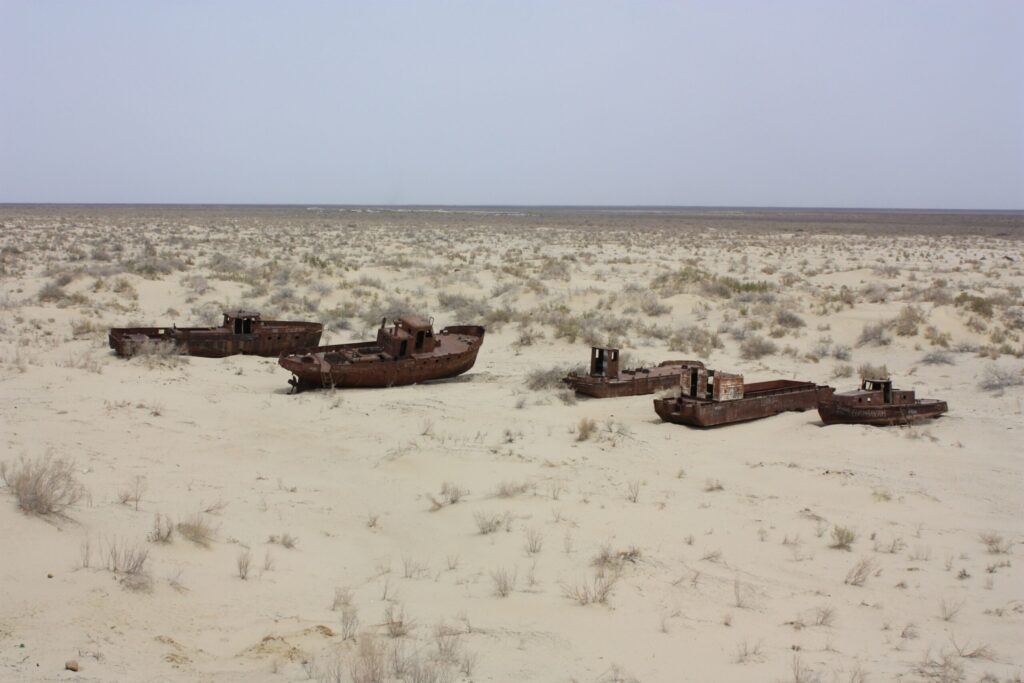
- The Aral sea, once one of the world’s largest lakes, was destroyed by large-scale human interventions, especially river diversion for cotton farming, that caused desertification in Moynaq, formerly a sea port in the Aral sea in Uzbekistan.
- The loss of the sea erased a fishing-based way of life, now preserved only through ship graveyards and a museum that documents a once-abundant community.
- The story mirrors India’s experience with canal irrigation and monocropping, where development boosted food production but also led to groundwater depletion, salinity, and long-term ecological stress.
- The views in this commentary are that of the author.
My feet crunch an uneven, dusty saltiness, as I stare at a slanting row of ghosts. Of boats.
Like some clothes after their first wash, each of these seem to have shrunk in size and shape. One, no more than a heap of rust. The other, with scrap metal joints clanging in a windiness that slap-welcomes you into sensing. You are now in the thick of a desert. Another has so many holes, it looks like an indecisive XXL submarine periscope.
Zero-buoyancy remains, of where the Aral sea once used to moisten the floor. This expanse where the boats seem to have amnesia is where the once fourth largest lake in the world, the size of Sri Lanka, went into nature’s ICU, in the second half of the 20th century. Shrink, sputter, disappear. The southern Aral sea, by Moynaq town, in what is now the autonomous region of Karakalpakstan in Uzbekistan, which is where I am standing, never recovered.
For several epochs before ours though, the Syr and Amu Darya rivers as a combo, kept the water level high here. Guided tours to the State museum of history and culture back in Nukus, the capital city of this region, apparently used to start with the high bird count, once found all over the Aral sea. Archaeological records also confirm the provenance of the people of Karakalpakstan’s Moynaq township: a nomadic East Asian gene base, always somehow being able to fish. Small clans, who were able to live across vast spreads of the steppe, given their proclivity to make a life close to marsh and river.
This is the short prehistory of a town in a post 1990s independent country, one could once potentially not call landlocked earlier. Due to the Aral sea shared between Kazakhstan and Uzbekistan. Kolya, my guide and driver on this trip, who is from this region, remembers how ’abundant with fish’ it once was. He also reminds me that the tragedy of what I am seeing is entirely created by humans.
Just walking up and down this site and then driving through a sparse Moynaq township, brings an old-ish news montage of the last 30-40 years of environmental realities in India, right before one’s thoughts. Chief in this mental drone view is the fraying representation of the nation state consuming resources faster than it is replenishing and that far too many people across socio-economic classes are being left out of substantive conversations about the mineral or natural resource in their backyard. But first, let’s go back almost a hundred years.
What exactly led to the Aral sea’s near demise
While the imprint of Russian intervention is older than the 20th century here, the era of Stalin’s first five-year plan in 1930 right down to the Khrushchev premiership in the 60s, accelerated ecological change, in the USSR. Particularly in this southern Aral sea region. Abolishing the private sector, forced collectivisation of agriculture, replacing Karakalpakstan’s grain crop with cotton and leading a canal building spree, which diverted the Darya waters. At the same time Moynak/Muynaq also collectivised its farms, it got a cannery unit for its fish produce, under the Russians. As water-intensive cotton yields went up, the Aral Sea’s diverted water level went down.
India’s own Central Soil Salinity Research Institute (CSSRI) came into being in the late 60s as well, established under her own fourth Five Year Plan period. This need for high yielding crop varieties in centralised projects is now acknowledged by CSSRI too as one of the long-term reasons for high soil salinity and sodicity in many parts of India in the 20th century. In India though, it fed a hungry, populated nation for a long while. In Karakalpakstan, it also ended a people’s known livelihood.
By the 70s, the Aral lake was down to a trickle. The rivers too retreated and split. The “dry tears of the Aral”, the UN called it. Anyone who resisted these decisive changes from this region were sent to a gulag, one that erstwhile USSR had made unironically, at an Aral sea site. By the time Khrushchev’s power declined in the mid-60s, even the canal infrastructure was groaning, cotton productivity was plateauing and the region was becoming increasingly saline. USSR seems to have benefitted, but one of the countries that made up the SSR did not seem to have a say in how.
Greenaralsea.org, an ongoing multilateral initiative to reduce the Aral sea area desertification marks the shift, noting, “The sea has lost 60,000 sq. km., or 90% of its size, over half a century. Along with the Aral sea’s waters, the marshes and wetland ecosystems of the Amu Darya and Syrdarya river deltas have also disappeared. Fifty percent of Aral sea flora and fauna has been lost, including 11 types of fish, 11 plants species, 26 species of birds, and 12 mammals. The Aral sea was once the centre of a fishing industry that caught 40,000 tonnes of fish each year — that prosperity is now gone.”


India meanwhile
Like the Moynaq community, humankind has known that life thrives close to water sources and rivers. If the Sumerian civilisation was built around rhythms of water, so was the Indus civilisation shaped by it. Perhaps canals have been a way to replicate this, as a controlled experiment through the centuries, from the Suez down to Industrial Revolution towns. Or as farming revolutions in a country like India where about 60% of agriculture is rain-fed. About a fourth of it, overexploited groundwater.
This is where, over 300,000 km of irrigation canals, artificial channels to direct water toward dryland agriculture, have covered one out of every four villages in India, by the first decade of the 21st century, according to this development economics study, which has studied them over a century.
While groundwater irrigation tops as water source, irrigation is a close second, even in 2025. Monsoons service much of the middle of the Indian year, irrigation has boosted the winter crop in canal areas. But where India differs from the apparent European norm is even as canal colonies grew, many areas close to it urbanised, but did not necessarily industrialise in non-farm directions. Not even substantially in agro-processing, like the fish cannery here in Moynaq.
While irrigation’s own role in making new crops profitable has been studied across the decades in India, the lesson that surface irrigation makes farmers choose monocropping, as against efforts to lift the groundwater table itself, is evident as recently in Telangana’s own 2024 assessment. When we say surface irrigation in India, it is of course as much a combo of canals, tubewells and direct groundwater sources, depending on where you look.
By 2017-2018, 98% of Punjab and 93% of Haryana had already benefitted from this surface irrigation, but the declining water table and productivity tell a more complete story, even as monocropping remains to this day. So much so that the National Bank for Agriculture and Rural Development (NABARD) assessment of Indian agriculture in 2025, available on the Niti Aayog website, quickly launches into a chapter called Overexploitation of Depleting Water Resources, soon after an introduction to Indian agriculture.
Since the 90s, when Uzbekistan became gained independence from the Soviet Union, national news headlines in India have continually reported on the issues with canal irrigation, be it underperformance or cost overrun, climate change-related hydrological basin water stress or those left out downstream from the benefits of such reach. Additionally, there has been an increase in smaller water works like farm ponds, through rural employment guarantee schemes, across India. Studies like these are beginning to evaluate what it means realistically for people living close to them.

A still life album
That is also where a small museum here in Moynaq is a uniquely educative rewind for our century of natural abundance, human ingenuity and consequent depletions. From the skeletal leftover of once sea faring boats, standing here at the Museum of the History of the Aral Sea, by the ship graveyard site in Moynaq town., one is hit by the full force of delta living blues in Uzbekistan. Mix taping in my mind still with the distant hum of India’s own tryst with desertification. What may engulf the visitor in this museum though is not decay, but absolutely lived fullness.
Each exhibit taking one into the throes of a bustling, enterprising community where fishing was central. Where abundance was natural and man-made. Barely a generation ago. Kids posing in boats, as only kids can, where their yesterday’s grins can feel like a joint selfie taken just the other day. Women separating fish with the hectic calm of surplus. A worker at the fish plant with a large chopping knife. Canned aquatic fish produce — Made in Moynaq. Size of the sea shells put out in a row. The United Nations Convention to Combat Desertification’s definition of land degradation hits home with a real human face here. (“reduction or loss of biological or economic productivity… resulting from land uses or from a process or combination of processes, including… human activities.”)
This in fact might be the museum’s greatest success and sadness. That it records clearly what fullness looked like. To feel its utter goneness soon after, like a broken group hug. The museum is also shaped like a yurt. (Yurt: a term for the once dominant roundish tented living of several Central Asian peoples.)
On display, paintings by a range of local artists who bring alive an Aral Sea sunset or specific fishing scenes. Men sailing into the sea in a group of boats. Fish being spread out in the steamboat soon after being caught. Fishing under ice when the Aral Sea would freeze in winter. Three men in a smaller catamaran like boat, fishing with spears in a small area of the sea, with a fish net cordon sunk a few feet underwater. Homes cheek by seaside jowl, with steamboats setting out to sea in the visible distance. While another fisherman makes bamboo borders to fish by the shore. A shadowy afternoon sandy patch, a little away from the water. The album of Muynak cannery, with a smiling sailor posing like a peppermint ad. A range of stuffed birds like a gannet to animals like the swamp lynx. A picnic table laid out by the shore.
Kolya seemed quite right, didn’t he? At the centre of the museum is a screening room in which a documentary film shows the ships being hauled away on trucks, to be sold in large numbers. The southern Aral sea is now dryland in the footage. I exit the museum feeling like a community has somehow represented their epitaph as a living memory. As reminder and requiem.

What now?
On our long drive back from Moynaq to Nukus, we cross much of this deserted township living with its back toward where the Aral Sea used to be. The cotton fields come and go from view, as my mind continues playing games with Indian memories on Uzbeki soil. (Soon after Uzbekistan became free from Russia, by the mid-90s, I was part of the reportage team for India’s first environmental reportage show, Living on the Edge on the national TV network, Doordarshan. I remember Ahmedabad’s mill workers showing me the public health issues which cropped up with cotton dust pollution then.)
I tear myself away from staring at the cotton stretches and take in what Kolya is sharing with me — an agreement among the republics of Kazakhstan, Kyrgyzstan, Uzbekistan, Tajikistan and Turkmenistan on protecting interstate waters has yielded better results on the Northern shores of the Aral since the 90s. The Russian era Chemical Research institute site here, using a chemical agent allegedly in production, has been largely dismantled with international help. Overall, 3.5 million people, though are said to have been affected by the Aral Sea disaster on both sides of the border.
The Saiga antelope here, once poached for horn and meat, ironically after the fall of the USSR, has bounced back on this side of the Aral now. Led by Uzbekistan’s own efforts as well as the Saiga Conservation alliance initiative. While we do not see one under these clear, autumn skies, Karakalpakstan’s major natural resource — the transcontinental natural gas pipeline rears its head all along our drive. As do greenhouses, a governmental effort to shift farmers here away from cotton. Cotton fiber though continues to feature in the top five list of the official produce of Uzbekistan in 2025.
Marshrutkas or share taxi vans, as much of Eastern Europe and Central Asia calls it, with resident rural drivers are picking up working folk in sparse stretches of desert. We see no buses, but large containers for natural gas. School hours begin late and last the day in this agrarian belt. Kolya tells me Karakalpakstan starts school for kids at the age of seven, different from the rest of Uzbekistan. He points to a Russian era home and says, so many of the young boys of his parents’ generation were forced into collectivist agriculture by the Russians. He also shows me more recent saxaul planting, meant to check desertification.
‘Aral Sea is waiting’. The adventure agency poster says loudly in Uzbek, Russian and English, at my hotel back in Nukus. Right next to it is Grigori Reznichenko’s booklet on the Aral 1988 expedition, by a group of global scientists called simply, the Aral Sea tragedy. Migration remains substantial from the region even today. Sophie Ibbotson & Stephanie Adams, co-authors of the Bradt guide to Karakalpakstan, remind us that some local youth initiatives have led to an unlikely EDM festival at the huge, empty stretches I have been visiting near Moynaq, 200 km away from the capital. Further ahead are off-roading trips on the Western side of the Aralkum Desert nee Aral Sea. Tourism is of course on the rise across Uzbekistan.
I leave with a feeling I cannot fully name. Have I been in a country inside a country? Seen a community memory inside a people. Holding a map, emptied of blue ink. Now trying to get something as simple as a refill. To write a different future.
Yet somewhere between the tag of disaster tourism to Moynaq in the Lonely Planet guide to Uzbekistan, one wonders, would in situ museums like these become the norm one day soon, in the face of interlinking rivers and climate change in India too? More forgotten worlds to remember. Embalmed, like the queens of that other once great waterborne civilization along the Nile.
The author teaches Media Studies at Ashoka University.
Banner image: Rusted boats lie on the dried-up bed of the Aral sea. Image by Arian Zwegers via Wikimedia Commons (CC BY 2.0).

