
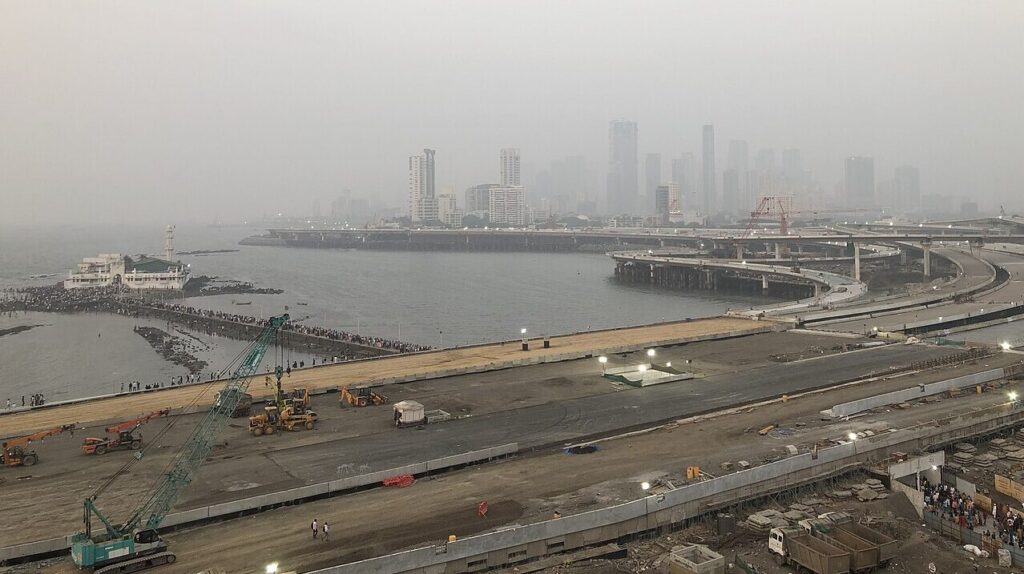
- In December, the Bombay High Court cleared the Versova-Bhayandar DP road, a project that will affect more than 45,000 mangrove trees along Mumbai’s western coast.
- The decision has drawn sharp criticism from citizens, fisherfolk, and environmental activists, who have raised concerns about the significant impact on the environment, livelihoods, and people.
- Experts say that the loss of mangroves could worsen tidal flooding, air pollution, and other climate extremes, putting people at high risk.
Dipti Dheeraj Bhandari, a fisherwoman from Mumbai’s Charkop village, has been worried for weeks. In mid-December 2025, the Bombay High Court granted permission for the Versova-Bhayandar Development Plan (DP) road, an approximately 26 kilometre arterial corridor that will cut through western Mumbai and impact more than 45,000 mangrove trees. “My entire family depends on fishing in these mangroves,” she says. “Without them, our life comes to a standstill.”
The proposed road, which will run from Versova through the city’s western suburbs to Mira Bhayandar, is planned as the northern extension of Mumbai’s coastal road network, which currently runs from Marine Lines in South Mumbai to Worli. The Brihanmumbai Municipal Corporation (BMC) says the ₹18,000-crore project (₹1,802 billion), will relieve traffic on the Western Express Highway and significantly reduce travel time. However, the court’s clearance has triggered opposition from environmentalists, fisherfolk and citizens, who say that the loss of mangroves will severely affect the environment, their livelihoods and increase climate risks in one of India’s busiest cities.
In its submission to the court, the BMC said that 103 hectares of forest land, mostly mangroves, will be affected by the project. Of the 60,000 mangrove trees in the area, the civic body proposed diverting more than 45,000 mangrove trees and the felling of 9,000 mangrove trees. Diversion means that land classified as forest land for mangroves will open up for non-forest use such as road construction which could lead to cutting of the trees in the area that intend to be compensated with afforestation in another area.
The High Court, while granting permission, directed that the BMC’s plea remain pending for 10 years, during which the civic body must file yearly updates on compensatory tree planting.
Development versus climate risks
In recent years, Mumbai has been at the receiving end of severe climate change: from rising sea levels to worsening air pollution. A 2024 study by the Centre for Study of Science, Technology and Policy (CSTEP), a Bengaluru-based think tank, revealed that Mumbai has experienced the maximum rise in sea levels (4.44 cm) from 1987 to 2021. It also stated that more than 10% of the land in Mumbai will be submerged by 2040 due to rising sea levels.
In December 2025, Mumbai’s air quality index (AQI) slipped into the hazardous range, following which, residents of Bandra’s Carter Road held a peaceful protest and formed a human chain to voice their concerns.
“In the past few decades, Mumbai has experienced extreme rainfall, heavy precipitation, and heat waves,” says Praveen Kumar, assistant professor at the Centre for Climate Change and Sustainability Studies, Tata Institute of Social Sciences (TISS). “In such situations, cutting mangroves, which are among the most ecologically productive systems along the western coast of India, will cause massive social, economic, and ecological damage.
Natasha Pereira, an environment activist, who has started a petition to stop the felling of mangrove trees, points to a report by the World Meteorological Organisation (WMO), which showed that Mumbai’s sea levels rose by 4.5 mm a year between 2013 and 2022. “If you go to Carter Road (a coastal promenade with mangroves) and neighbouring areas during a high tide, the waves are already crashing across the shore,” she says. “In such a scenario, cutting mangroves, which are the first line of defence, puts citizens at high risk.”
She adds that with the proposed project, the city “will lose 75% of the mangrove forest at the Manori Creek area between the Versova and Dahisar wetlands.” Her focus is now on filing a review petition with the High Court, and then taking the matter to the Supreme Court.
Meanwhile, in its 2025 writ petition, the BMC argued that the proposed project will have a “significant and direct beneficial impact on the public”. It stated that the overall road travel distance between Versova and Bhayandar will be reduced by over 10 kilometres, and travel time by road will be reduced to around 18 minutes from 120 minutes.
“The coastal road will ensure faster vehicle movement and save people’s time,” a state government official told Mongabay-India, on condition of anonymity as they were not authorised to speak to the media. “This will also save diesel and petrol, which will benefit the environment. “The BMC has already paid about ₹300 crore (₹3 billion) for the restoration plan to the Mangrove Foundation.” Mangrove Foundation is an entity under the Maharashtra Forest Department focussed on protecting mangroves and coastal biodiversity in the western state.
Debi Goenka, an environmentalist, calls out the unnecessary construction of the road. “Under the guise of development, the government is cutting mangrove [trees] and saying it is building essential infrastructure, which everybody will pay for, but only a small fraction of the population will benefit from.”


What happens if the mangrove trees are cut?
Rupesh Bhomia, an independent researcher and former senior scientist at Centre for International Forestry Research and World Agroforestry (CIFOR-ICRAF), sees the impacts in three broad brackets: immediate, short-term, and long-term. “As the project begins, there will be direct habitat loss where mangrove trees are actually cut down, and the root mass may be excavated or removed, which will lead to fragmentation and gaps.”
He further explains that a healthy mangrove ecosystem thrives on constant tidal flushing. Twice daily, a cyclic pattern of tides brings water in during high tide and takes water out during low tide, creating a continuous rhythmic flushing.
“This dynamic creates unique biodiversity assemblages of microbes, plants, and animals, including many crustaceans, crabs, snails, mudskippers, fish, and all kinds of birds,” he adds. “All these species are interconnected, and their survival is very much interdependent. The construction work, including excavation, earthwork, and tree uprooting, will damage the existing linkages between species, causing loss.”
Furthermore, disruptions at the ground level will impact how water flows and how tides come in and go out. “These changes will create local stressors, so even the trees that may not be cut down will experience much higher stress and will eventually not be able to cope,” he says.
Elaborating on the cascading impacts, Bhomia says that they will be noticeable within one to five years or longer. “In the case of any cyclone or storm surge, the network of roots and stems creates a barrier that reduces the energy of waves, protecting everything behind the mangroves, including landward areas, other trees, housing, or people,” he says. “The city might lose this natural barrier, called the bioshield function, when the mangroves are cut.”


More than carbon storage loss
One of nature’s most effective ecosystems that can significantly help in reducing carbon dioxide in the atmosphere is the mangrove forests. According to the World Wildlife Fund, mangroves store about three to four times more carbon per acre than tropical forests, and their loss contributes to a tenth of global greenhouse gas emissions from deforestation.
Experts have also pointed out that it’s not just about carbon sequestration, but also emissions. Kumar and Bhomia both stated that the felling of mangroves will also add more emissions to the environment. “When they [mangrove trees] are cut down, the carbon stored in their biomass and soil is also released as the soil is exposed to air,” Bhomia says. “This adds more emissions per unit area. That is why protecting mangroves makes more sense from a climate change standpoint.”
While civic body officials have argued that the time saved due to reduced traffic will help the environment, Goenka says it might actually lead to more emissions. “This could result in induced traffic, which means the moment you create new infrastructure, within six to 12 months, even that gets saturated,” he adds. “So, the new road ends up encouraging more people to use their cars.”
Livelihoods at risk, Koli community raise concern
For the Koli community in Charkop and surrounding areas, the proposed project is a matter of grave concern as it directly impacts their livelihood.
Fisherwoman Dipti Bhandari, who is also the founder of the Charkop Koliwada Machhimar Sahakari Society, a fisherfolk cooperative, says 90% of the fish that her family sells every day comes from these mangrove-associated waters. Every morning, around 6 a.m. , the fisherfolk head out into these mangrove waters to catch fish, which takes them approximately four hours.
“The mangroves have been part of the Koli community’s daily life for decades,” Bhandari adds. “If they cut the mangroves and we do not get fish, what will we survive on?”
With rising unemployment and shrinking incomes, she worries for her family. “We have school fees to pay, put food on the table and take care of basic necessities,” she says. “The entire community depends on fishing for their livelihood.”
The community had sent in written objections to the BMC for the proposed project. However, Bhandari says, they haven’t received a reply yet. “This road is for people with cars,” she adds. “Nobody is thinking about those who live here.”
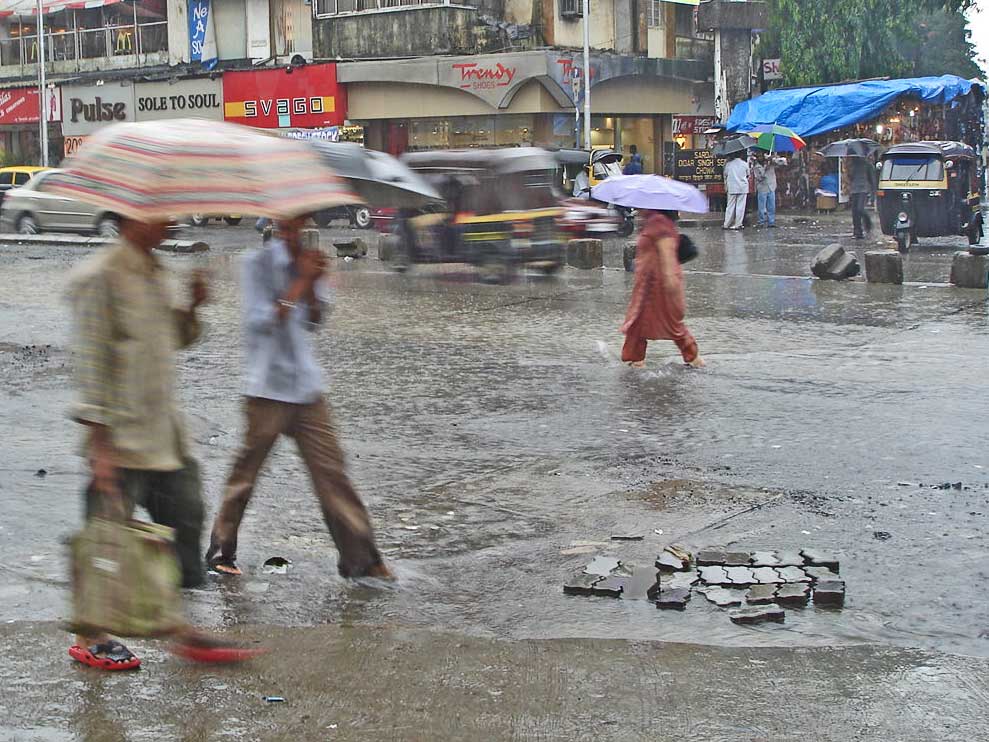
Kumar added that marginalised communities, particularly fisherfolk and those in informal settlements will bear the brunt of this project. “Even now, there is significant urban flooding happening in informal settlements,” he says. “In Mumbai, around 50% of the population lives in informal or vulnerable housing, meaning flood impacts a very large segment of the city.” he says, adding that there is growing evidence that multiple infrastructure projects in areas like the Thane Creek have contributed to declining fish availability, which has directly affected fishing-dependent communities. This could further exacerbate the impact on their livelihoods.

Is compensatory afforestation enough?
The BMC has proposed planting over 1.3 lakh (130,000) saplings, three times the number of mangroves proposed to be cut, as compensation. “The compensatory land can be given anywhere; it’s not necessary that it has to be in Mumbai,” the state government official told Mongabay-India. “The forest department is taking areas in Palghar and Thane. Mangroves have already been planted over 31 hectares in Thane. More will be planted in the 250 hectares set aside for this in Palghar.”
Kumar says that while planting trees is a good move, this is about cutting down 40 or 50-year-old mature mangrove ecosystems and then starting from the beginning, which is “ecologically inefficient and not productive”.
He further adds that Palghar has a different environment with a slightly different climate. Therefore, it is unclear how the mangroves will fare in the area.
According to a 2025 study, between 2012 and 2022, more than ₹45 crore (₹450 million) was invested in the restoration of Mumbai’s mangrove forests. The study assessed 25 sites in the city through remote sensing and time-series analysis and found that restoration failed at 52% (13 out of 25) of the sites, with no mangrove growth from their restoration year.
Pereira emphasises that mangroves grow in estuarine regions where rivers meet the sea, in brackish waters. “They just cannot survive any area.”
Bhomia says that mangroves around urban areas such as Mumbai are already under extreme stress. “They are facing much higher pollution loads and disrupted hydrology,” he adds. “When these remaining stretches or patches are lost, and we try to restore them, the probability of success is generally very low. Hence restoration projects in urban settings often fail.”
Bhomia further says that one of the key questions often overlooked in compensatory afforestation efforts is whether it has resulted in biodiversity restoration. “It should not just be about structural restoration, which means trees are growing again in an area. The real test is whether functional connectivity is restored, he says “This means whether critical foundational species, such as crabs, bird populations, and fish have returned.”
On January 2, the Ministry of Environment, Forest and Climate Change (MoEFCC) sought an action taken report from the Maharashtra State Wetland Authority regarding the loss of mangroves for the coastal road project.
Bhomia adds that there should be collaboration between Mumbai’s citizens, planners, civic authorities, and researchers to come up with “more contextual, local solutions”. “It cannot simply be about building roads; we may need to reimagine transportation and movement through these areas while minimising environmental damage.”
Read more: Understanding coastal risks with and without mangroves
Banner image: A stretch of Mumbai’s coastal road being constructed near the Haji Ali Durgah in 2024. Representative image by Qiw007 via Wikimedia Commons (CC BY-SA 4.0).

