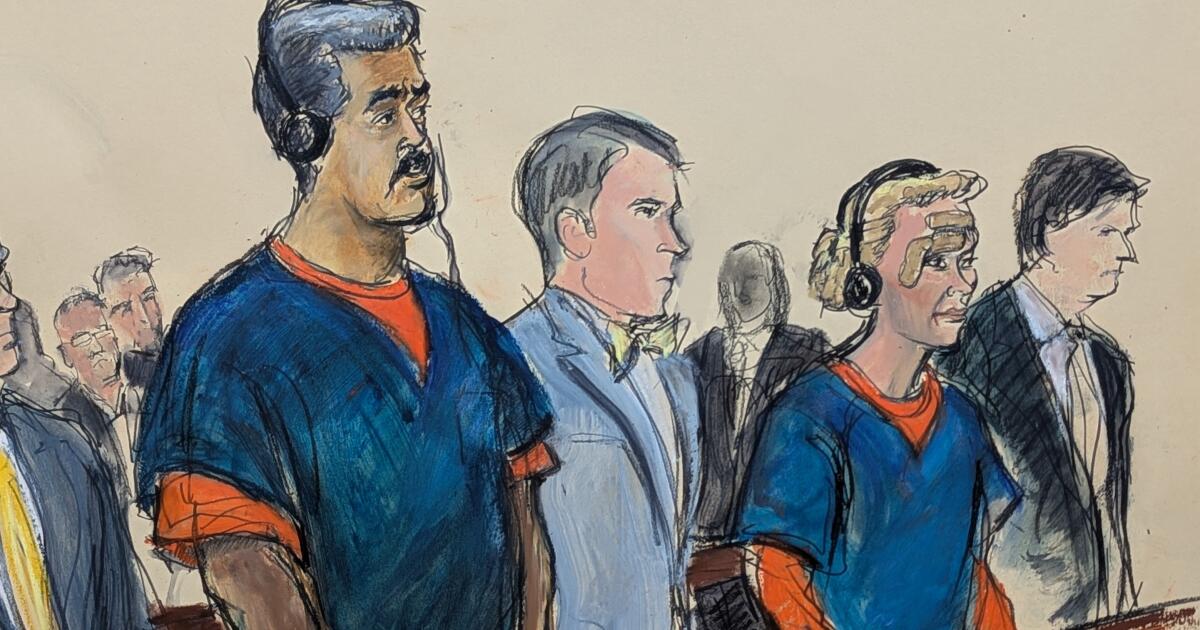
Last week, Donald Trump ordered a military operation in Venezuela that included a series of air strikes in Caracas and the seizure of Nicolás Maduro, the country’s President, and his wife. The couple were then brought to New York City to face drug-trafficking and other charges. (They have pleaded not guilty.) The operation, which killed more than seventy people, has been followed by vows from President Trump to take Venezuela’s oil—something that he said the new Venezuelan government would facilitate. Delcy Rodríguez, Maduro’s Vice-President, the interim leader of the country, has contradicted Trump’s claim that he will “run” Venezuela, but she nevertheless is currently favored by the American government to remain in charge. Trump has pushed aside the opposition to Maduro, who won the election that Maduro stole, in 2024.
Democrats have largely condemned Trump’s actions in Venezuela, but Republican support has been strong, even among some so-called Never Trump Republicans, including the former congressman Adam Kinzinger, who backed Kamala Harris in the 2024 Presidential election. But there’s bipartisan concern, shared by American allies abroad, about Trump’s escalating threats to Greenland, which is part of Denmark, and which Trump and the White House have repeatedly said should be taken by the United States.
I recently spoke by phone with Matthew Kroenig, who is a professor at Georgetown and the senior director of the Atlantic Council’s Scowcroft Center for Strategy and Security, and a columnist for Foreign Policy magazine. Kroenig recently wrote a piece for the New York Times titled “Trump Was Right to Oust Maduro.” (Kroenig has worked as an adviser to Mitt Romney and Marco Rubio, and in the Pentagon during Trump’s first term.) During our conversation, which has been edited for length and clarity, we discussed what Trump’s ultimate aims are in Venezuela, the possibility of an American attack on Greenland, and whether there is a danger in encouraging Trump’s bellicosity.
Why do you think that the move by the Trump Administration to remove Maduro was the right one?
Well, Maduro’s a bad guy and it’s good that he’s gone is the bottom line, and he gave America’s adversaries like Russia, China, and Iran a foothold in the Western Hemisphere. He mismanaged his economy so badly that about a quarter of the population fled, contributing to a refugee crisis and pressure on the U.S.’s southern border. And he is charged with trafficking drugs into the U.S. So he was bad—bad for U.S. security, and bad for the Venezuelan people, and it’s better that he’s gone.
Do you have some sense that the Trump Administration cares about the welfare of the Venezuelan people and the future of Venezuela? I read a piece of yours in Foreign Policy in November where you said that it’s important for the Trump Administration to try to insure that a pro-American democracy arises in Venezuela after Maduro.
In terms of the mismanagement of domestic politics and economics in Venezuela, there are two ways you could get somewhere better. One is a policy change and the other is a regime change. It does seem like the near-term strategy is to use carrots and sticks to encourage the current leaders in Venezuela to change policy. It is possible that the remnants of the Maduro regime could put in place the right policies—economic reforms to curb or stop drug trafficking, and to push out the Russians, the Chinese, and the Iranians—for a variety of reasons, including that they don’t want to have happen to them what happened to Maduro. But I do think over the longer term, the outcome we would want is a democratic Venezuela. As to whether the Administration cares about that—if you just look at Trump’s statements on Saturday or Rubio’s appearances on the Sunday shows, they did talk multiple times about how they were pursuing America’s interests, but also that this would be to the benefit of the Venezuelan people. [The New York Times reported on Wednesday that repression in Venezuela had ramped up, from already high levels, since Maduro’s removal, with journalists and people who celebrated Maduro’s capture being detained.]
You could make a utilitarian case that an invasion or a regime change will improve the lives of the Venezuelan people. That’s a little different than saying that the Trump Administration cares about democracy. Because Trump seems like he’s more interested in pursuing oil rights for American companies and whatever else.
Yeah. Well, and so again, looking at the Rubio interviews, he did talk about how democracy is the goal, but he said we have to be realistic. The opposition [to Maduro] is not in the country. These things take time.
Trump seems like he’s soured on the opposition.
Yeah, I think that’s right. Obviously America has an Iraq and Afghanistan hangover and part of how I see the strategy is that it’s kind of correcting for some of the mistakes of Iraq and Afghanistan. And I think one of the mistakes was overpromising on democracy in places where it was not realistic. I see Rubio as trying to downplay the expectations that a Jeffersonian democracy is going to pop up overnight. But even Trump was asked about elections, and he said something, like, Well, I hope it happens quickly, but it’s a process.
Sure, but you’re a very smart guy. You know that Trump doesn’t actually care about Venezuela in terms of whether it’s a democracy or not, right?
I think that’s fair—that he’s less focussed on values than traditional U.S. politicians.
Less focussed. Yeah.
Yeah. Whereas I do think that Rubio does care, including because of his family background and his long record in the Senate being a supporter of democracy and human rights.
Your Times piece does not address the fact that the person carrying this out has the qualities of Donald Trump, and that he’s also threatened a bunch of other countries in the past several days. The Administration seems to even be threatening Greenland. I’m curious if that should be part of our calculation as Americans when we wonder whether it’s a good idea for the President to order a military operation to remove a head of state.
I guess I do see the cases as different, and you’re right that Trump has threatened adversaries and allies. But in the case of Maduro—this is a leader who has stolen an election, who’s committed human-rights abuses, who was not recognized by Joe Biden or by the European Union. And so this is kind of the easiest case. With Greenland, Denmark is a NATO ally, and it’s very hard for me to see something similar happening there. With Mexico, the President has a pretty good relationship with Claudia Sheinbaum. She and the Colombian President, Gustavo Petro, are both democratically elected. The one place where I do think there should be some concern is Cuba: Rubio was asked about this and he said, ‘Yeah, if I lived in Havana, and I was in the government, I’d be concerned.’ And, in fact, the cutting off of Venezuelan oil is already really putting a lot of pressure on the government in Cuba. So I do think this is a model that could be applied elsewhere, but I think some of the hyperventilating over the past few days that this is going to be unleashed everywhere probably goes too far.