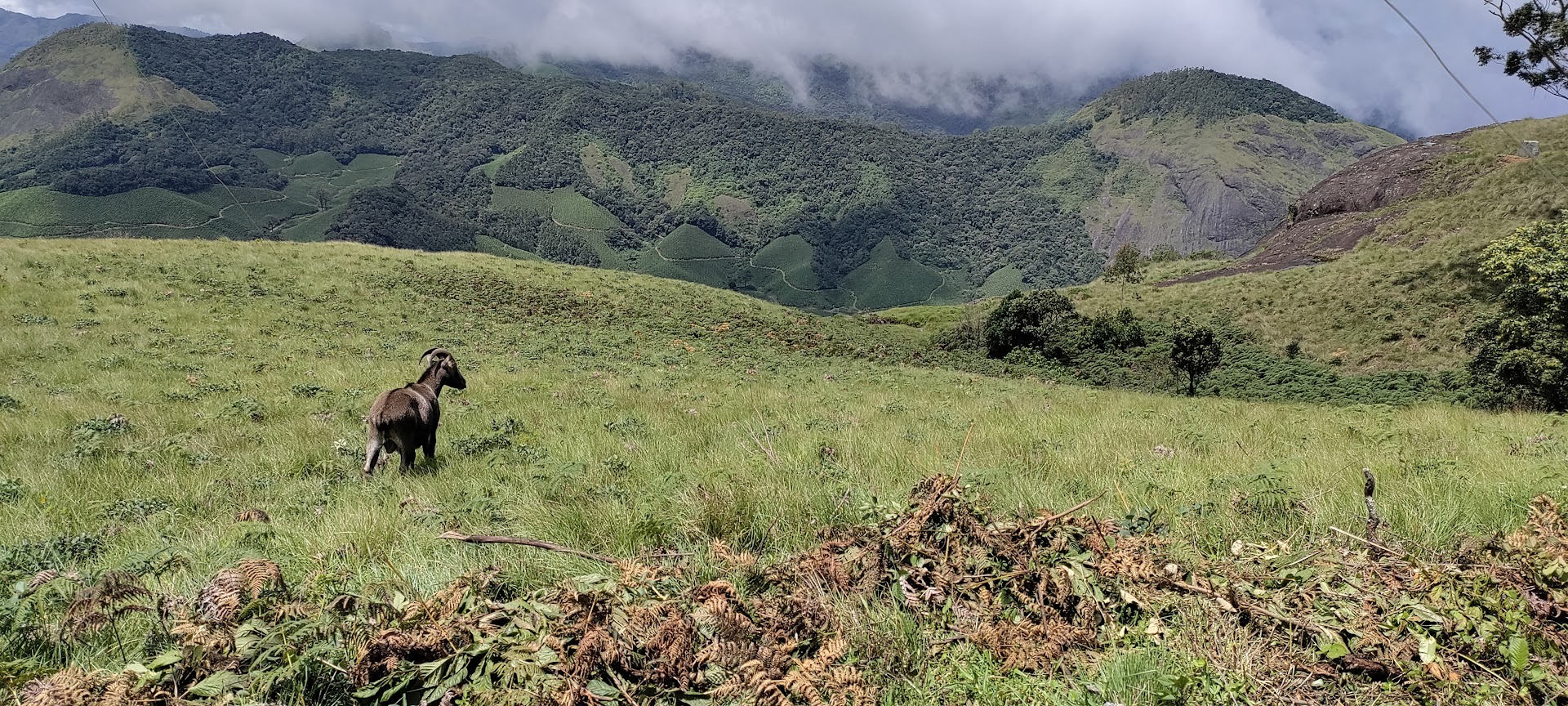
- Eravikulam National Park celebrated its 50th anniversary in 2025. Kerala’s first national park has become a vital sanctuary for the endangered Nilgiri tahr and famous for its Neelakurinji blooms.
- Long before Silent Valley became a national symbol of environmental protest, Eravikulam was quietly protected through an unknown movement of persuasion, letters, photographs, and tribal knowledge.
- Today, the park’s 841 Nilgiri tahr and fragile twelve-year flowering cycles face genetic isolation, stray dog disease, tourism pressure, and climate stress.
The hills of Eravikulam wake slowly. Before sunrise, the slopes are almost invisible, holding the last cold breath of night. Then a thin, colourless light appears over the rounded grass ridges and reveals shola hollows, rock faces, and faint animal paths. A Nilgiri tahr steps out near its main point Rajamala, pausing above a cliff as if listening for something familiar in the wind.
Located close to the famed hill town of Munnar in Idukki district of Kerala, Eravikulam looks inevitable today, as if these vast expanses of high grassland had always been destined to become a national park. Nothing about its present stability indicates how close it once came to vanishing under a file stamp at the state revenue department. Fifty years ago, the same slopes, now described as prime habitat of the highly endangered Nilgiri tahr, were listed as surplus land under Kerala’s much-celebrated and revolutionary land reform programme. The grasslands that hold the highest concentration of Nilgiri tahr in the world, apart from supporting vast spreads of Strobilanthes kunthiana, known as kurinji or Neelakurinji, which blooms once in twelve years, were treated in official language as “vacant”, “idle”, and “available for redistribution” among the landless.
When grass was treated as nothing
In fact, the misunderstanding did not begin in the 1970s. It began much earlier, when colonial hunters arrived in their old plantation town, Munnar, with rifles. In British estate records, the high grass country above Munnar was referred to by names such as “top grass”, “spare slope”, “estate waste”, indicating that it was not of any use. Hunters travelled to shoot Nilgiri tahr on weekends and took trophy photographs beside carcasses on the bare granite of Anamudi. Grass was treated as the space between the tea and the forest. The colonial eye looked at slope vegetation and saw only entertainment. That vocabulary persisted in settlement records, revenue manuals, and land classification documents long after independence. Grass was not timber. Grass was not a plantation crop. Therefore, grass was considered nothing.
When Kerala vested private forests with the state after 1971, revenue officers used that inherited language. Everything not under the tea estate boundaries was considered surplus by default. The administrative categories were dangerous because they carried a century of misunderstanding. Land not classified as a plantation was marked ready for redistribution. Officials in Munnar repeated a familiar line in those years. Grass has no purpose. It appeared regularly in file notes and in discussions with foresters.
Quiet persuasion
Environmental activist and senior journalist M.J. Babu, who lived in Munnar during the 1970s, recalled how persistent that official view was. Revenue officers questioned why anyone would want to protect an area where nothing edible or tall seemed to grow. He remembers the response of a certain conservationist in the plantation town. They relied on a simple ecological truth. Growth, they said, does not mean height. “Life here moves sideways, not upwards,” they said. “It is not a tree. It is a slope.”
Babu believed persuasion worked best in that time before public protest shaped conservation. He remembers one evening in the early 1970s, when a sceptical senior revenue officer went to Rajamala. He watched a herd of Nilgiri tahr move in single file across a narrow cliff ledge with slow confidence. At dusk, the officer said only one sentence. “This cannot be chopped.” That line marked the beginning of a shift in the file language that would eventually save Eravikulam.
The tribal memory of slopes
Before any forest officer took an interest, Munnar’s famed Muthuvan tribal community protected the slopes in their own quiet way. Tribal forest watcher P.V. Sreenith said that his elders understood breeding cliffs and grazing patterns of the endangered species long before government surveys arrived in Munnar. They knew where the animals moved naturally through rock formations before calving season near the Lakkom forest region, and which ridges bachelor herds used when moving between grass patches. They learned by repeating the same walk for generations. No formal training was involved.
Muthuvan Krishnan, who lived as a living repository of forest knowledge in Eravikulam till the age of 85 and passed away on July 30, was a long-time watcher of Nilgiri tahr under the forest department. “We never used the word protect,” Krishnan used to remind visitors. “We called it respect.” He also described how elders sometimes misled surveyors by inventing stories of dangerous leopards or sudden landslides to keep them away from maternity slopes. Their methods were simple, but their effect was long term. “Grass listens,” he said. “Heavy steps break it.”
Retired Indian Forest Service officer James Zachariah, who worked for long in Eravikulam as a divisional forest officer, recollects how science began to influence policy decisions at around the same time through the work of several researchers. They moved through the slopes with notebooks, tracking seed dispersal, sketching shrubs, and studying the Neelakurinji, the plant that flowers once in twelve years. He observed that policy sees flowering, not waiting, but waiting is the life of kurinji. The plant remains underground for most of its cycle, storing energy until a single collective bloom. Today, threats such as soil compaction from tourism and road construction, and climate change, pose risks to this ancient ecosystem, underscoring the need for careful management and community engagement to protect Eravikulam’s delicate balance.
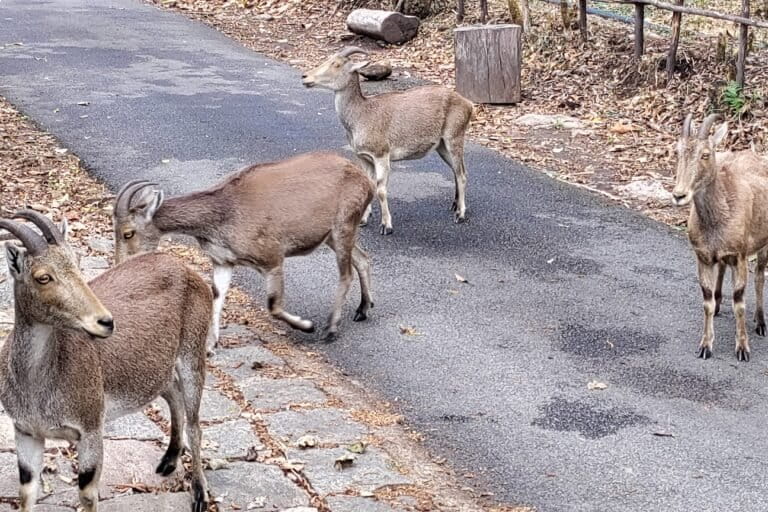
At first, the scientific arguments were not enough. But they were not alone. Behind the shift was M.K. Ranjitsinh of the Central Forest Department, an architect of the 1972 Wildlife Protection Act, who repeatedly spoke to the Prime Minister about Eravikulam based on reports from scientists and a Scotsman with a deep attachment to those hills. That Scotsman was J. C. Goldsbury, a former officer of the Gurkha Regiment during World War II who later served as manager of Vagavur Estate under the Kannan Devan Company.
Goldsbury knew every footpath, ridge line, and unseen gully in what later became the national park. He argued that building a motorable road through this landscape would destroy its wildness. He believed the essence of Eravikulam lay in its lack of roads. In April 1976, the then Prime Minsiter Indira Gandhi visited Kochi to inaugurate the first ship keel at Cochin Shipyard. Then, Navy Chief Admiral O.S. Dawson arranged a helicopter to take her to Munnar so she could see Eravikulam from the air. But unforeseen political developments led to urgent meetings, and she had to refuse the flight. She said, “Next time I come, we will go to Munnar.” That next time never came. Dawson later flew over the hills himself, photographed them, and sent the pictures to her. The images showed long ribbons of grass, shola patches like dark tears in the green, and slopes like frozen waves. It was those images, not speeches, that helped persuade the highest levels of government that Eravikulam mattered.
Rice, files, and a sanctuary
There is a little-known episode from 1974 that demonstrates how unusual the sanctuary’s creation was. Kerala needed rice from the central stores during a food shortage. Union Food Minister Annasaheb Shinde, who also handled forest matters, told Kerala minister Baby John that rice stocks would be expedited if Kerala moved quickly to create a Nilgiri tahr sanctuary at Munnar, as it concerned the Prime Minister. The conversation produced momentum in a file that had stalled for months. A resource as ordinary as rice helped shift the fate of a wild grassland. Ranjitsinh, who held the additional charge of union food secretary, played the catalyst.
By 1975, forest officer G. Mukundan drafted the sanctuary notification. Chief Conservator K.K. Nair supported it, and Forest Minister K.G. Adiyodi signed it. Kannan Devan Company promised to support patrolling expenses and involve Muthuvans as watchers. It was the first time a corporation, a government, and tribals came together for conservation. That year, Eravikulam became a national park, well ahead of the Silent Valley movement that would become a national symbol of environmental protest in the 1980s.
Eravikulam’s story remained largely hidden because it did not involve demonstrations or confrontations. It depended on persuasion, memory, and timing rather than slogans. Silent Valley needed public mobilisation and political struggle. Eravikulam needed a change in file description and a few crucial decisions made quietly.

Fifty years later, the numbers speak of success and risk. Recent census findings show 2,668 Nilgiri tahr across Kerala and Tamil Nadu. Kerala has 1,365. Eravikulam alone supports 841. Officials say the number is considerably fair. But they hide worrying details. Tea plantations, roads, and tourism infrastructure genetically isolate the Eravikulam population. Wildlife veterinarians warn that diseases such as canine distemper, which can spread from stray dogs entering park fringes, could devastate the herd. Rangers have documented injuries from dog attacks on young tahr.
The Neelakurinji faces quieter threats. Tourism during bloom years compacts the soil where seeds lie dormant. Botanists have documented uneven bloom patches, delayed flowering on certain ridges, and reduced seed germination. Climate change brings erratic monsoons, prolonged dry spells, and warmer nights, disrupting the 12-year cycle. The effects show themselves slowly, often invisibly.
What the next fifty years demand
The shola-grassland mosaic demands humility. The fragmented corridors between Eravikulam, Chinnar, and Pampadum Shola need restoration to allow genetic exchange among tahr populations. Strict controls on feral dogs entering from nearby settlements are necessary to prevent disease. Scientific monitoring of kurinji cycles is required to understand shifts in flowering patterns under climate stress.
M.J. Babu has said that the true challenge now is not changing the law but changing attention. Conservation originally succeeded in Eravikulam through persuasion. That method works only if new generations are willing to see the landscape correctly.
Eravikulam will always remain in the shadow of Silent Valley in public memory, but it came first. Silent Valley needed a protest. Eravikulam needed patience. Silent Valley was the country’s visible awakening. Eravikulam was its quiet rehearsal.
Read more: Mass flowering and why some plants bloom and die together [Explainer]
Banner image: A Nilgiri tahr strolls through grasslands at Eravikulam National Park. Image by K.A. Shaji.