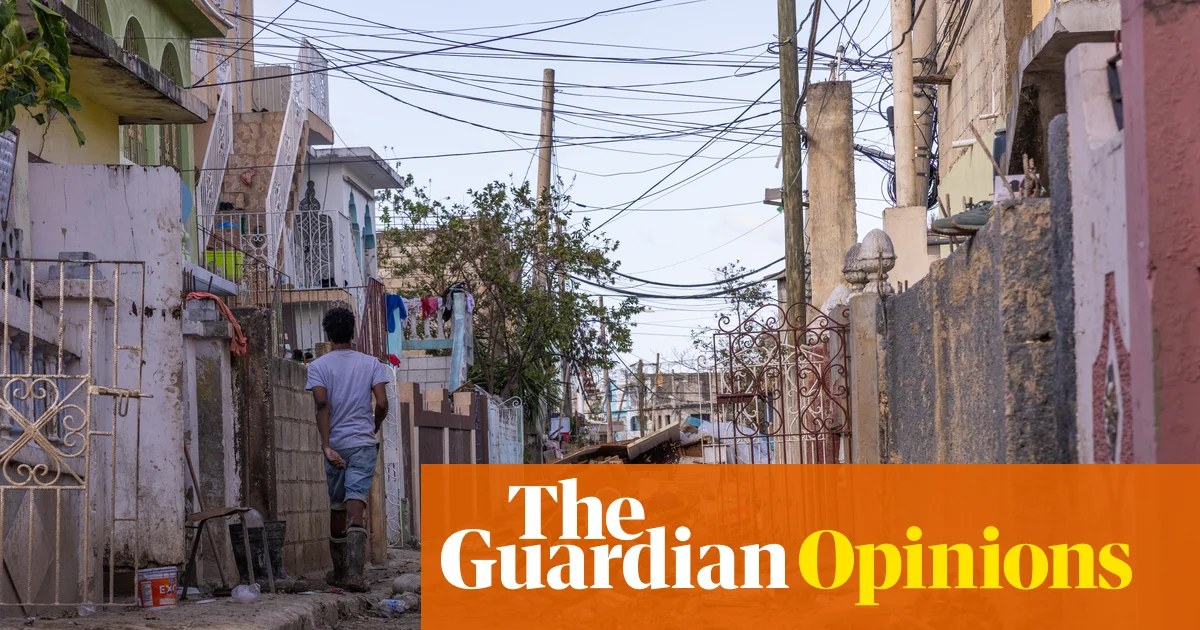
The record-breaking 252mph winds of Hurricane Melissa that devastated Caribbean islands at the end of October were made five times more likely by the climate crisis. Scorching wildfire weather in Spain and Portugal during the summer was made 40 times more likely, while June’s heatwave in England was made 100 times more likely.
Attribution science has made one thing clear: global heating is behind today’s extreme weather. That greenhouse gas emissions warmed the planet was understood. What can now be shown is that this warming produces record heatwaves and more violent storms with increasing frequency.
What we can do to minimise, or at least reduce, the risks to life from such events – as well as more gradual changes – is what climate adaptation experts think about all the time. The alarming consensus is that we are not doing anywhere near enough. The result is paid for in lives: floods and cyclonic storms across Thailand, Sri Lanka and Indonesia left hundreds dead at the end of November.
The president of Cop30 in Brazil, André Corrêa do Lago, called for the UN climate change conference to be a “Cop of adaptation”. But the governments of the most vulnerable countries went home from Belém angry about an outcome that saw the projected size of the annual adaptation budget triple to $120bn, but with the deadline pushed back to 2035 and no clear mechanism to make rich countries pay up.
Even that total falls short of the $300bn in climate finance overall that was agreed at Cop29 in 2024. The risk is that without international support, heavily indebted countries such as Jamaica become trapped, with resources that ought to be directed towards green energy and future-proofing being spent instead on coping with disasters.
But the need for preparation is not limited to low-lying countries and those most affected by extreme heat and violent storms. This imbalance in climate programmes can be seen all over the world. Last month, a group of UK scientists organised what they called a “national emergency briefing” in London in an effort to alert people to the scale of the climate crisis threat – and alarming underpreparedness.
Everyday injustice
In the global context, the politics of adaptation are clear. Poorer countries, including the small island states whose existence is threatened by sea-level rises, have consistently argued that the rich nations whose historical and current emissions are responsible for climate heating must support them to adapt to the crisis, as well as to transition away from fossil fuels. Rightwing, nationalist governments in the west are extremely hostile to this idea – and to aid spending more broadly – even if their most vociferous objections are reserved for the phaseout of fossil fuels and net zero.
But within wealthy countries, adaptation can appear more as a technocratic challenge than a political one. Policies regarding flood risks or increased resilience to high temperatures are not usually top priorities for voters – except when there is a disaster such as the floods in eastern Spain that led to the resignation of Carlos Mazón, president of Valencia, in November. While the grossly mismanaged water industry is a live political issue in England and Wales, big questions about natural resources and the resilience of infrastructure sit outside the daily cut and thrust, with responsibility delegated to arm’s-length agencies and rarely touched on by party leaders.
A recent report from the UK’s Glacier Trust and Climate Majority Project argued that charities and politicians should seek to change this, and promote an “action-oriented public understanding of climate risk”. All must recognise that adaptation cannot simply be left to market forces because the economics of climate risk make private finance retreat just as danger rises.
The long, low-profit investments needed to defend communities from flood, fire and heat are not attractive to private lenders. It is the state that must build seawalls or insure subsistence farmers when the risk becomes too great. Leah Aronowsky, a historian of science at Columbia University, says that climate risk is everyday injustice made worse – and she is right to argue that how we adapt is a political battle.
What adaptation should look like
One reason that adaptation receives so little attention is the sheer urgency of cutting emissions. In the context of warnings that the 1.5C target in the Paris agreement could move out of reach, mitigation – reducing or removing emissions – is the top priority.
Discussing preparations for global heating can feel like a distraction or even an admission of defeat. But while it makes sense for climate campaigners to maintain the strongest possible pressure for emissions cuts, there ought to be scope to get ready for a hotter, more unstable climate as well. Under the terms of the UK’s Climate Change Act, the government is legally obliged to do so, and to regularly review its preparations.
The UK’s Climate Change Committee will soon outline what a truly “well-adapted” country should look like: flood defences that can withstand the storms to come, transport links built for a harsher climate, food and supply chains resilient to global shocks, and coastal communities protected rather than abandoned. Experts also want to ensure that the 1.5m homes that the government has pledged to build in England alone are fit for the future. In an era of polarised attacks on net zero, such projects could help rebuild a shared belief in responsible care for the land.
For the rich world, adaptation is prudent. For the poor world, it is survival. The latest UN report is unequivocal: developing countries will need more than $310bn annually by 2035, yet received just $26bn in 2023. Catastrophic floods in Asia and worsening droughts in Africa this year point to the growing need to accelerate climate adaptation.
Under the Paris agreement, nationally determined contributions (NDCs) – country plans to tackle global heating – are meant to cover both emissions reduction and adaptation to climate impacts.
But NDCs end up focusing mostly on cutting greenhouse gases and establishing decarbonisation pathways. That needs to change. National adaptation plans, which came out of Cop16, need to be foregrounded. These put adaptation centre stage – and demand real plans, real finance, real justice. They ask the question that really matters now: how do vulnerable nations survive a warming world that emissions cuts alone can’t stop?