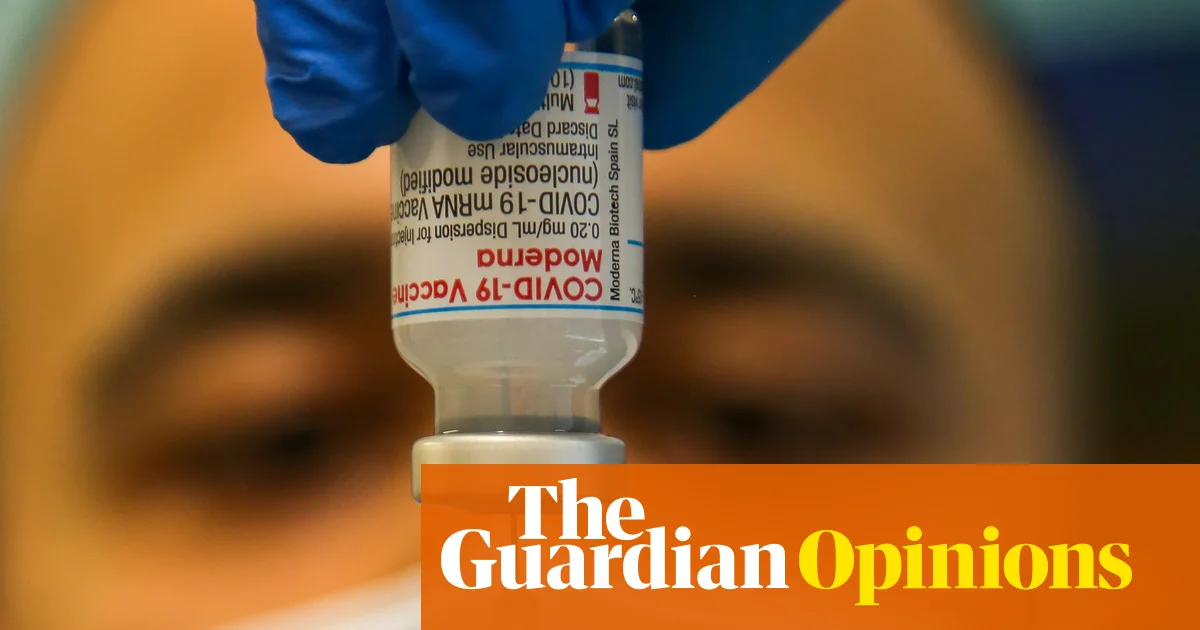
The late scientist and thinker Donald Braben argued that 20th-century breakthroughs arose from scientists being free to pursue bold ideas without pressure for quick results or rigid peer review. The rapid development of Covid-19 vaccines seemed to validate his claim: emergency conditions sped up trials, relaxed regulatory sequencing and encouraged scientists to share findings before peer review. Out of that sprang one of the great scientific success stories of our age: mRNA vaccines. These use synthetic genetic code to train the immune system to defend itself against viruses. Katalin Karikó and Drew Weissman, whose work enabled the mRNA Covid vaccine, went on to win the Nobel prize. Their breakthrough suggests that loosening traditional constraints could accelerate major scientific advances.
The extensive scientific and logistic infrastructure built during that period is now occupied with turning the technology towards other diseases: flu, HIV and even cancer. Until very recently, the US, which put more than $10bn into mRNA development, appeared primed to reap the scientific and commercial rewards. Despite the deregulatory zeal that birthed mRNA, the second Trump administration has rejected it. Instead, it has been remarkably steady in its commitment to the radical anti-science and anti-vaccine agenda of the US health secretary, Robert F Kennedy Jr. He has spent the past year undermining and outright sabotaging the US’s own success. Over the summer, the US Department of Health and Human Services announced a “coordinated wind-down” of federal funding for mRNA research, cancelling an additional $500m in funding for 22 projects.
These cuts will be devastating. Developing safe novel therapies depends on long timelines, steady funding and – despite Braben’s thesis – predictable regulation. The abrupt US reversals signal that Washington is now an unreliable partner, willing to walk away after others have invested heavily. And when once-trusted federal agencies stop recommending mRNA vaccines or deliberately slow approvals, the harm doubles: it undermines public confidence and cripples the system meant to keep people safe. That’s all too visible in falling vaccination rates in the US. The pharmaceutical industry is not a benevolent actor, but these firms want to deliver – and profit from – mRNA technology. An unstable US market makes that significantly more difficult.
The future of vaccination
Although mRNA vaccines proved their efficacy against Covid, the next frontier remains an open question. Early lab and trial data shows that they excel at priming the immune system, though real-world results are harder to pin down. They can be made quickly, tweaked easily, and a factory that makes one kind of mRNA vaccine should – with some caveats – be able to make any other one too. This means that scientists can test huge numbers of candidates: there are hundreds of vaccines currently in clinical trials, including early-stage work on extremely difficult pathogens like HIV.
So far, mRNA’s biggest impact has been on diseases that we already vaccinate against, but not very effectively. For example, flu shots are slow to develop and cumbersome to produce, a terrible match for a virus that mutates every year. In some winters, the standard flu jab protects against serious illness only about 30% of the time. Recently developed mRNA flu vaccines like Moderna’s mRNA1010 and Pfizer’s modRNA significantly outperformed the standard flu jab in final-phase trials. This is another vote of confidence for the technology, but also sets up a potentially clarifying conflict with the Trump administration: the decision on US approval for those vaccines is expected in early 2026 and rests with the US Food and Drug Administration’s Center for Biologics Evaluation and Research – which is run by Vinay Prasad, a close ally of Mr Kennedy. A negative or stalled result would confirm just how far the administration is willing to go in its anti-mRNA crusade.
Ironically, the most ambitious mRNA work has escaped the Trump administration’s notice. Companies are racing to develop personalised cancer vaccines – drawn by both the huge market and the fact that the White House doesn’t seem to view these treatments as “vaccines” at all. As a result, they’ve been largely left untouched. The development of mRNA was not just an academic enterprise. The technology advanced because firms built the infrastructure needed to turn laboratory findings into therapies. Paradoxically for a Republican president, it is this business that US policy now jeopardises.
The world’s responsibility
It will take more than a mercurial Donald Trump to destroy the US’s advantage in mRNA research and production. The technology emerged from an American university, most industry jobs are there, and nearly 75% of all manufacturing comes out of the US (the remainder is almost entirely in the EU). However, both public and industry researchers are alarmed by the government’s actions, and both say that they will take their work elsewhere if it continues. It’s quite a leap from threatening to move to actually doing it. Given the circumstances, the UK and the EU should help them along.
The EU has made the right noises on recruiting US scientists horrified by Mr Trump, with a proposed €500m from the European Commission and another €100m pledged by France. But it is only a fraction of what the US president has cut, and it remains to be seen if that money will materialise. If Mr Trump’s campaign against mRNA research continues, the forthcoming EU Biotech Act should make it a priority for Europe to surpass the US as the world’s pre-eminent mRNA research and manufacturing centre. As a bloc, it is already comfortably in second place.
The UK has a role to play as well. It is a major vaccine research power and has taken an interest in mRNA cancer therapies and partnerships with industry. Its manufacturing ambitions have been largely focused on vaccine self-sufficiency but, with several facilities already able to make vaccines, the knowhow is there to be built on.
As long as Mr Kennedy is allowed to set policy, American mRNA research will be operating in a hostile environment. This is a critical moment for the technology, with a second generation of vaccines emerging and a plethora of promising long-term programmes that need support. The US underwrote much of the early success of these vaccines, but it was always a global project. The rest of the world must now see it through.
-
Do you have an opinion on the issues raised in this article? If you would like to submit a response of up to 300 words by email to be considered for publication in our letters section, please click here.