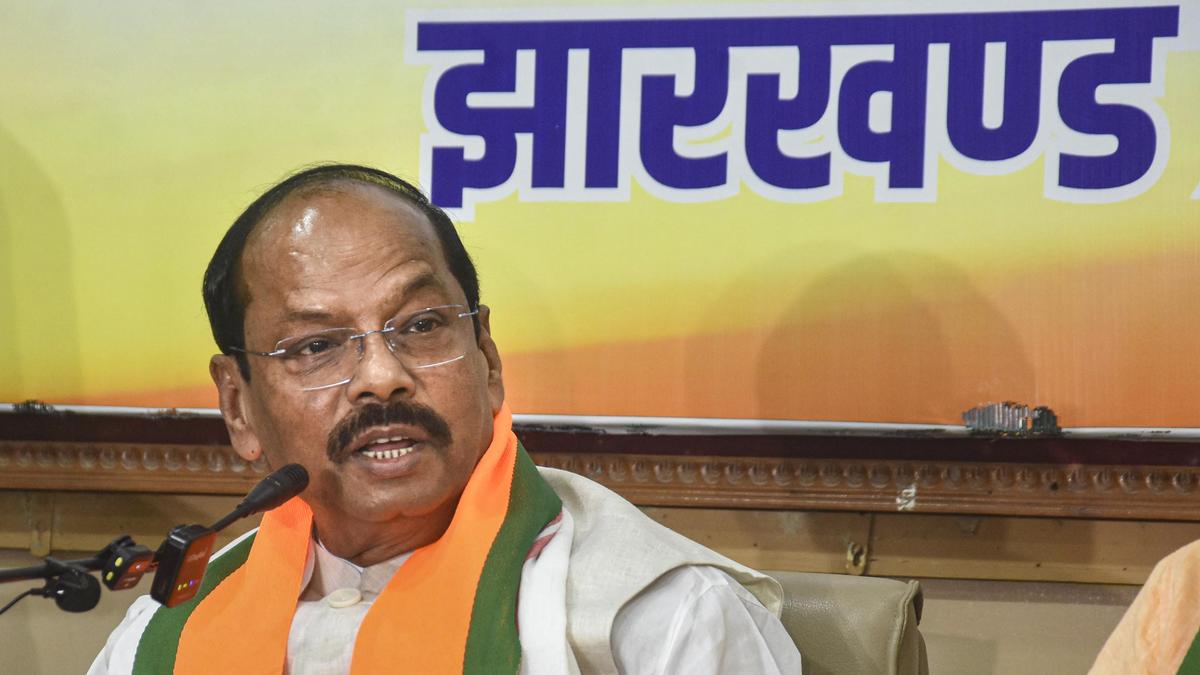
Ranchi: BJP leader Raghubar Das addresses a press conference, in Ranchi, Wednesday, Sept. 10, 2025. (PTI Photo) (PTI09_10_2025_000107B)
| Photo Credit: PTI
Bharatiya Janata Party (BJP) leader and former Chief Minister of Jharkhand Raghubar Das on Tuesday (December 30, 2025) slammed the Hemant Soren government over recent cabinet approval to Panchayat Extension Scheduled Areas (PESA) Act rules giving Gram Sabha administrative and decision-making power.
Under the approved rules, Gram Sabhas in rural areas will have authority over the use of minor forest produce, preparation of local area development plans, and management of water resources.
Mr. Das while addressing the media at party office in Ranchi said that the primary objectives of PESA Act was to strengthen the traditions of the tribal community, their self-governance system, and the rights of the Gram Sabha, but the rules framed by the State government appear to be completely contrary to the spirit of PESA Act 1996.
He alleged that through these rules, an attempt is being made to weaken the traditional Gram Sabha system of various tribal communities such as the Santhal, Ho, Khariya, Oraon, Munda and Bhumij.
“According to information published in newspapers, the government has limited the definition of Gram Sabha to the traditional tribal system and traditional leadership. Whereas, in Scheduled Areas, the Gram Sabha has been envisioned in accordance with traditional customs and social structure,” Mr. Das said.
Referring to the traditional village leadership systems of various tribal communities, he asserted that traditional positions such as Manjhi-Pargana in the Santhal community, Munda-Manki-Diuri in the Ho community, Dhoklo-Sohor in the Khariya community, Hatu Munda, Padaha Raja, Pahan in the Munda community, Mahato, Padhavel (Raja), Pahan in the Oraon community, and Munda, Sardar, Napa, and Dakua in the Bhumij community have been recognized for centuries.
“Sections 4(a), 4(b), 4(c), and 4(d) of the PESA Act, 1996, clearly state that the formation, functioning, and representation of the Gram Sabha shall be in accordance with the traditions, customs, socio-religious practices, and traditional management of resources of the tribal communities. However, these provisions have been ignored in the rules formulated by the State government,” Mr. Das said.
He also questioned whether the new regulations would grant the chairmanship of the Gram Sabha to individuals who do not belong to the traditional tribal system or who have a different background than the respective community and tradition. Mr. Das pointed out that the position on this issue has not been clarified calling it a matter of serious concern.
Mr. Das stated that under the PESA Act, the Gram Sabha has been granted full management and control over collective resources such as minor minerals, sand ghats, forest products, and water sources. He questioned whether the Gram Sabha would actually have control over these resources or whether the government would retain control as before.
At the end of the press conference, Mr. Das accused that the State government was merely offering a “lollipop” to the tribal community by enacting regulations at the cabinet level.
He emphasised that the purpose of the PESA Act is not to abolish the tribal traditional system, but rather to empower it by providing legal protection, so that tribal communities can maintain their cultural identity, traditional justice system, and natural resources.
Mr. Das demanded that the State government should immediately issue the PESA regulation in accordance with the sentiments of the tribal people.
The rules will come into force, once it would be formally notified.
Published – December 31, 2025 01:57 am IST