
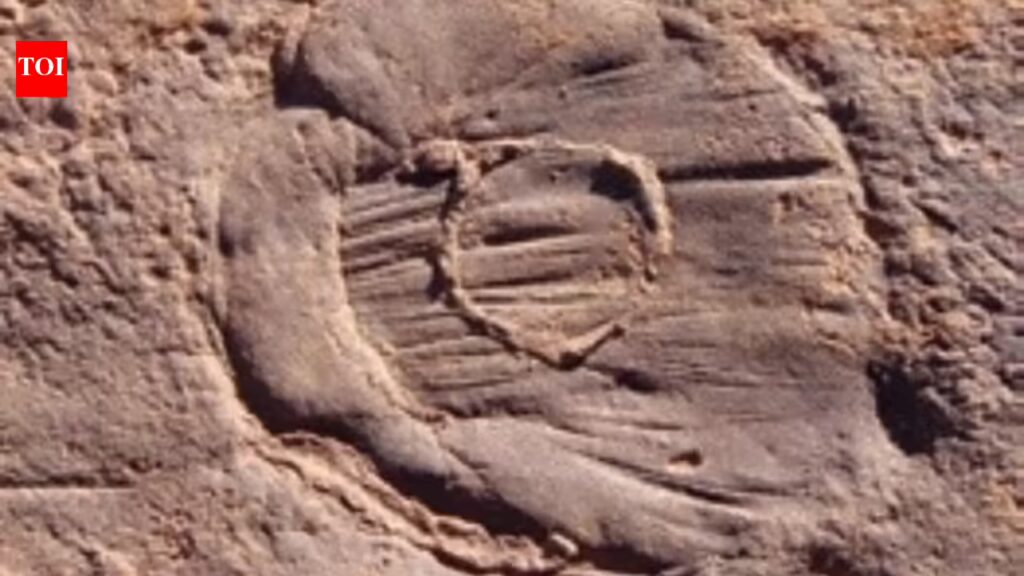
For more than a century, the Ediacara Biota has quietly confused scientists. These fossils, dating back around 570 million years, capture soft, squishy organisms preserved in sandstone, which is something that really shouldn’t happen. Sandstone usually destroys delicate tissues fast, the way waves erase footprints at the beach. Yet here were detailed impressions, textures, even outlines of ancient life. It felt like nature breaking its own rules. Recently, scientists think they’ve figured out why. By combining chemistry, geology, and palaeontology, researchers uncovered a preservation process that sounds almost accidental, but worked perfectly. It’s one of those discoveries that makes you realise how many ancient stories Earth is still quietly holding onto.
Why soft-bodied organisms rarely become fossils
Soft-bodied creatures are terrible candidates for fossilisation. Jellyfish, worms, and leaf-like organisms normally decay long before they leave a trace. That’s why most fossils we see belong to animals with hard shells or bones. The Ediacara Biota breaks that pattern completely. These fossils show fragile life forms preserved in sandstone, a rock type known for being rough on organic material. For years, scientists debated whether these impressions were even animals at all. Some thought they were giant algae. The mystery wasn’t just what these creatures were, but how they managed to leave behind such detailed records.
How ancient seawater chemistry preserved Ediacaran life
According to the new research published by NASA titled “Exceptional preservation of soft-bodied Ediacara Biota promoted by silica-rich oceans”, the secret lies in ancient seawater chemistry. Around 570 million years ago, oceans appear to have been rich in dissolved minerals that behaved differently from today’s seas. When the soft-bodied organism fell into the sandy sediment, clay minerals appeared almost instantly. The clays worked like a kind of natural cement, bonding sand grains together before the organism had even had a chance to rot. Picture pouring cement around a footprint just as the tide is rising. When the sediment hardened, the footprint was set. The entire process occurred quickly enough to capture even fine detail, which is why these fossils remain so sharp after hundreds of millions of years.
Why sandstone preserved these fossils differently than expected
Sandstone usually spells disaster for soft tissues because water can move easily through it. That movement breaks things down over time. But in Ediacaran environments, the clay minerals reduced that movement. They filled gaps between sand grains, making the sediment more stable and less likely to erode. It seems like a small chemical difference, but it changed everything.
Why the Ediacara Biota matters
Understanding how these fossils formed helps scientists interpret what they’re actually seeing. Instead of distorted remnants, researchers can now be more confident that these shapes reflect real organisms. These fossils might represent evolutionary experiments that didn’t survive, or early relatives of modern animals. Either way, knowing how they were preserved lets scientists reconstruct ancient ecosystems more accurately. It also reminds us that fossil records depend as much on the environment as biology.