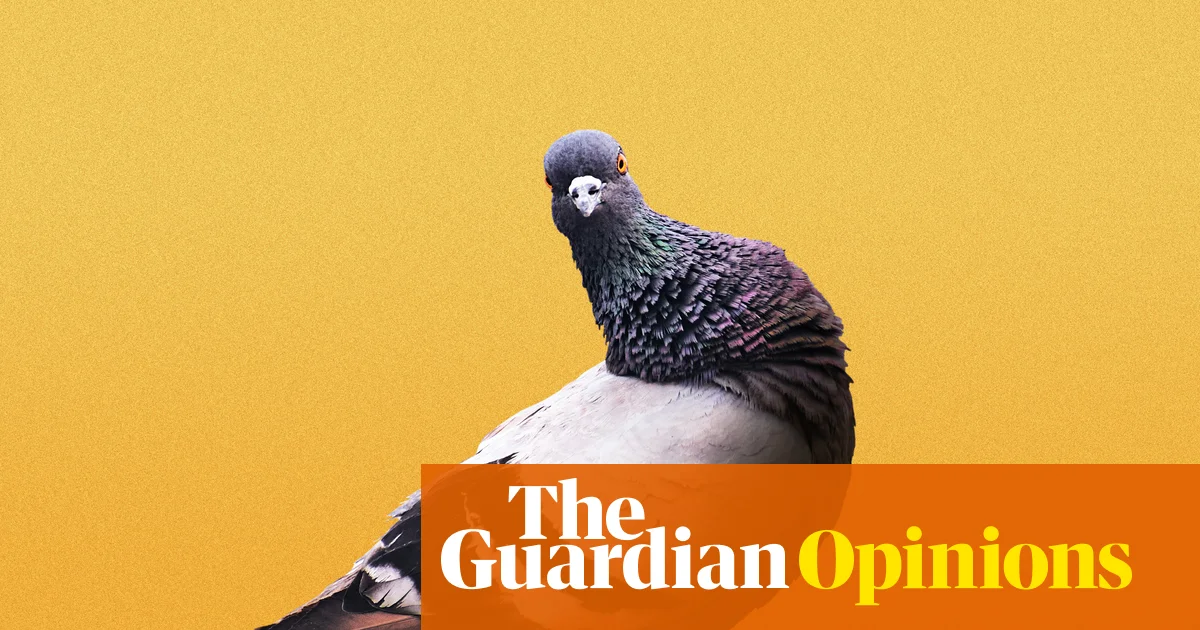
Is there something I would figuratively die on a hill for? Yes, there is – and as it happens, I’m sitting on a literal hill right now, feeding them. Pigeons. Why pigeons? Because it’s about time they get the respect they deserve.
I like pigeons. Because they’re like me, working class. You can tell pigeons are working class because every pigeon looks knackered. It’s about this point in the conversation that people politely make their excuses and slowly back away (literally) while avoiding eye contact. No doubt, reading this, you are doing the same (figuratively).
But aren’t you just a bit curious why, out of all the birds, pigeons are the most tolerant of humans? It’s certainly not mutual. No other bird faces so much hostility from us. Spikes, netting, “do not feed” signs – all things we inflict on a bird whose greatest crime is exhibiting an impressive lack of shame when it comes to scrounging our leftovers. Pigeons eat that bit of sandwich you’ve dropped on the ground with the same energy that one friend of yours thinks carrying only their drink back from the bar is an act of service.
But we’re the tolerant ones, I hear you cry. Who told them they could live alongside us so brazenly? You’re going to want to sit down for this M Night Shyamalan-esque plot twist. We did. The year is 4,500BC. As our ancestors trade the nomadic hunter-gatherer life for farming, they have the bright idea to take the pigeon’s ancestor, the Columba livia, from the cliffs they live on and build them little pigeon houses so that they could breed them for food.
Soon, with a nice supply of pigeon nuggets added to their diet, our forebears begin to notice other things about pigeons, such as their excellent homing abilities. Unlike us, pigeons don’t need a combination of Google Maps, road signs and backseat drivers to find their way home. In further proof of their working-class roots, they just get on with it. Incredibly, they’re able to find their way home from distances of 1,000km.
You know that civilisation you think was so great, and can’t stop banging on about? It doesn’t matter which one – Roman, Greek, Ottoman, Han, Mughal – they all used pigeons to communicate across their vast territories. That’s right, the first posties were pigeons. And the service was one we can only dream of: fast, reliable, not a single “sorry we missed you” card. Before the advent of telecommunications, it was pigeon messengers that allowed our cities, worlds and lives to expand. And it’s not just ancient history but our very recent history, as well.
May I present Exhibit A, the pigeon fact to end all pigeon facts. The pidge de résistance. Pigeons in this country served in the second world war. You heard. Such were the existential stakes for Britain, no one batted an eyelid when thousands of pigeons joined the war effort. There was a National Pigeon Service that had more than 200,000 serving pigeons. Nazi Germany had the Luftwaffe, the largest and most technologically advanced air force at that time, and we called up birds that eat floor chips. Nowadays, it would be considered w0kE and DeI g0n£ mAd to have pigeons in the armed forces, but back then they were there on merit.
Not only that, but they performed heroically, successfully carrying out missions and saving human lives. Like Mary of Exeter, a pigeon-intelligence operative who survived a German falcon attack. The tip of her wing was blown off and shrapnel lodged in her neck. And worst of all, she then had to go back to Exeter. It won’t surprise you to know that Mary was a proper member of the pigeon proletariat, who lived above a bootmakers. After each enemy attack, did she make a fuss? No, of course not. Instead of bothering doctors with her life-threatening injuries, she opted for something far more British, to keep calm and carry on cooing.
“Oh God, what can we do to make amends?” I hear you cry out hysterically. It’s very simple. You can see them. Not like how you normally do, as if they’re not there. But really see them. Spend a few minutes pigeon- watching. Maybe you’ll see what our ancestors saw thousands of years ago: a bird that’s not like other birds. A bird that’s a fellow commuter on this journey of ours, just trying to get through it like the rest of us. And if you’ve got a problem with that, you can find me on a hill with 20 hard-as-nut Lewisham pigeons.
-
Toussaint Douglass is a comedian from Lewisham, south London. His show Accessible Pigeon Material will be showing at Soho Theatre, 26-31 January 2026