
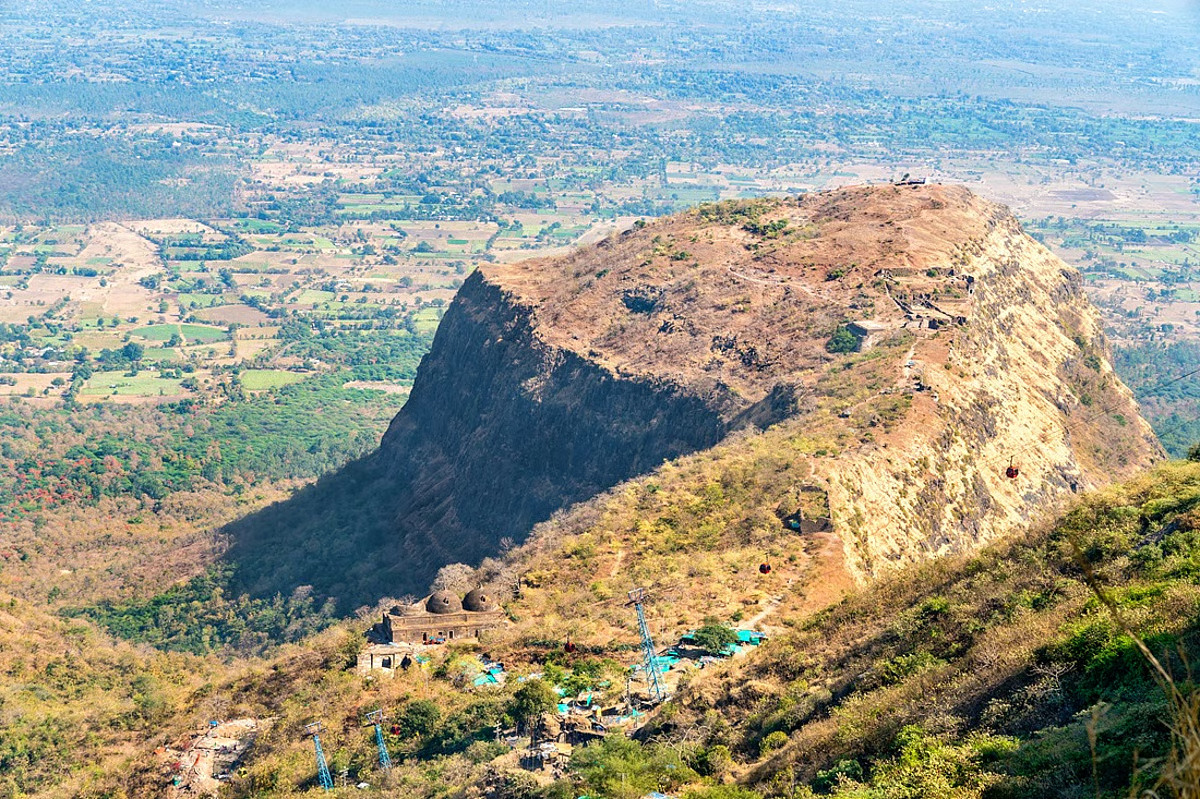
Some 45-60 kilometres from my family’s home in Vadodara, Gujarat, lies Pavagadh Hill. It is a majestic sight, rising above the surrounding plains to a height of 700 metres. It is part of the Deccan Traps, defined by the American Museum of Natural History as “a huge, rugged plateau that formed when molten lava solidified and turned to rock. The Deccan Traps date back to around 66 million years ago, when magma from deep inside Earth erupted to the surface.”
But Pavagadh Hill is also classified by some to be an important outlier or extension in the southern Aravalli foothills area in the northern part of Gujarat. The latter is, after all, one of the four states where the hill range, currently in the throes of controversy, is situated.
Pavagadh’s height and commanding vistas made it an important area of human settlement since prehistory. The area today is home to the Rathwa Adivasi community. In the past, it was home to a host of Hindu dynasties, culminating with its capture by the Khichi clan of Chauhan Rajputs in 1300.
But it was on November 21, 1484, that Pavagadh’s star began its ascendancy. The hill fell to Mahmud Begada, Sultan of Gujarat, who decided to move his capital from the bustling city of Ahmedabad to the settlement of Champaner at the base of the Pavagadh Hill.
Which brings us to the subject of this piece. The Supreme Court’s November 20, 2025, judgement regarding the Aravallis has triggered a huge controversy, with critics terming it the ‘death warrant’ for the range. The dust raised by the issue raises a fundamental question: what is the importance of a ‘hill’?
Here, it is important to point out that ‘hill’ and ‘mountain’ are terms that are usually subjective. Usually, hills are thought or imagined to be landforms smaller in height to mountains. So, while the Himalayas, the great landform straddling India’s northern border, are mountains with heights of over 7,000 metres, hills like Pavagadh are miniscule in comparison. But here comes the moot point. Small they might be, but hills are not less important in any way that they be obliterated like critics perceive the government intends to do with the Aravallis with its judgement.
Higher ground has usually been preferred by humans through history (and prehistory) since it offered many advantages.
According to a 2024 paper titled Assessing landscape ecological risk in the Southern Hill and Mountain Belt of China: A 30-year analysis and future projection published in Ecological Indicators, “hills and mountains comprise approximately one-fourth of the Earth’s total land area and are distributed across continents and ecosystems, making them crucial for global sustainability. Furthermore, 40% of the global population is dependent on hill and mountain resources.”
It also adds that hills and mountains offer several ecosystem services. They serve as ‘barriers’ (remember the Aravallis?), preserve water, sequester carbon and produce oxygen. They also mitigate floods.
Pavagadh ticks all these boxes and more. The Hindu Rajput Kings and Muslim Sultans of Gujarat desired it for its strategic value. Begada also made Champaner his capital as he could control trade routes, show political dominance and leave an everlasting legacy as he made Champaner the most pre-eminent Islamic city of India (in terms of art and architecture) prior to the Mughal Empire, as UNESCO notes.
Across India, other hills and hill ranges have fulfilled similar functions.
Just south of my family’s home in Vadodara, lies Bharuch district, where the Narmada river ends in the Gulf of Khambhat after flowing through Bharuch town, the famous Barygaza port of old. Further south, the Tapi or Tapti river ends into the Gulf of Khambhat in Surat district after flowing through the eponymous city.
These two rivers flow almost parallelly along the northern and southern slopes of the Satpura range, which, in turn, runs parallel to the Vindhya range.
The Vindhya range, like the Aravallis, has been a geographical and cultural boundary marker between the Indo-Gangetic Plain of the northern Indian subcontinent and the Deccan Plateau of the Indian Peninsula. The ancients too recognised this, for the Vindhyas marked the southern boundary of Aryavarta (‘Land of the Aryas’ or northern India) in Hindu epic literature.
In addition to being a natural border, the Vindhyas are also a barrier, with areas to its north and west being more arid as they lie in the shadow region, blocking winds from the south. It is also a significant watershed, with rivers like the Kali Sindh, Parbati, Betwa, Ken and Son flowing from it towards the Ganga in the north.
Lastly, the Vindhyas also host rich biodiversity, with its teak, sal, bamboo and mahua forests, grasslands, wetlands, and scrublands teeming with wild buffalo, tiger, leopard, and sloth bear. One only needs to head to the Bandhavgarh Tiger Reserve in this range to have a communion with these flora and fauna.
Similarly, the Satpura or ‘Seven Fold’ Hills also host endemic biodiversity found nowhere else. According to UNESCO, the Satpura Tiger Reserve, located in the range, “has many rare and endemic plants, especially bryophytes and pteridophytes like Psilotum, Cythea, Osmunda, Lycopodium, Lygodium etc.”
The Satpuras have also been hypothesised as a ‘faunal bridge’ from where fauna spread from the Himalayas to the Western Ghats, as stated in the “Satpura Hypothesis”.
Who can also forget that the Vindhyas and Satpuras are also home to rock shelters like Bhimbetka, where the earliest humans in the subcontinent resided and painted scenes from their daily lives? Does one need any further evidence of the importance of hills for humanity?
But there is one more collection of hills worth mentioning. The Eastern Ghats, home to some of India’s most ancient tribal communities and a plethora of biodiversity. More than 2,600 plant species of angiosperms, gymnosperms and pteridophytes including 160 species of cultivated plants, are reported to occur in the Eastern Ghats region which includes 454 endemic species belonging to 243 genera and 78 families.
One can also not forget that the Jeypore Tract of the Rayagada section of the Eastern Ghats is home to a tremendous variety of both wild and domesticated paddy varieties. The Jeypore Tract has been identified as a putative secondary centre of origin of cultivated rice.
Hills, thus, are not something whose usefulness can be measured tangibly. Rather, they are ecosystems that have withstood the test of time. They have sheltered humans and nurtured them as well as a host of other life forms. They have blocked moisture bearing winds (or desert sands like in the case of the Aravallis) and created human civilisation. They have been the abode of ascetics, early humans and armies, who realised their value and importance. Relegating such vibrant landforms to the language, terminology and most importantly intent, as in the new definition is a denial of hills’ role in human history.
Perhaps, one may as well remember what American preacher Edwin Hubbell Chapin said about them: “Hill and valley, seas and constellations, are but stereotypes of divine ideas appealing to and answered by the living soul of man.”
May good sense prevail.