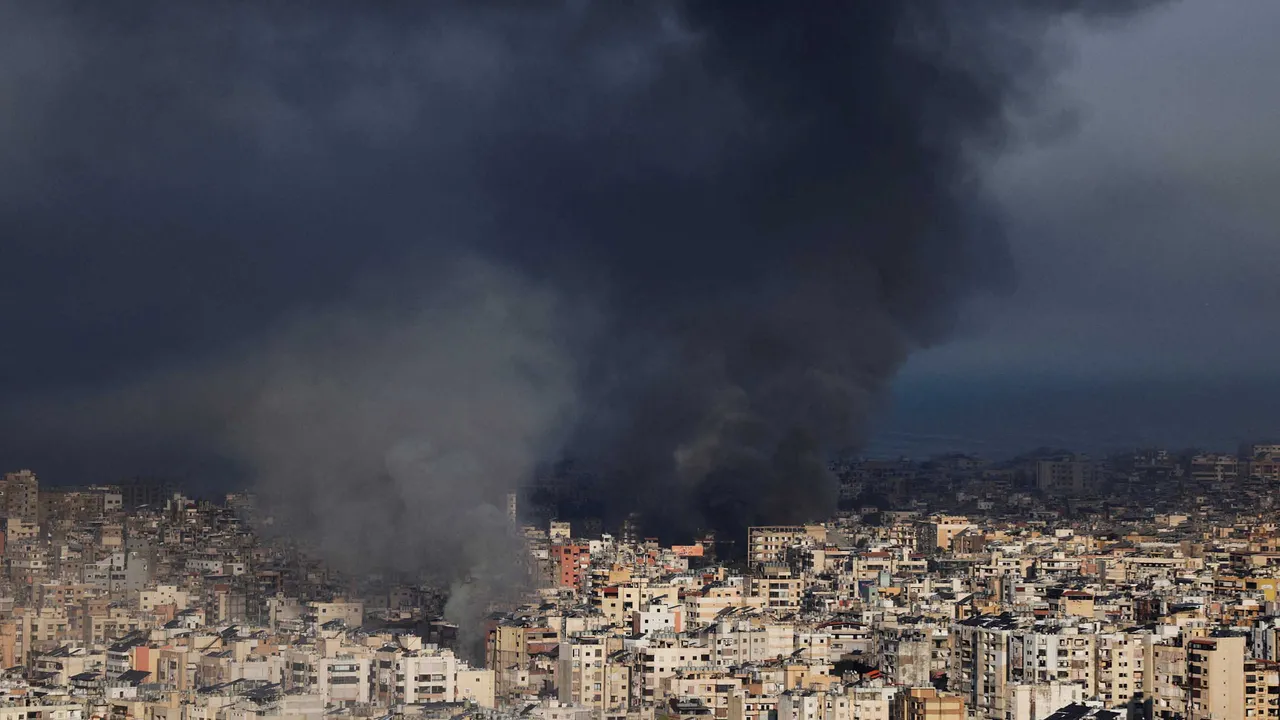
On Tuesday, Israeli ground troops stormed across the border. (Israeli forces already occupy five positions captured during the previous war, in addition to other southern territory that they have held for decades.) The Lebanese Army, which is supplied by the U.S., is not authorized to engage Israel except in self-defense; it withdrew some troops from the area. The next day, Israel issued evacuation orders for dozens of villages south of the Litani River, an area extending some thirty kilometres from the border. On Thursday, it followed up with an unprecedented evacuation notice for Beirut’s southern suburbs, a densely populated area home to hundreds of thousands of people. (Prior notices have indicated specific structures, not entire areas.) As drones circled overhead, messages spread on WhatsApp, warning people to open their windows so that they wouldn’t be shattered by blasts. The city fell into mayhem as panicked residents fled. Hours later, another forced-evacuation order was issued, for several towns in Lebanon’s Bekaa Valley. More than ninety thousand Lebanese have already been displaced. At least a hundred have been killed.
The Lebanese front is bleeding into a larger war across the Middle East. After the U.S. and Israel hammered Iranian nuclear sites last June, Iran offered a performative response: it struck U.S. bases only after providing enough warning for them to be evacuated first. This time, Iran has said that there are “no red lines.” Although many Iranian leaders have been killed, the regime remains intact, with no visible defections. The assassination of Khamenei, an octogenarian whose ideology considers martyrdom a religious reward, has galvanized his supporters. Ali Larijani, the secretary of Iran’s Supreme National Security Council, said that his country will not negotiate. Tehran began retaliating against Israel and the U.S., striking bases and installations in Bahrain, the United Arab Emirates, Iraq, Qatar, Jordan, and elsewhere. The U.S. Embassies in Saudi Arabia and Kuwait were struck by drones. So was the consulate in Dubai. Air-raid sirens are blaring across the region.
Though Hezbollah is battered after the previous war with Israel, it remains the vanguard of an Axis of Resistance that includes Yemen’s Houthis, Palestinian groups, and numerous Iraqi militias. An Iraqi militia commander who recently attended meetings in Tehran told me that the Iranians were ready for a “very long war,” which they had “calmly and extensively prepared” for. In recent days, some of Iraq’s armed factions have launched attacks on U.S. interests—in Iraq and, the groups claim, in Kuwait and Jordan. The militias have sustained casualties in counterattacks. Like other Axis forces, many of the Iraqi militias have been weakened since the war in Gaza began, but the commander told me that the “circle of resistance” was expanding with each new escalation.
The Iraqi state is proceeding carefully. It has condemned the attacks on Iran and on Iraqi militias; at the same time, it has asked armed factions in Iraq to refrain from strikes without orders from the state. Baghdad fears that instability in Iran, one of its largest trading partners, will have devastating economic effects. Iran has already effectively shut the Strait of Hormuz—a major conduit for shipments of oil, which funds most of Iraq’s national budget. Yemen’s Houthis also retain the ability to resume their siege on shipping in the Red Sea. Oil prices and shipping costs are rising.
Iran faces what is widely considered the strongest military in the world, alongside Israel’s technologically advanced forces; France, Germany, and the United Kingdom have indicated that they may join the campaign, too. But small, agile forces can still inflict harm, particularly in battles that they consider existential. Tehran’s strikes are already draining Washington’s supply of air-defense interceptors. On Monday, the U.S. Secretary of State, Marco Rubio, lamented that, in a month, Iran can produce more than a hundred ballistic missiles and field thousands of drones; in the same time, the U.S. can deliver only six or seven interceptor units.
On Tuesday, Hezbollah amplified its campaign, launching drones and rockets at military sites in Israel and at Israeli Merkava tanks that had entered Lebanon. It also said that it had downed a drone. Israel Katz, Israel’s defense minister, announced that he’d ordered his military to seize additional positions in southern Lebanon. On Wednesday night, Hezbollah’s leader, Sheikh Naim Qassem, made his first televised remarks since the front reopened. He said that Hezbollah’s weapons weren’t up for debate. He urged the Lebanese people “not to stab the resistance in the back during a period of confrontation and war” but to instead unite and “prioritize confronting this enemy. After that, we can debate our other issues.”