- In Jaigaon, a town in West Bengal on the border of India and Bhutan, poor waste disposal and the lack of waste management is becoming a critical environmental issue.
- Jaigaon is a key tourist and trade entry point to Bhutan.
- Content creators from the town are using social media to raise the problem and are participating in clean up drives while they wait for action from the authorities.
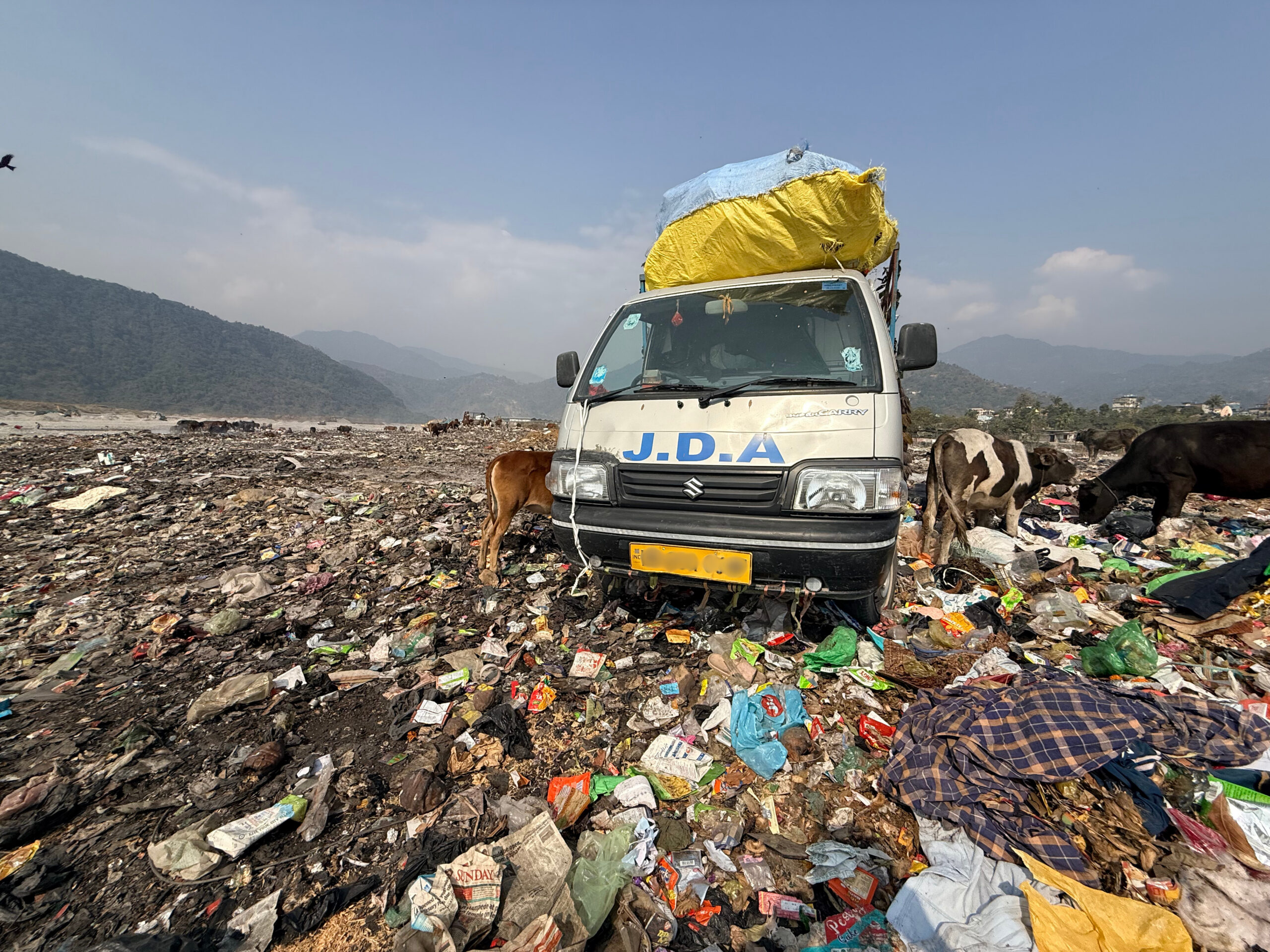
Dark grey smoke curls above the Torsa riverbank in Jaigaon, a crowded border town of West Bengal, India, separating India and Bhutan. Plastic waste, medical refuse, construction debris and household waste lie scattered across the river bed and cows and dogs forage through the garbage.
In January, an Instagram reel of this area drew a long-ignored environmental crisis into public notice. In it, a young content creator who goes by the name Rock Lama on Instagram, stood before the smouldering waste, appealing to the West Bengal Chief Minister Mamata Banerjee for immediate intervention to stop what he describes as the routine illegal dumping of the town’s waste along the river.
The video by the 24-year-old Jaigaon resident, spread widely across social media platforms, sparking discussions about rural waste management, governance, environmental negligence, and the growing waste crisis in smaller towns and Panchayat areas where populations have increased with time and waste has increased proportionately, without infrastructure to manage it.
A border town struggles under its own waste
Jaigaon is a densely populated commercial town with approximately 100,000 residents and serves as a crucial gateway between India and Bhutan. Its markets bustle with cross-border trade, tourism, and transport activity. Yet, beneath this economic vibrancy lies an escalating environmental problem of riverside pollution amplified by rapid urban growth without corresponding civic infrastructure to manage it. According to estimates by the Central Pollution Control Board, small and medium-sized towns like Jaigaon generate about 30-40 tonnes of solid waste daily.
The Himalayan Torsa River emerges from Chumbi Valley in the Eastern Himalayas and flows through Bhutan to reach West Bengal in India. At the Gubari stretch of the Torsa River, heaps of plastic waste, construction debris, and mixed panchayat refuse have accumulated over months.
Jayant Mundra, Convenor, Joint Forum of Business Association Jaigaon and Vice President Jaigaon Merchant Association said, “Our towns share an international border and a lot of tourist footfall takes place every year, as the town is growing population-wise, we demand a municipality facility to manage the solid waste and also other issues of Jaigaon.” He also raised concerns, explaining how, during rainfall, much of this waste slips directly into the fast-flowing mountain river and enters homes and public spaces during floods.
Local traders also worry that the pollution could damage Jaigaon’s image as a key tourist and trade entry point to Bhutan.
Environmental activists say that open burning releases toxic pollutants, including particulate matter and harmful chemicals produced by burning plastics and mixed waste.
Health concerns among residents
Thirty-four-year-old Fatima Khatun, a resident staying near the river Torsa, said, “I was born and brought up here. Staying here amidst the foul smell of waste is very frustrating. Sometimes we fall sick and have nausea, a cold and a headache. With little kids, it’s more difficult because they constantly fall sick.”
Like Khatun, most of the residents living near the dumping zone claim that daily life has been affected by the poor air and water quality caused by waste dumping and burning.
Many complain of persistent coughing, eye irritation, breathing difficulties, and fever. Others report skin infections and recurring stomach illnesses, which they claim are linked to contaminated water sources.
Another 40-year-old mother, Jaikam Bibi, holding her one-and-a-half-year-old child, narrates how she frequently had to carry her baby to the Public Health Centre to visit a doctor, as her baby kept falling sick. “Nausea, vomiting and coughing are the symptoms my child had when I had to take him to the doctor. I am worried about his future because the more waste dumping takes place, the more my child might be affected.”
Dr. Namrata Biswas, doctor in charge of Jaigaon Public Health Centre, said, “We mostly get patients suffering from tuberculosis, diarrhoea, stomach infection and dermatitis. Asthma and COPD cases are rising here in Jaigaon.”
She added, “We can’t say that water and air pollution are the primary culprits, but it can definitely aggravate any health condition among patients.”

Administrative challenges and governance gaps
The Torsa River travels downstream through ecologically sensitive floodplains connected to Jaldapara National Park, home to Indian one-horned rhinos, elephants, and diverse migratory bird species.
“River life depends on three things: flow, silt and oxygen in the water. But we excavate the river, pollute it. So, if we don’t manage the river system, then the river will also not manage its wetlands, flora, fauna, agricultural fields, and groundwater systems in the plains,” said Dipankar Saha, Former Additional Director, Central Pollution Control Board. He added, “Now, after knowing everything, if we don’t respect our river, and if we immediately don’t bring strict laws and policy change keeping rural areas in mind, we are calling for a huge health and environmental crisis.”
The Jaigaon Development Authority declined to comment.
Environmental and legal governance experts argue that the crisis reflects a broader structural issue of rapid urbanisation without proper climate-resilient infrastructure planning.
Senior advocate of Kolkata High Court, Sabyasachi Chatterjee, explained, “Dumping trash along a riverbank is a straight-up violation of the Water Act (1974) and the Environment Protection Act (1986), and there’s really no wiggle room here. The law is effectively ‘geography-blind.” It doesn’t matter if the dumping happens in a bustling city or a quiet border village; if the water is being poisoned, the crime is the same”
He adds, “There is no special permit or lower standard for rural areas just because they lack a municipal office. When authorities try to hide behind a lack of infrastructure or a zeroed-out budget, the legal defence usually falls flat. The courts have spent decades establishing that a clean environment is a fundamental part of the Right to Life under Article 21 of the Constitution.”
“India does have a fairly strong policy framework. The updated Solid Waste Management Rules, 2025, include specific provisions for waste processing in hilly and eco-sensitive regions. In addition, both the urban and rural components of the Swachh Bharat Mission emphasise strengthening waste collection systems, promoting zero-waste approaches, and reducing single-use plastics,” says Swati Singh Sambyal, an international circular economy and waste expert, who works on policy and practices to mitigate plastic pollution in the Global South countries. “However, the challenge today is not policy absence but implementation.”

Citizens begin cleaning up the waste
Rock Lama’s reel brought national attention to a local environmental issue in Jaigaon. Social media activism, observers note, is part of the environmental discourse in smaller towns where traditional media coverage remains limited. Yet, activists caution that visibility alone does not guarantee change.
“This is an important environmental crime going on. Our local bodies tried to stop the waste disposal in the river, but it’s in vain. When nobody heard us, I was compelled to make the video and refer to West Bengal Chief Minister Mamta Banerjee in the reel,” says Tamang.
Rock’s team, with the help of other content creators, initiated a cleanliness drive for the town. Talking to a resident and content creator of Jaigaon, Bhumika Biswakarma, she said, “Pollution has become a major threat here, along with waste. My husband and I, along with other content creators and citizens of Jaigaon, joined Rock to carry on this cleanliness drive in our town every Sunday.”
Every Sunday, students, citizens, the business community, and content creators are seen cleaning the streets, government offices, and the nooks and corners of the town. They say that when the administration neglects the town, we want to at least create some awareness through our work.
As smoke continues to rise from the riverbanks, the question remains whether visibility of the problem will translate into policy action.
Banner image: Cattle forage through heaps of plastic and household waste at an open dumping site in Jaigaon, exposing the town’s growing solid waste crisis and poor waste management. Image by Chandrani Sinha.