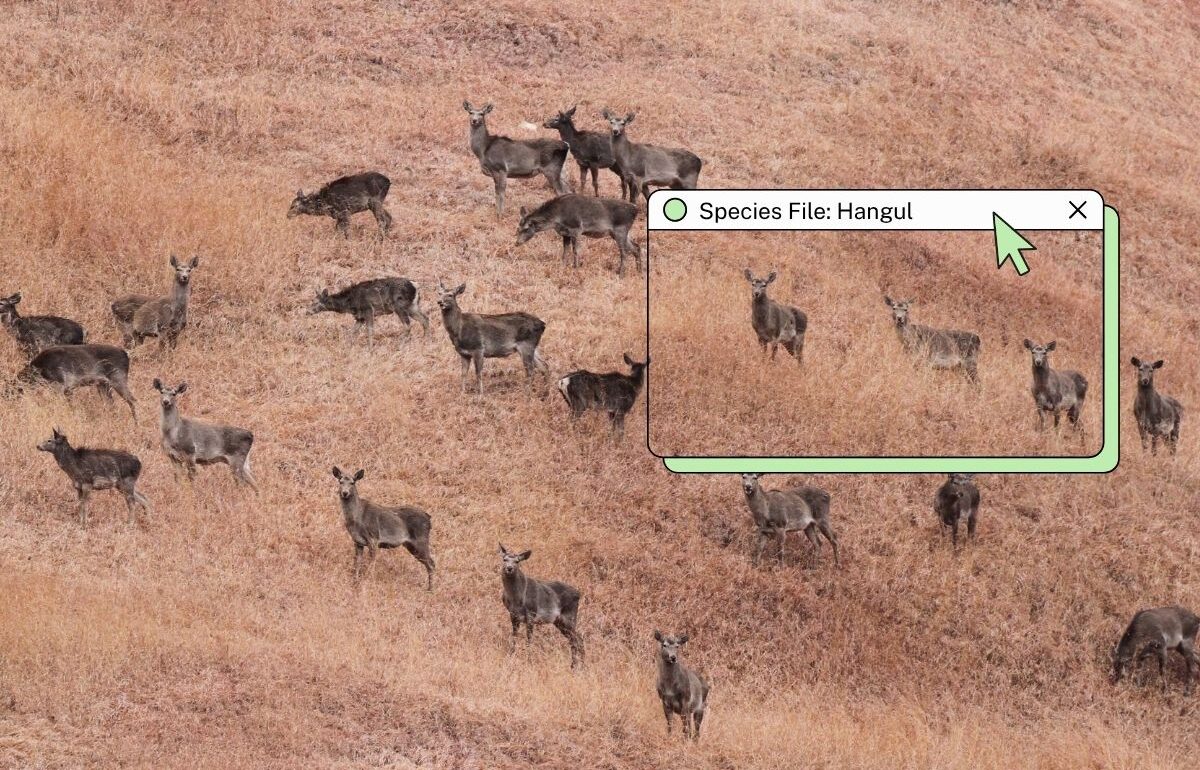
Jammu and Kashmir’s hangul population registered a slight increase in the latest census in 2025, which recorded 323 individuals. An encouraging rise from 289 in 2023, hope is renewed for the survival of this species found only in the Kashmir Valley.
The hangul (Cervus hanglu hanglu), also known as the Kashmir stag, is a subspecies of the Central Asian red deer. It was once widespread in the mountains of Kashmir, parts of Chamba district of Himachal Pradesh and Pakistan. Today, the hangul is largely found only in Kashmir’s Dachigam National Park and adjoining landscapes.
Hangul are recognised by their branched antlers and thick brown coats, well-suited to the cold winters. They migrate between higher and lower altitudes, shedding and growing a fresh set of antlers each year. Their return to lower valleys signals the rutting season, when males display their antlers and lock horns with rival males in a fight for mates.
According to the International Union for Conservation of Nature (IUCN) Red List of Species, the hangul is listed as critically endangered, denoting an extremely high risk of extinction in the wild. The hangul has the highest level of protection under the Schedule I of the Indian Wildlife (Protection) Act, 1972, and is also protected under the J&K Wildlife Protection Act, 1978. The species has declined sharply over the decades due to multiple pressures. Livestock grazing in Dachigam encroaches on hangul habitat and reduces food availability, while poaching for meat, skin and antlers is also a threat. Populations are also affected by a skewed sex ratio, with significantly more females than males.
While the 2025 census shows an increase, conservationists caution that the population remains small and vulnerable. In an earlier story that Mongabay-India published in 2022, scientist Khursheed Ahmad, heading the department of wildlife sciences at Sher-e-Kashmir University of Agricultural Sciences, said, “There is a female-biased sex ratio – we have more females than males – which is not healthy. We also have a very low recruitment (addition of new fawns) in the population of hangul. These are the main ecological reasons why the population of hangul is not stabilising for the last two or three decades.”
In fact, 19 years of monitoring and a population viability analysis by conservationists concluded, in 2023, that the hangul population could potentially go extinct without interventions like monitoring calf survival and controlling free-ranging dog populations.
Read more about conservation efforts to help hangul population grow and threats faced by Dachigam National Park.
Banner image: A herd of hangul. Image by Tahir Shawl via Wikimedia Commons (CC BY-SA 4.0).