
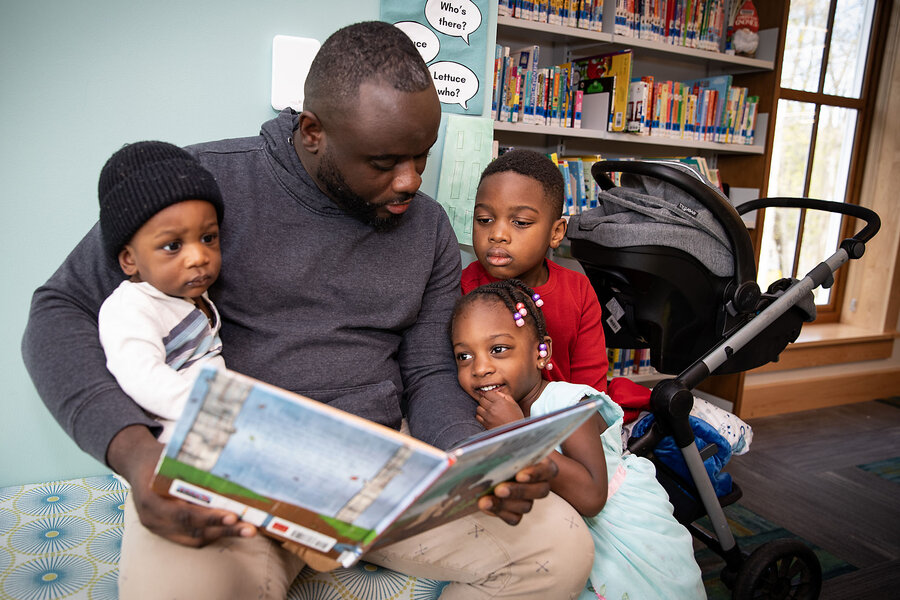
America’s network of libraries is vast, with 9,000 systems serving 155 million registered users. But that network is also under threat. While some communities are investing in modern new libraries, others are letting their branches crumble. Funding cutbacks for affordable housing or mental health services have led many low-income or unhoused people to use libraries as places of shelter. And widening polarization over social issues has sparked debates within some communities about whether some books should be banned as offensive.
Despite the challenges, libraries play a civic role that many see as more vital than ever.
“A democracy requires an educated public who are aware of the roles, responsibilities, [and] the powers that they have in just being citizens and taking part,” says Eric Klinenberg, a sociologist at New York University. “A library prepares you. It gives you the tools to prepare you for that.”
Why We Wrote This
Public libraries have long been among America’s civic gathering spaces, helping to combat social isolation and bridge digital divides. Even as they struggle under budgetary constraints, they are reinventing themselves as foundational spaces for teaching democracy.
Some cities – even those with relatively modest budgets – are bucking the financial headwinds.
Serving a population of just over 18,000, the library system of Sharon, Massachusetts, survives by constantly evolving and reimagining how to best use its space and resources to meet community needs.
When it opened in 1879, the Sharon Public Library had 524 books. Now, it has a significantly larger collection, a pod for small-business owners to hold meetings, a classroom for teaching English as a second language, and even a Library of Things, which includes home and garden tools, technology, music, games, and sewing machines. The library also sponsors a lecture series by local retirees, including an art historian, an anthropologist, and a Holocaust expert.
“You have to figure out where are your strengths, and where the community needs you the most,” says Randy Gagné, the library’s director. “What people need most is connection and access. It’s the library that brings people together.”
In nearby Stoughton, Massachusetts, Smadar Gekow teaches English for Speakers of Other Languages in classrooms provided by the Stoughton Public Library. There, tutors from Literacy Volunteers of Massachusetts teach English to immigrants and individuals with low literacy skills. They also show their adult students how to sign their children up for school, open a bank account, and get health insurance.
“Libraries are no longer what they were when you and I were kids, when you would be hushed, and you would check out a book and return it on time,” says Ms. Gekow, coordinator for the LVM affiliate in Stoughton, which also provides English language classes in Sharon. “The library has become a community center, an information center. It’s become a catchall.’’
The library as best hope for community
“It’s true that we have Google, and many people say we don’t really need reference libraries anymore,” Ms. Gekow says. “But people need to connect with one another. The library is our last stand.”
This year, millions of American school children will receive their first library card, says Dr. Klinenberg, author of “Palaces of the People: How Social Infrastructure Can Help Fight Inequality, Polarization, and the Decline of Civic Life.” It’s a crucial moment for developing the social and cultural skills needed for a functioning democracy, he says.
For example, checking out and returning books teaches a child their first lesson in community, he says. If you and your friend both check out, say, Curious George books, and your friend doesn’t return his, then you can’t read that one. If you don’t return yours, he misses out. “The library is one of these places where we get our earliest lessons about what it means to be part of a community,’’ he says, “and the kind of rights and obligations that that entails.”
A certain American “genius”
Tax-supported public libraries didn’t exist when Alexis de Tocqueville, the French academic, visited America in the early 1830s. But he saw enough of the young nation’s community spirit during his tour – ostensibly to study prison reform – that he specifically mentioned the practice of book lending in his 1835 book, “Democracy in America.” De Tocqueville said that Americans had a “genius” for forming private, voluntary associations to achieve common public goals.
“Americans use associations to give fêtes, to found seminaries, to build inns, to raise churches, to distribute books, to send missionaries to the antipodes; in this manner they create hospitals, prisons, schools,” he wrote. “I often admired the infinite art with which the inhabitants of the United States managed to fix a common goal to the efforts of many men and to get them to advance to it freely.”
If that public spirit is showing signs of waning, many libraries are striving to do their part to maintain and support it.
In 2017, the city of Austin, Texas, invested $125 million in its Austin Central Library, which features an Innovation Lab with 3D printers and specialized software, dedicated spaces for children and teens, a rooftop garden, restaurants, and community services such as passport services and a seed library.
Partially funded by a nonprofit initiative, Memphis Public Libraries in Tennessee has invested $6 million to renovate its Cossitt Library branch, the city’s first public library (opened 1893), and a historic landmark on the Mississippi River bluffs that became famous for its 1960 sit-ins that led to the official desegregation of all city libraries by the end of that year.
The new facilities will include performance spaces, a café, recording studios for podcasts and music, and a collection of newspapers, photos, and speeches centered on social justice.
Charlotte, North Carolina, has invested $137 million to renovate its five-story Main Library. When completed next spring, it will include a technology hub, career center, and community center with a café, event spaces, and enhanced reading rooms.
With support from private donors and from Mecklenburg County, the library system has created a master plan to build, improve, and renovate libraries throughout Charlotte, especially in neighborhoods that haven’t had them.
“This is not a monolith or a castle. This is a public commons, a public square, that folks are able to make their own and use as their own,” says Caitlin Moen, library director of the Charlotte Mecklenburg Library system.
Libraries remain a public draw
Charlotte and Mecklenburg County have put money into its local libraries because “we just have a really dedicated community that sees the value in education, the impact of education on economic mobility, the impact of economic mobility on the way that the community works together,” Ms. Moen says.
Many communities have started to question libraries’ basic functions and ask whether those are still what people need. “But the realities are that people are still looking for some of those same core tenets,’’ says Ms. Moen. “We still see over 2 million people walking in our doors every year. We are circulating more books and materials than we ever have.’’
She adds: “People still want a book in hand, and they still need to learn how to read and how to read with their kids effectively.”