Thank you for reading this post, don't forget to subscribe!
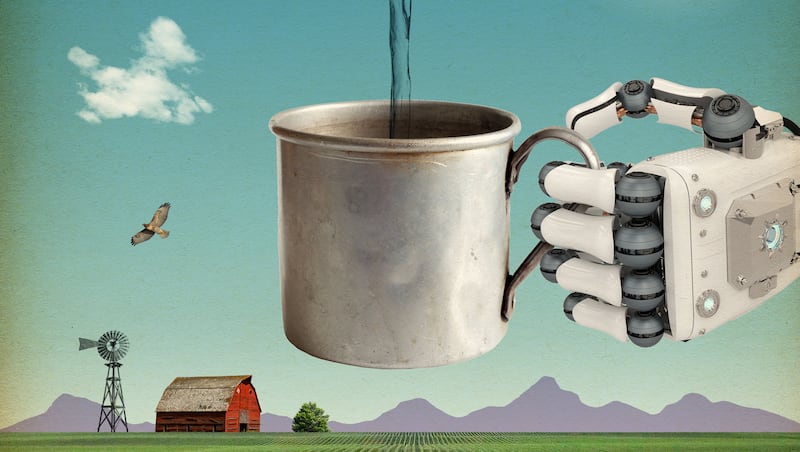
Michael Waraksa for Deseret Magazine
Jerome, Idaho, was named for a man who brought water to the land. Jerome Hill poured money into the North Side Canal Company, which, in turn, helped irrigate some 265 square miles of flat sagebrush steppe with water from the Snake River. The town lent his name to the county, which grew in the intervening century to encompass some of the West’s most-farmed land. There are around 450 farms here, 92 percent of which are family owned, according to the 2022 USDA Census of Agriculture. Cows outnumber people 10 to 1. Pound for pound and farm for farm, the 26,000-person county is one of the state’s most productive agricultural areas, according to the College of Southern Idaho, producing, processing and packing around $1 billion in farm products each year.
Across the gridded backroads, it’s hard to envision anything else for this part of the country. The feed fields — two million acres of corn, potatoes, alfalfa and sugar beet in the Magic Valley alone — stretch northward toward hills that stack into the high peaks of central Idaho. There’s your purple mountains’ majesty. Here’s your fruited plain.
But on the east side of State Highway 93, a plated, steely glint breaks the idyll. That’s the Midpoint Substation, Idaho Power’s roughly 45-acre utility hub, wheeling electricity across the West.
Tech is staking claims on Western land that has never seen a building larger than a milking barn. The result is competing visions for the West: data centers or center-pivots.
To some, southern Idaho’s future isn’t sprouting beneath rolling sprinklers, but pulsing through those wires. The same characteristics that make this land ideal for agriculture make it appealing for developing data centers. Open land, approachable climate, cheap power and sufficient water drew cattlemen from Southern California to southern Idaho in the 20th century. In the 21st century, it’s tech giants and investors eyeing ready returns.
Technology, data and power are staking claims on land that has never seen a building larger than a milking barn. The result is competing visions for the West: industrial or agrarian, data centers or center-pivots.
Sam Wirzba/Design Pics Editorial/Universal Images Group Via Getty Images
These days, the Kuna-Mora Road is one of the last places in the Treasure Valley that still feels remote. Miles of boots and old shoes top fence posts, an ambiguous homage to old cowboy tradition. The tallest structures on the horizon are the water towers that balloon on the low hills.
The towns that the road is named for have taken different paths themselves. Kuna, outlined on maps as a pixelated blot of annexation, has grown more than sixfold in the past 25 years, the 30,000-person vanguard to Boise’s southern expansion. By 2040, city staff expect it to top 45,000 residents.
Mora no longer exists. It’s a ghost town marked by a 115-year-old schoolhouse across from a small stockyard, and little else. The school closed in the 1950s after the well serving it was found to be contaminated. Today, its name lingers on the schoolhouse, the road and the Mora Canal, a key lateral routing water from the reservoirs above Boise downhill to the state’s southern deserts.
This is where Meta, parent company to Facebook, Instagram and WhatsApp, chose to put its 15th domestic data center, an $800-plus-million, 960,000-square-foot complex in what’s become southeast Kuna. The work broke ground in 2022, and on an afternoon in December, it was in its final stages. At its center, behind a chainlink fence topped with cantilevered barbed wire, are two low buildings, each about three football fields long, lined with 204 cooling fans in banks of six. Inside, servers will feed Facebook’s vast digital enterprise. More than ever, that means AI.
Meta’s plan came with promises of sustainability. During the winter months, Kuna’s climate is cold enough to cool the plant, cutting water use by 80 percent to an average of 70,000 gallons per day, a spokesperson for the company told the Idaho Statesman in April. That’s much less than the half-million or so daily gallons scientists estimate are needed to cool a similarly sized server farm, but it’s still enough to fulfill the average American family’s water needs for 233 days.
The data center will have access to that water by right: Meta bought four parcels of former family farms and a beef processing operation, totaling roughly 485 acres, according to property records. Though it’s only using about 22 of those acres. The purchase of that acreage also bought Meta seven separate water rights; about the equivalent of around three million gallons of water per day for commercial and industrial uses, the Statesman reported. Meta also sweetened the pot with promises of water “restoration” — that is, projects to improve water availability elsewhere in the basin — and a $70 million wastewater treatment plant, granted to Kuna as a gift to help process and recycle the data center’s effluent as irrigation for nonedible crops. The total power demands won’t become clear until the plant comes online later this year, Meta has said, though it plans for the site to run on renewables, and it’s backing a 200-megawatt solar farm southeast of Boise on lands purchased from a local rancher.
This is where Meta, parent company to Facebook, Instagram and WhatsApp, chose to put its 15th domestic data center, an $800-plus-million, 960,000-square-foot complex.
The construction alone is a win for state lawmakers, who carved out a tax exemption for data centers during the 2020 legislative session. The law waives sales tax on servers, equipment and construction materials in exchange for a minimum $250 million investment and at least 30 local jobs at or above the county-average wage. Republican Rep. Greg Chaney, a graduate of Kuna High School who represents nearby Caldwell, brought the bill to the House floor.
“Whether it’s our low power costs, low risk of natural disaster, or temperate climate, Idaho has all the markers to be the perfect home for data center facilities,” the Idaho Department of Commerce declared when the measure took effect. Two years later, Meta unveiled its plans to broad acclaim from elected officials. The state’s U.S. Sens. Jim Risch and Mike Crapo offered praise. Down the political ladder, so did Kuna Mayor Joe Stear.
“As the first large anchor in the city’s East Kuna Industrial area, (Meta’s) infrastructure investment is a catalyst for expanding the city’s ability to support well-paying jobs and attract other industrial and manufacturing users to Kuna,” Stear said at the time.
His proclamation is beginning to look like prophecy. A field down from Meta, Aypa Power, a portfolio company of the global investment giant, built a new battery energy storage facility on 200 acres covered in mirrored solar arrays. And a 10-minute drive east, Diode Ventures — a subsidiary of engineering giants Black and Veatch — is eyeing a 620-acre spot for another server farm. Diode bought those parcels from the family of Duane Yamamoto, a former Kuna mayor, who died last year at 90 years old. Yamamoto farmed the land for more than 65 years after gaining his release from the Japanese internment camp in Minidoka. The land, which he called “the Desert Farm,” was rezoned out of agricultural use for the data center.
Land and water come with a high cost. Acreage in the Treasure Valley is selling for $15,000 to $20,000 per acre, according to Rick Naerebout, CEO of the Idaho Dairymen’s Association. That’s up to five times the national average, and a price that only investors and tech giants coming to the area can afford.
Sam Wirzba/Design Pics Editorial/Universal Images Group Via Getty Images
The reason that the price is so high is that the state of Idaho is selling “value-added water,” said Rep. Jack Nelsen, a Republican from Jerome. Nelsen is a third-generation Idaho farmer who also spent 20 years on Jerome County’s Planning and Zoning Commission, mapping out the direction of the Magic Valley. We spoke last summer after a public meeting discussing a proposed nuclear power plant in Jerome County.
Dozens of neighbors from the area showed up at the Jerome County Courthouse to oppose the project, which was then seeking a permit for a swath of federal rangeland on the county’s northern boundary. The concept targeted the corner of a familiar area: Earlier that year, the Trump administration froze an approved 104,000-acre wind farm earmarked for the same swath of BLM land. Sawtooth Energy and Development’s plan, put forth by local rancher Roy Prescott and one-time gubernatorial candidate Dan Adamson, would pin the nuclear plant atop 320 acres above the middle of the Snake River Aquifer, a natural underwater reservoir about the size of Lake Erie. Local farmers and cattlemen were not pleased.
Meta’s data center in Kuna will use 70,000 gallons of water a day, the average American family’s water needs for 233 days.
The aquifer is a quirk of Idaho’s volcanic past. Gravity pulls water down through igneous basalt and into the sink, where it flows westward from the Tetons near Wyoming to the Oregon border. Pull up an aerial map on Google Earth, and you can trace it along the Snake River, a green, irrigated smile spanning the face of the state. That water, as well as the infrastructure it spurred on the surface, is what separates southern Idaho from the dun sagebrush steppe of northern Nevada. In a state nicknamed for its gems, the aquifer is widely considered Idaho’s greatest natural resource. Human ingenuity has optimized it, policy has preserved it, but dumb geological luck brought it to be.
To Nelsen, the aquifer has made Idaho what it is today, and its management will determine where it goes in the future.
“I’m not sure it has shown its true force just yet,” he said. “But you look at almost all the aquifers and river drainages in the nation, they’re in trouble. The Colorado’s looking at rough numbers. They’re going to have to get by on half the water. It just simply isn’t in the river anymore. … We’re miles ahead of everybody else.”
Even that luxury is, in some years, spread too thin. Idaho uses more water per capita than nearly any state in the nation. Nearly all of it — 86 percent at last count — goes toward irrigation. And basically none of it goes toward thermoelectric power — that is, cooling equipment or steam that drives turbines, as Prescott and Adamson had proposed.
The Sawtooth Energy plan hinged on Idaho Power’s Midpoint Substation, which would be just a few miles away. The details at last summer’s meetings weren’t clear, but pointed toward installing six small modular reactors — a nascent alternative to massive light-water reactors as yet deployed in the U.S. — to produce enough electricity to power 400,000 homes, or nearly half of the state.
Homes isn’t the right unit, though. The power would go where the market dictates, Prescott said. More and more, that means server farms across the American West, where tech firms are building massive complexes. Data centers used 4.4 percent of all U.S. electricity in 2023, according to the Department of Energy. By 2028, they’re expected to use between 6.7 and 12 percent. At one meeting in July, Prescott presented a vision of Jerome County as a future hot spot for the data industry, drawn in by low-cost power through proximity to his plant.
To the southwest, Idaho Power is developing a new transmission line, a 300-mile joint venture between Idaho Power and PacifiCorp, to link land south of Boise to eastern Oregon. It’s closing in on construction. In October, The Oregonian reported that the 500-kilovolt line may serve a single data center in Oregon, not the general public, after a local discovered the information.
“Idaho doesn’t need the power,” Julie DeWolfe Arroyo, a Jerome homeowner, told Idaho Power execs Prescott and Adamson in July. “Data storage needs the power. AI needs the power. Idaho is being turned from an agricultural community into a data center.”
In the days after the open house, the Sawtooth Energy project went quiet.
Idaho had been a state for 17 years when Laurie Lickley’s ancestors homesteaded a rocky, lava-shot section of what would soon become Jerome County. They built up their ranch before water reached the land and carved out an operation in the great roadless space north of the Snake River Canyon.
Today, Lickley can see an Amazon fulfillment center from the window of her family’s home. She thinks it’s an aberration, not an advanced scout of buildings to come. But the former state representative spends a lot of time thinking about what will happen next. Her children are grown, the fifth generation of Lickleys to ranch in Jerome. They have children of their own. Their beef business has evolved with the times — vertically integrated, she said, to grow some of their own feed and buy into a new beef processing plant nearby.
“I wouldn’t say that I feel threatened. I would say this is the reality,” Lickley said. While she sees a common goal of “an agricultural backbone” among her neighbors, she can’t miss worrying signs.
Idaho doesn’t need the power. Data storage needs the power. AI needs the power.
Lickley’s family has seen farmers cash out before. After the Lickleys’ first generation passed on, a great-uncle took his portion of the inherited property and sold it off. The echoes of that decision are still visible on the land, written in the lighted signs of chain hotels and truck stops where Highway 93 meets the interstate north of Twin Falls. Once a property turns away from agriculture, it almost never goes back.
Still, she’s hopeful. Twenty-five or 30 years from now, she believes Jerome County will look much like it does today. She’d like to see downtown spruced up a bit. Maybe there will be taller apartments and less single-family sprawl. But when the wind blows south, she’s confident that the decisions made now will keep the smell of cattle in the air.
“I think you’re going to have to have responsible leadership,” she said. “I think you’re going to have to have people at the table who are willing to make hard decisions, and be visionary, because if we don’t have a strategic plan in place … it’s going to be hard. But we’ve got a lot of smart people in Jerome County, and I see us all working together to make sure that agriculture stays protected.”
Back in Kuna, the land around Meta’s data center is still mostly vacant. A warm, humid start to winter helped green up the complex’s earthen levees, fed by driplines and landscaped with native grass. The adjacent lots looked tilled, waiting for crops, and girded against South Cole Road by three stands of rusty barbed wire. On a windy Sunday in December, the fence did all it could to keep out the tumbleweeds, sun-dried tangles of Russian thistle that blew between the windbreak and Meta’s perimeter barrier. They stacked deep against the fence, then fell back like slow-breaking waves, riding the whim of the wind. Some caught a blue wooden sign. The open fields were for sale, it read, and zoned industrial. Call to inquire.