
MEXICO CITY — It started out as a well-planned law enforcement operation that culminated in the successful takedown of an illicit drug laboratory deep in the mountains of Mexico’s northern Chihuahua state.
But last weekend’s raid has now become a flash point inflaming U.S.-Mexico tensions as officials on both sides of the border struggle to explain how two CIA agents — along with two Mexican law enforcement officers — lost their lives early Sunday in the aftermath of the counter-narcotics assault.
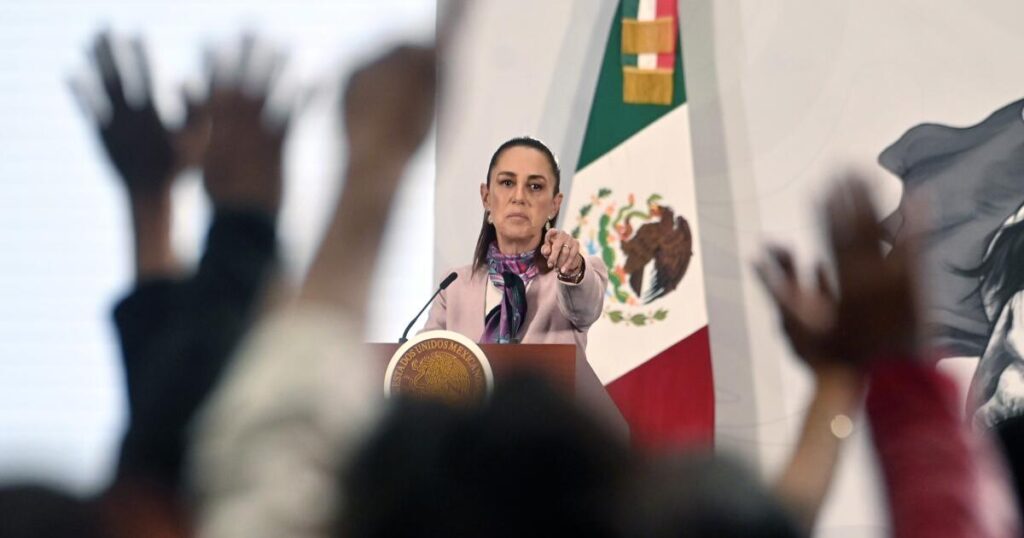
Mexico doesn’t want to “generate a conflict” with the United States, Mexican President Claudia Sheinbaum said Thursday, as questions mounted about the incident.
However, Sheinbaum said, the participation of U.S. agents in a raid without advising Mexico’s central government would be a clear violation of a Mexican law aimed at protecting the nation’s sovereignty. Mexico’s defense ministry was unaware of the raid, she said, even though state authorities say dozens of federal troops were involved.
Amid often-conflicting versions of Sunday’s events, there is still dispute about a central point: Did CIA personnel actually participate in the raid? Or were they present in some other capacity?
The incident comes at a key moment, as negotiators from Mexico, the United States and Canada work to revise a free-trade accord that is a linchpin of the Mexican economy.
President Trump, who has pushed for direct U.S. anti-drug involvement in Mexico, has said that Mexico could have shown “some sympathy” for the agents killed in the operation, his spokeswoman, Karoline Leavitt, told Fox News.
In fact, Sheinbaum’s first public reaction was to express condolences for both the U.S. and Mexican officers who lost their lives.
Mexico has demanded an explanation about U.S. participation in the incident from Ronald Johnson, Washington’s ambassador in Mexico City. Johnson has declined to comment publicly beyond initially expressing condolences for the deaths of two “U.S. Embassy personnel” and two officers of Chihuahua’s State Investigative Agency.
Johnson, himself a former CIA officer who spent more than two decades with the agency, never publicly identified the two U.S. casualties as intelligence operators. But multiple sources have since confirmed to both the U.S. and Mexican press that the two were, in fact, CIA officers.
The CIA has declined to comment.
On Wednesday, The Times reported that the raid involved a total of four CIA agents and marked at least the third time CIA operatives have joined Chihuahua state officials on operations this year.
Two of the four CIA agents died in a road accident after participating in the raid. The other two were riding in a separate vehicle and not harmed.
The CIA personnel, The Times reported, were dressed in the uniform of the Chihuahua State Investigative Agency, which led the operation.
In a bid to allay U.S.-Mexico tensions, Sheinbaum placed the blame for what she called a violation of Mexico’s sovereignty on authorities in Chihuahua state.
State authorities in Chihuahua have denied any wrongdoing. Complicating the dispute are internal Mexican politics: Governing Chihuahua is the center-right National Action Party, a fierce rival of Sheinbaum’s ruling leftist Morena bloc.
The incident has raised suspicions here of a much broader involvement in Mexico by the CIA, an agency long assailed in Latin America because of its decades-long involvement in coups, assassination attempts and other undercover actions.
“The threats of Trump’s government to invade Mexico have materialized, not with a conventional occupation force, but with an undercover war, with clandestine operations,” Víctor Hernández, a security expert, told El Universal newspaper.
Others point out the long — but clandestine — history of the CIA in Mexico, dating back to the Cold War.
A trove of documents declassified last year after Trump signed a bill to release records connected to the assassination of President Kennedy revealed that several Mexican presidents had been informants for the CIA during or before their time in office.
Some security experts say CIA operators have been involved in helping Mexican authorities locate some of the country’s top drug lords.
“It’s almost laughable for the president of Mexico to feign ignorance” about CIA activities in Mexico, said Gilberto Gonzalez, a former DEA agent who worked here in the 1980s and 1990s. “It’s no surprise to anyone.”
But he said it would be difficult for Sheinbaum to acknowledge her government’s knowledge of CIA activity, given that sovereignty is such an crucial issue here, particularly for members of her Morena party.
“She’s in a catch-22, because if she says, ‘Yes, they’re CIA, and they’re here with my permission,’ then all the Morena people are going to jump down her throat,” he said.
Sheinbaum’s predecessor, Andrés Manuel López Obrador, championed laws that barred foreign security agencies — including the DEA, CIA and FBI — from acting on the ground without informing Mexican federal authorities.
With Trump’s ascension, Gonzalez said, the CIA and other agencies involved in fighting drugs and organized crime have been emboldened.
In the past, he said, “the CIA was trying to be clandestine in their operations and kind of remain in the background, in the shadows.” In Mexico, the agency focused mostly on the interception of phone calls and other spying, he said.
“With President Trump, everything has changed,” Gonzalez said. “The CIA is a lot more out there and a lot more proactive than they were before.”
The vehicle involved in the fatal crash was part of a five-vehicle Mexican law enforcement convoy returning from the two-day raid on the drug lab, according to official accounts. It plunged into a ravine in the predawn hours Sunday along a mountain road.
But according to César Júaregui Moreno, the state attorney general, the two Americans killed were “instructors” from the U.S. Embassy and not direct participants in the raid — which, he said, involved 80 personnel, including state officers and federal soldiers.
Rather, Júaregui said the two U.S. staffers had been conducting a drone-training exercise in a town, Polanco, that is a six-and-a-half-hour drive away from the site where the raid occurred. Mexican officers returning from the raid picked up the U.S. personnel at 2 a.m. Sunday in Polanco and provided them with a ride, Júaregui said. The fatal crash followed, he said.
Special correspondent Steve Fisher contributed to this report.