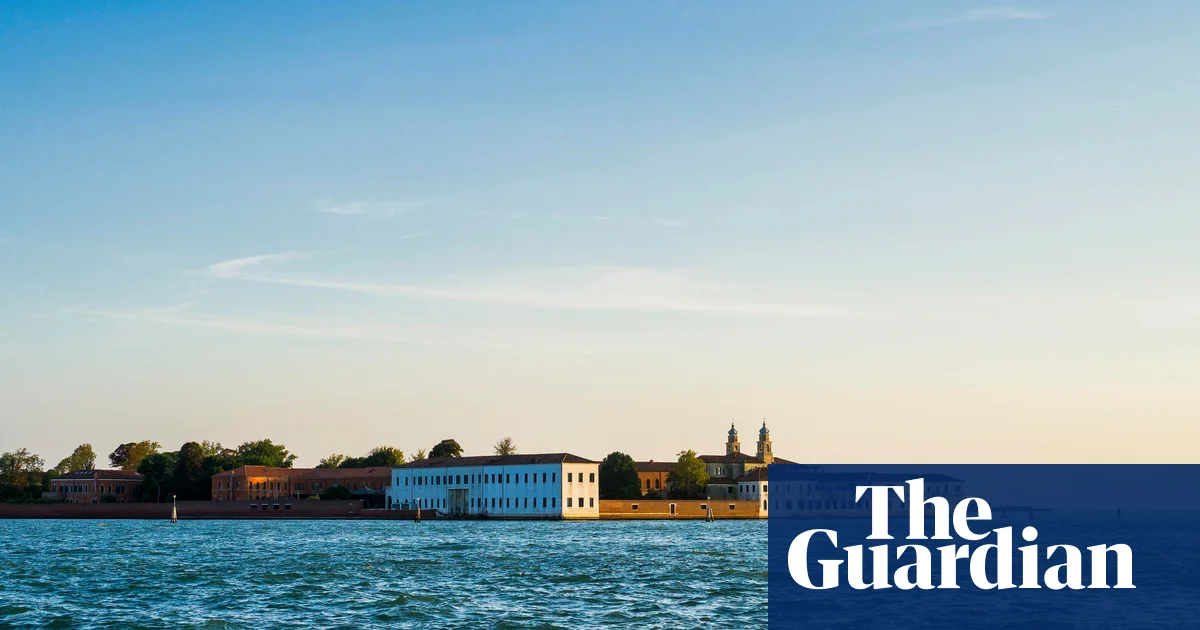
On the scrubby banks of the rural swathes of the Venice lagoon, an evening chorus of cicadas underscores the distant whine of farmers’ three-wheeled minivans. Dotted along the brackish fringes of the cultivated plots are scatterings of silvery-green bushes – sea fennel.
This plant is a member of a group of remarkable organisms known as halophytes – plant species that thrive in saltwater. Long overlooked and found growing in the in-between spaces – saltmarshes, coastlines, the fringes of lagoons – halophytes straddle boundaries in both ecosystems and cuisines. But with shifting agricultural futures, this may be about to change.
Once known as the breadbasket of Venice, farmers on the island of Sant’Erasmo are facing a challenge that will soon become commonplace in coastal marshes worldwide. A trifecta of rising sea levels, increases in average temperature and decreases in rainfall is leading to a rise in the concentration of salts in the soil – a death knell for many traditional crops, which can survive only up to a salt concentration of about 1.2% – about one-third that of seawater.
Sant’Erasmo’s soil has long held a trace of salinity, just enough to give its prized violet artichokes their vivid hue and delicate flavour. But the balance is delicate: too much is bad news. Last year, the Food and Agriculture Organization of the United Nations estimated that about 10% of the world’s total land is currently affected by salinity, and that this may rise to between 24% and 32% of the total land surface because of the climate crisis.
“I started to become fascinated by these plants more than five years ago. They’re a bit of a miracle,” says Filippo Grassi, an environmental scientist at the Tidal Garden, a research agency based in the Venice lagoon exploring the edible potential of halophytes for cultural adaptation to climate change.
“And then Venice is the perfect playground because you have a very interesting and nuanced environment that has been lived by humans and changed and transformed by humans for centuries.”
From Sant’Erasmo, the spires of Venice, majestic – and unavoidably sinking – are just visible across the water. The Tidal Garden’s task is to unite these two worlds.
They work with six or seven species, including marsh samphire, monk’s beard and purslane. For a long time, these crops have been foraged by coastal communities in Venice and beyond – a Tudor record lists three accidental deaths in England linked to samphire foraging in the late 1500s – but never taken seriously as a commercial crop.
“Really, a lot of [it] is about telling the story and it’s about piecing it together. The farmers say: ‘Oh this plant? We know people who are now 89-year-olds who used to pick it’,” says Grassi. “Most of these [foraged] plants were eaten at some point and then were forgotten.”
Echoing these concerns, Lodovica Guarnieri, a researcher, explains the more complex barriers to embracing these species: “For farmers it’s still seen as a weed, or even worse, as a warning sign. If marsh samphire starts appearing in someone’s plot, it means they’re in trouble.”
She is not wrong. While samphire’s specialised glands and internal pump-like channels enable it to move salt through its system efficiently in brackish water of 1-1.6% salinity, such concentrations would be disastrous for the humble tomato, inhibiting its very germination.
On Italy’s western coast at the University of Pisa, a team of researchers is using halophytes to address this very issue. Antonella Castagna is an associate professor specialising in eco-friendly solutions to crop fertility problems. Last year, she and her colleagues found that intercropping and rotating tomatoes and glasswort respectively led to more nutritious and bountiful harvests. The researchers envisage planting halophytes on the tracks and fallow land bordering farmers’ fields.
They believe this conservative approach would enrich the soil without requiring farmers to sacrifice land already designated for cash crops. The urgency of the problem helps too. “Luckily from the point of view the situation now is so dramatic and salinity is so dramatically increasing that farmers are recognising the problem,” says Castagna.
“In one area we’re working, there is a producer of grain, and his yield is progressively reducing, as you move from the internal field towards the sea. They 1766312481 get the same yields in fields that are twice as wide as before, so there is an economic issue.
“It’s bad from one point of view, but it’s good from another because people have finally started to trust in our operation. We hope that working together we can try to find some solutions.”
The obscurity of halophytes and suspicion of their weed-like ability to thrive in harsh environments is partly why, in Venice, the Tidal Garden has recruited chefs, artists and poets to its cause, aiming to grow a steady awareness and commercial demand. And how do you create a demand?
“Basically, spike people,” says Grassi. “There’s a lot of work going into embedding these plants into the normal food culture of the place. We use them as ingredients in food that people already know, such as pizza. We bring them into the culinary language.”
He points to a collaboration with AEDS, an organisation based in Tunisia, where even higher soil salinity and a much drier climate mean halophytes are also being cultivated.
“In Tunisia, we’re going to start working in a different way – they don’t really use these plants as food for humans, it’s mostly food for animals. And so we’re going to try and explore local recipes there,” Grassi adds.
In Venice this approach has saved the herbs from obscurity. The venerated Gelateria Alaska has created a samphire sorbet. One of the city’s most exclusive eateries, the two-Michelin-starred Glam Enrico Bartolini, has an avowed halophyte-lover at the helm in the form of its resident chef, Donato Ascani.
“I was very lucky to come to Venice because there are ingredients that are unique in Italy,” he says. “Wild herbs – the soil where they’re grown – our vegetables have a particular savoury taste that’s hard to find in [the rest of the country], so this soil allows us to have an extra edge with what we do in the kitchen.”
Ascani is acutely aware of the changes that are already affecting seasonal availability of the lagoon’s offerings.
“Every chef knows that every time he changes location, there is a spirit of adaptation to the new place and the crops,” he says. “Similarly, there will also be adaptation to climate change. We’ll go with whatever [nature] has to offer; it’s not like we can just come back and grow crops in the kitchen.”
For Ascani, halophytes represent a way to connect his customers to the lagoon, and “understand the importance of all the land offers”, even if those offerings are obscure.
And in their resilience, halophytes are important, says Ascani: “We can’t tell the season from the calendar any more. We have to look at it in the morning, when you go to the market to buy groceries.”