
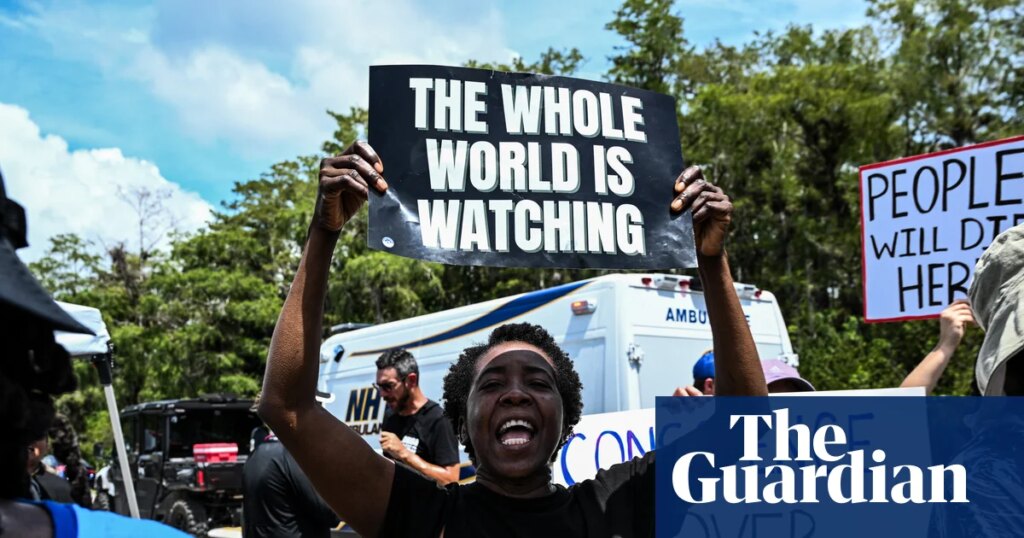
They come on buses, in cars and RVs. Some ride on motorcycles. Every Sunday afternoon, convoys of protestors from all over Florida, and others from out of state, descend on the notorious “Alligator Alcatraz” immigration jail in the Everglades to stand vigil for those held inside.
It is a ritual that began in August, a month after the opening of the remote detention camp celebrated by Donald Trump for its harsh conditions, and hailed by Florida’s Republican governor, Ron DeSantis, as a model for the president’s aggressive detention and deportation agenda.
The open air vigils continued, and grew in size, through the brutal heat and torrential rains of the south Florida summer. They endured through a federal judge’s order in August that “Alligator Alcatraz” should close, and a subsequent reversal by an appeals court; the protestors’ voices grew louder at alleged human rights abuses and violence inflicted on detainees.
Over the holiday season, thousands more people are expected to join the protests. The Guardian spoke to several people at the heart of the vigils:
The daughter
Arianne Betancourt’s Cuban-born father Justo, 54, was detained during a routine immigration check-in appointment in October and swiftly transported to “Alligator Alcatraz”. He is diabetic, she says, and has been denied his twice-daily insulin injections.
“They just told him he can get it in Mexico,” said Betancourt, who found strength at the vigils supporting other families with loved ones who are incarcerated.
“I’ve met Roxana, her husband is detained, she has a baby; Michelle, her father is detained, and she was there with her daughter, who’s 14 or 15; there’s Jeffrey, whose boyfriend was detained. We’re all feeling the same way. There’s no options, no due process, no actual legal process, nothing you can appeal, nothing you can fight. So if there’s anything I learn, any resources or anything, I’m just sharing it with the other families, because at the end of the day we’re all going through the same thing.”
The oldest of three siblings, all US citizens, Betancourt says she is angry at what she sees as the unconstitutional treatment of her father, who came to the country on a humanitarian parole program from Panama when he was a teenager. He served probation for a criminal conspiracy charge several years ago, she said, and reported regularly to immigration authorities before his detention.
He tries his best not to cry on the rare occasions they can speak by telephone, she said, noting she fears he will suddenly disappear.
“When I talked to him this week he was like, ‘Listen, you know, they’re not giving people court dates, they’re not standing before a judge. They’re pulling them out of their cells at night, putting them on a plane and sending them to Mexico, regardless of where they’re from’,” she said.
“I’m the oldest one, so I have to be like, ‘OK, hey, you know, everything’s gonna be OK. I’m gonna figure this out.’ But the truth is I don’t know how I’m gonna figure this out.”
The pastor
As pastor of the Allendale United Methodist Church in St Petersburg, Andy Oliver has never been afraid of diving into political issues. The treatment of detainees at “Alligator Alcatraz”, he said, compelled him to organize a bus to attend the vigils, and he was encouraged that other locals joined his parishioners to make their voices heard.
“We filled up the bus and had to rent a couple more vehicles. We had so many people wanting to be there,” he said.
Oliver sees parallels at the immigration jail with the religious stories he preaches.
“In the Christmas story, the person who came to announce Jesus’s arrival was his cousin John the Baptist, and he was pretty quickly thrown in jail for calling for liberation,” he said.
“Jesus came to bring liberation to people. We have people that are physically being detained even beyond the scope of what the law allows, families are being separated, harms are being done. Jesus was born as a refugee. He spent most of his ministry with people on the margins. I think that’s where Jesus would be, he’d be calling for these prisons to be emptied.”
Oliver said the diversity of the vigil crowd is notable, and that it was “powerful” to share the experience with people of different faiths.
“I’ve always been touched by the family members who show up. Many of them are putting themselves at risk,” he said.
“Sometimes people inside the jail have called out, so we put that on the speaker and listen to prisoners’ experiences of getting cold food with worms in it, inadequate showers, all the horrible conditions of the place.
“And just the journey itself … for many of us it takes several hours to get there, and you do a lot of reflection there and back. It’s a long drive and it’s inconvenient, but also you’re driving back to your bed at night, to your family.
“These people have been plucked out from whatever life they had into hell.”
The military veteran
John Reynolds was a US army intelligence expert serving in Vietnam when he experienced the first pangs of discomfort at how his country treated marginalized populations. Decades later, Reynolds, 81, looks at “Alligator Alcatraz” and questions what has changed.
“We have these ICE thugs who have been paid bonuses of $50,000 to take somebody off a park bench, to arrest somebody in a church parking lot that happens to be brown. That’s the target,” he said.
“I see people that have served in the military, Hispanic, Black, women … and despite all the progress made over the years, all of the efforts, all of the sacrifices to take us to a better level of living together and appreciating what we have, we have a regime, a group in power that are absolutely racist and bigoted.
“The way this immigrant population is being tortured, and it’s just beyond anything I’ve ever seen.”
Reynolds ventures across the Everglades every Sunday from his home in Naples to attend the vigils, which he said he sees as a small part of the protest movement. “The people here are very well informed of what’s going on,” he said.
“The more the general media exposes the inhumanity, the injustice, and the lack of due process, that will be the education tool to take us further. It’s getting people’s attention, they’re beginning to see more and more examples of injustice, and it’s the kind of injustice that they’re not comfortable with.”
An army career followed by many years as a schoolteacher, Reynolds says, gave him an appreciation of the good, but now also the bad things he sees at “Alligator Alcatraz” and elsewhere.
“It was a wonderful experience, a fantastic challenge and a great experience, but to see how the country could wander down those paths again, lie to the American people again, have this loss of life, spend money again on [repressing] civilian populations,” he said.
“What was positive that came of that? That’s why I told myself I’ve got to do something about this.”
The civil rights activist
Lois Cohen has seen a lot in a lifetime of civil rights activism. The 91-year-old lived through the assassination of Martin Luther King Jr, bombs at Black churches, the 1965 Bloody Sunday attacks on protestors in Selma, Alabama, and the 1964 Civil Rights Act.
Nothing she has experienced has angered her as much as the alleged treatment of detainees inside “Alligator Alcatraz”. “Other than the Holocaust, I can’t imagine this any worse. It’s unbelievable,” she said.
“People keep saying, ‘Well, the Lord will provide, or God will.’ I’d love to know where he is, because he’s forgotten about the Everglades.”
Cohen said she marched in high school protests in the 1940s, the start of a lifelong dedication to political activism she said still burns strongly within her. She has been at “Alligator Alcatraz” every weekend.
“I can so easily write a check, anyone can write a check, but that doesn’t get you involved. To see it, and feel it, and emotionally be so distressed by it that it changes your whole attitude about life,” she said.
“Because you can’t imagine people being treated like dogs, and kept in cages like dogs. And when you’re there it is an extremely emotional, gut-wrenching experience.”
Cohen, however, takes comfort from the people she meets at the vigils, and the message they deliver. “It is a feeling of companionship, and that there are people in this world who still care, because in my everyday life I see too many that don’t,” he said.
“It’s not right. I don’t want to be friends with them any more. I want to avoid them.”
She said not enough people are aware that the jail quickly ramped back up to full operation after an appeals court decision in September, which is why she believes publicity for the vigils is crucial.
“People don’t know about it. I’ve talked to people and they say, ‘What are you talking about?’ They’re still under the assumption that it was closed by the judge in Miami,” she said.
The organizer
The growth of the weekly “Alligator Alcatraz” vigils from a handful of people in August to a regular gathering of hundreds can be attributed in large part to Noelle Damico, director of social justice at the Workers Circle.
Her decades of experience in grassroots activism helped pull together of a diverse alliance of church groups, trades union, veterans, Native American tribes, other advocacy groups and individuals that show up every Sunday in the Everglades, and at “freedom vigils” at immigration detention facilities around the country.
“One of the most rewarding parts of this ongoing resistance is that people are finding one another. They’re breaking their isolation. They’re coming out from their homes and their neighborhoods, and they’re saying, ‘I’m not alone in thinking this is wrong, and I’m not alone in wanting to do something about it’,” Damico said.
“It’s so uplifting to see people whose paths might not otherwise have crossed, united in shared purpose, in a belief in our common humanity, and a refusal to let the Trump administration drag us further into the depths of despair.”
Damico said she is already filling buses for the next two weekends. “People are still in detention, separated wrongfully from their loved ones,” she said. “How can we not be out there in the spirit of the holidays to proclaim a message of love and justice and hope?”
The closure of the jail is coming, she said.
“It’s not a matter of if ‘Alligator Alcatraz’ and the rest of the sprawling, cruel detention network will one day shut down, it’s a matter of when. And when is up to us,” she said.
“Thousands of people, many who have never publicly protested anything, are coming off the sidelines to peacefully demand an end to these violent, vicious abductions, torture, detention, and disappearances, and that is what will determine the timeline.
“It’s not up to Donald Trump. It’s not up to [White House policy adviser] Stephen Miller. It’s not up to [homeland security secretary] Kristi Noem. It’s up to us. And we will end this.”