
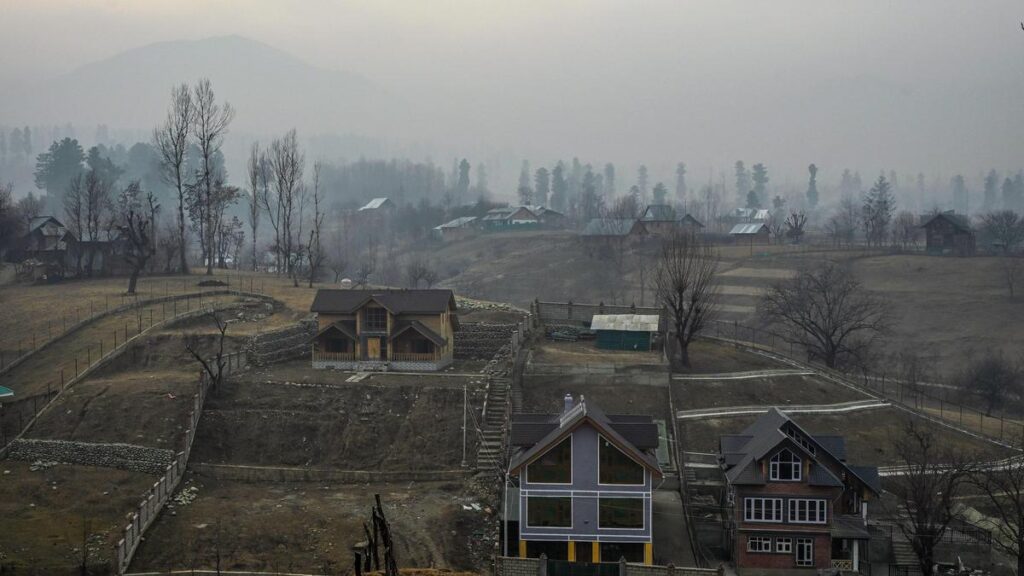
The upper reaches of the Pir Panchal mountain range in the Lesser Himalayas is covered with fresh snow, forcing large-billed crows to fly downhill in search of food. One village they often flock to is Raiyar, a hamlet in the hillocks adjacent to Doodhpathri in the Budgam district of central Kashmir. This is around 43 kilometres from Srinagar, the capital of Jammu and Kashmir (J&K). Watching the crows perched on leafless apple and walnut trees, Rafiqa Jan, 38, complains that they keep cawing at a high pitch — considered a bad omen.
With its sprawling meadows, crystal clear streams, and evergreen pine trees, Doodhpathri has been an increasingly popular choice for both domestic and international tourists over the last few years. However, this year, it remains deserted and quiet. It is among the 48 destinations that closed for tourists after the terror attack in the Baisaran meadow in Pahalgam left 26 people dead on April 22 earlier this year.
Jan and her husband, a labourer, live on the border of Doodhpathri. She has had a tiring day, scaling the nearby forests dotted with dense pine trees to collect wood for cooking.
In 2024, Jan would make enough money from her tea stall to buy cooking gas cylinders. Her stall catered mostly to tourists — couples in love, honeymooners, and friends and families yearning to see and touch snow on the slopes.
“I would earn a profit of ₹500-2,000 a day, depending on the footfall. There are more tourists during the winter months because this place is covered by a thick blanket of snow,” she says. “But all that came to a halt this year. All our plans, from conducting weddings to renovating our homes, from buying new winter clothes to getting new furnishings for our houses, have been ruined,” says Jan, whose son got selected last year for the MBBS course in a government medical college in Jammu.
Jan raised a loan of ₹60,000 to pay the fees for her son’s first year in college. “I thought I would repay the amount this year. I expected booming business from tourists,” she says. “But the year is almost over and I have failed. We are now staring at the most stressful winter months of our lives.”


Changing the status of women
By September, Jammu and Kashmir Lieutenant Governor Manoj Sinha had reopened 28 of the 48 destinations in the Kashmir Valley in a phased manner. The rest await clearance from his office.
The places reopened included Pahalgam, where the attack took place, and popular tourist sites such as Gulmarg and Sonamarg. Doodhpathri, located more than 126 km away from Pahalgam and walled by a series of mountain ranges, remains closed, along with other prominent destinations such as Yusmarg, Tosamaidan, Drang, Nilnag, and Aharbal. This decision has impacted thousands of locals in these places, who earn their living from tourism.
According to official sources in the Governor’s Office, a security audit is still underway and the destinations will be re-opened after the audit is completed. As of now, Central Reserve Police Force (CRPF) personnel are manning Doodhpathri and the J&K Police have set up a barricade to ensure that outsiders, including journalists, do not enter these destinations.
Doodpathri recorded less than 50,000 tourists in 2011; this increased to the highest-ever figure of 18 lakh in 2024. This year, according to the Tourism Department’s figures, only 1.25 lakh visited the place in the first four months.
The earlier booming tourism in Doodpathri not only changed the economy of the place, but also the status of women. Jan is one of the 200 women from Raiyar and its adjoining villages who broke the glass ceiling by becoming the first owners of roadside tea stalls in Kashmir.
Also read:The gavel over Gulmarg’s hotels
“For the first time in our lives, we were like the working men of our villages, who earned their own money and met their own needs. We also started buying new clothes without pressing our husbands for it, and ate what we wanted to,” says Naseem Bano, 40, who was among the first few women in 2020 in the area to sit on the streets serving roasted corn to visitors.
With the number of tourists rising over time, more women set up tea stalls in and around Doodhpathri. Social media ‘influencers’ soon turned up at these stalls to shoot Reels of kehwa, a piping hot brew of crushed almonds, saffron, cardamon, and cinnamon. The stalls also popularised home-made collard greens, chutney of onions and walnut, pickles, and corn flour rotis.
“In ones and twos, we started selling roasted corn to tourists in 2021. That business slowly picked up. Despite the initial reluctance and opposition from men, we continued to do this and carved a niche for ourselves,” says Bano.

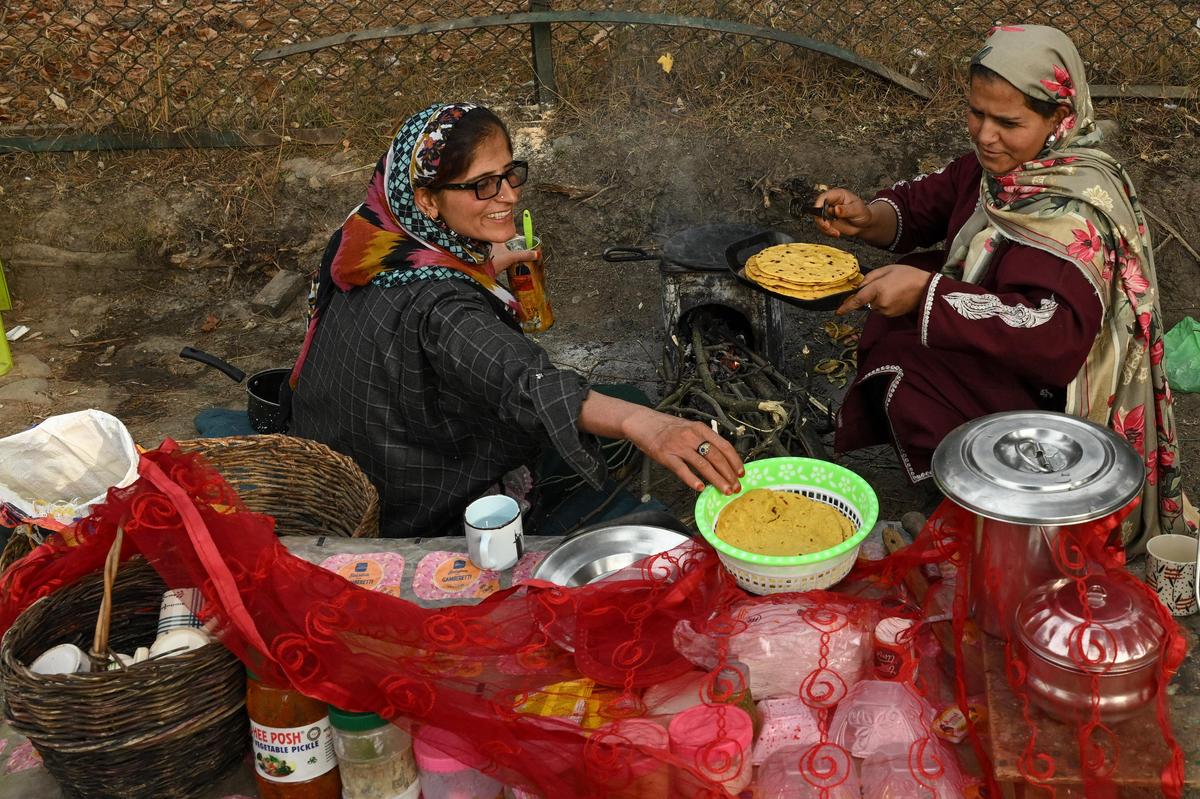
A woman prepares maize flour flatbread and sells salted tea to locals at her roadside stall in Raiyar village.
| Photo Credit:
Imran Nissar
A tourist hub waits with bated breath
According to the 2011 Census, Raiyar has a population of 1,937. Ghulam Hassan Sheikh owns the popular Lal Baab restaurant here. He says his 32-year-old son, Bashir Ahmad Sheikh, who used to drive a taxi till 2021, began earning more from the restaurant business. “Many labourers of Raiyar village, who worked as carpenters and plumbers in Srinagar, also switched to the tourism sector to earn their living,” says Sheikh.
Officials of the Doodhpathri Development Authority (DDA) say Raiyar has around 400 families of which 80% depend on tourism. “We don’t understand why Doodhpathri is closed, while Pahalgam is open. It seems like we are being punished for somebody else’s sins,” adds Sheikh.
There is growing distress among those who raised loans to invest in the tourism sector. Bashir Ahmad, 21, raised a loan of ₹5.5 lakh and invested in an all-terrain vehicle (ATV) in September 2024, seeing the leap in tourist numbers. Since April 29, a snow shield has been covering it.
“I am supposed to pay around ₹10,000 as monthly EMI (Equated Monthly Instalment). This growing economic distress will force us to sell our land to repay the loan,” says a worried Ahmad.
He lives with his older brother, two sisters, and parents in a single-storey house. “I used to earn even up to ₹2,000 per day. These days, I sell spices to survive,” he says.

According to the DDA, 1,500 locals were registered as labourers and horse owners, 200 as tea stall owners, and 50 as ATV operators in 2024. The government tenders out parking and ticketing to private players. The ticketing counter, tendered at ₹1.5 crore, has not generated any revenue this year, and the payment remains outstanding.
“Doodhpathri was emerging as a major winter destination. We had been receiving a lot of queries from prospective tourists and filmmakers,” says Riyaz Ahmad Beigh, Chief Executive Officer of the DDA. “We have not been able to grant permission because of the current status of the destination. We get a lot of representations from various stakeholders too, to re-open it for the winter. We are hopeful that it will re-open soon.”
In 2024, the DDA granted 29 permissions to shoot films and music videos at the destination. The government intended to introduce activities such as skiing and paragliding to entertain visitors this year. These plans have been put on hold.
The situation is equally grim at Kulgam’s Aharbal, around 50 km away from Doodhpathri. Aharbal is home to a 25-metre-high waterfall, popularly known as the ‘Niagara Falls of Kashmir’, on the Veshu river. Junaid Dar, an arts graduate, and his two friends raised a loan and invested in a guest house in Kulgam to cater to the rush of tourists visiting the waterfall. Dar says he is not able to sleep because of the anxiety.
Woes at the epicentre
The Pahalgam attack has struck a major dent in Kashmir’s tourism industry this year. “Kashmir has not even been able to touch 25-30% of the record number of tourists (26 lakh) who visited in 2024,” says Farooq Kuthoo, president of the Travel Agents Association of Kashmir.
Official figures say that Kashmir received 7.53 lakh tourists, including 15,319 foreigners, and 7.38 lakh visitors in the first six months this year. This is a dip of over 52% compared to the 15.65 lakh for the same period in 2024.
The continued closure of major destinations has impacted both itineraries as well as the number of days of stay for tourists. “For a week-long trip, tourists get to travel to the golden triangle of Gulmarg, Pahalgam, and Sonamarg. However, we could not make an elaborate itinerary that includes major off-beat destinations such as Doodhpathri and Aharbal. The closure has impacted tourists who want two weeks of stay and enjoy off-beat destinations more,” says Kuthoo.
There has been a steady retrenchment of hotel staff in Pahalgam after the attack. “Most hotels have a retrenchment rate of 40-50% this year,” says Kuthoo, who is also an executive member of the Kashmir Chamber of Commerce and Industries, a major traders’ body of the Valley.
Pahalgam has a population of around 10,000. Without orchards or rice fields, its economy is driven by tourism. Several people say most of the unemployed youth in and around Pahalgam bank on tourism to earn their livelihood. “Many of them formed groups and raised loans to take properties on rent for a year. They are the worst affected. The situation has pushed many into depression,” says Kuthoo.
Around 12 destinations were re-opened in September this year, including the famous trekking base of Aru, around 15 km away from Pahalgam. From Aru, tourists go to high altitude lakes such as Tarsar and Marsar. Several hotel owners in Aru village, with a population of around 4,000, claim that the closure has shattered the confidence of foreign tourists who visited frequently to trek.
Kursheed Ahmad, owner of Aru Heights, says this is the worst-ever tourism season this year since the 1990s. He says, “Aru has never been closed in the past for tourists. It has attracted foreign tourists for years and remained peaceful by and large. We had earned the faith of tourists over a period of time by offering a safe and secure environment. All that has gone to waste.”
The Union Ministry of Tourism had declared Aru as one of the winners of the Best Tourism Villages Competition 2024 on World Tourism Day.
The closure of key destinations has impacted local taxi operators, guides, and travel agents in many places too. In Srinagar, Tanvir Dar, who runs The Kashmir Cabs, says, “We have been serving tourists for the past three decades with two taxis. In 2023, we raised a bank loan to add three more, to create a fleet for new or lesser-known destinations. All the drivers and cars earmarked for these places have failed to make any profit.”

Several Srinagar-based travel companies have reduced their staff number because of the prolonged closure. “We receive several queries round the year for destinations such as Aharbal and Yousmarg, but we have had no guests. We had to cut the staff number due to decreased footfall,” says Akhtar Khan, a tour operator.
Many locals associated with adventure tourism are also idle because trekking in most mountain passes surrounding the Kashmir Valley has been stopped too.
Not on the same page
The elected government of J&K, headed by Chief Minister Omar Abdullah, is not on the same page as the Lieutenant Governor’s administration on the prolonged closure of tourist destinations. Abdullah says the J&K government, even at the peak of militancy in 1996, did not take any drastic measures, keeping tourist destinations out of bounds. He has repeatedly requested the Lieutenant Governor’s administration to re-open all the destinations.
Read:Snowfall ends long dry spell, heralds the revival of festive year-end tourism in Kashmir Valley
“The policy of closure of destinations sends a wrong message to the people. Kashmir has faced far more difficult circumstances. Unnecessary closures hurt local stakeholders, including hoteliers, tour operators, transporters, and thousands of families dependent on the sector,” said Abdullah, who inaugurated tourism projects including Asia’s longest ski drag lift and a rotating conference hall at an altitude of 4,390 meters on December 13. “Claims of normalcy ring hollow because of closed tourist destinations,” he added.
In Raiyar, Jan says the continued closure of Doodhpathri is not only shattering dreams, but also affecting the hard-earned esteem and economic azadi (independence) that many women tasted for the first time. “I pray five times a day that the destination be re-opened soon and we start earning again,” says Jan.